 |   | In this week’s briefing: What true revival looks like, how Allen Guelzo plans to save Western Civ, and Ben Sasse’s recommended habits for our age of disruption. |   | | | | Following the lead of the White House, various media have described the Rededicate 250 event last Sunday at the National Mall in Washington as a revival. In a recorded message, President Trump quoted from the quintessential national revival passage, 2 Chronicles 7:14: “if my people who are called by my name humble themselves, and pray and seek my face and turn from their wicked ways, then I will hear from heaven and will forgive their sin and heal their land.” In another recorded message, Vice President Vance cited his late friend Charlie Kirk and observed encouraging reports of increased church attendance among young adults. Almost 20 years ago I began researching and writing about revivals, leading to the 2010 book A God-Sized Vision: Revival Stories that Stretch and Stir, co-written with historian John Woodbridge. My interest began with curiosity: why did Reformed church leaders talk so much about revival in the 1700s and 1800s but not in the 1900s and 2000s? Is there something in the revival tradition worth recovering today? Revival is most commonly associated in our time with Pentecostals and charismatics. The Reformed usually keep at arm’s length, as they did with the Rededicate 250 event. When President Trump’s remarks concluded, charismatic pastor Lou Engle prompted thousands in the audience to shout together, “Revival! Revival! Revival!” But this event bears little resemblance to the biblical, historical, or theological vision of revival. I see two popular confusions about revival. First, revival is not just a series of rousing talks and chants. You can’t plan a revival. By definition, it’s an unexpected movement of the Holy Spirit. Second, revival is not just about growth in church attendance. Revival is about quality, not quantity. Yes, it’s common to see the fruit of evangelism in revival. Churches often attract outsiders they could never reach before. And since revival, or awakening, is about bringing new spiritual fervor to people who were already Christians, it’s reasonable to expect some backsliders to return to church. But church attendance has been high, even normative, in times and places untouched by revival. Spiritual health doesn’t necessarily correlate to popularity. We think of revivals as periods of spiritual highs, but they often repel as many as they attract. Fervent prayer drives away people who prefer to work in their own strength. Confession of sin and repentance can get awkward for people who’d rather keep their spiritual lives private. Preaching the sheer grace of God offends those who believe they contribute to their salvation. Bold service to reach marginal communities can anger people who want church to stay the same, or choose to surround themselves with other upstanding citizens. God’s authority upends our best-laid plans. Jonathan Edwards identified pride as the primary error that clogs the progress of awakenings. Pride was the first sin that came into this world. It will be the last one to leave. I appreciate all the talk about revival today, especially the hopes for Gen Z. I’ve prayed and labored almost 20 years so far toward this end, to see revival in our souls, in our churches, and in our nations. But revival probably won’t begin with recorded talks for our national anniversary. And it won’t necessarily lead to larger churches. (I disagree with Tim Keller on this point.) Though revival is supernatural, it is not magical. It does not solve all the church’s problems. In fact, we should anticipate new ones as Satan counter-attacks God’s people. Revival looks a lot like the church’s normal activities as laid out in Scripture. The revived church worships, prays, preaches, and evangelizes. But when awakened, we do so with a heightened sense of God and greater capacity to embody and proclaim the good news of Jesus Christ’s death and resurrection for sinners. Christ-centered exuberance in worship and boldness in evangelism attracts critics but appeals to others. Deeper understanding of God’s holiness leads to repentance and humility that may seem uncomfortable at first but ultimately fosters meaningful community. In short, a true revival has erupted when the church together can see the Holy Spirit exalt God in his glory as revealed in Jesus Christ. We won’t yet behold this scene in all its fullness until heaven. But every Christian can and should ask God to vindicate his name and demonstrate his glory by giving us a preview here and now. | | COLLIN HANSEN | | Editor in Chief | | |  |  | | How to Save Western Civilization with Allen Guelzo | | Is there a fate worse than condemnation? Yes, say Allen Guelzo and James Hankins in their new textbook, The Golden Thread: A History of the Western Tradition: Volume II: The Modern and Contemporary West. Worse than everyone hating you is no one remembering you. Right now for Western civilization, the former is leading to the latter. Having been widely condemned as oppressive, imperialist, colonizing, and appropriating, Western civilization is sometimes not even taught, let alone celebrated for producing the moral, technological, political, economic, and lifestyle achievements that give shape to our world. The Golden Thread helps in remembering and teaching without ignoring the failures and shortcomings of Western civilization. The textbook collaborators Guelzo and Hankins have been acquainted for more than 50 years. Hankins wrote volume 1, and Guelzo has written volume 2. Guelzo is the Thomas W. Smith distinguished research scholar and director of the James Madison Program’s Initiative on Politics and Statesmanship at Princeton University. Guelzo is a long-time favorite writer of mine, not least for his work on the American Civil War and Abraham Lincoln, for which he last appeared on Gospelbound in 2024. I was honored to host him again as we commemorate the 250th anniversary of the founding of the United States, one of the hinge points in Western civilization in that memorable year of 1776. Historians hate being asked to predict the future. And they don’t usually like being asked about contingency, how history would be different if, say, Washington had never crossed the Delaware on Christmas 1776. But I think we need to emphasize, under God, the difference we can make in history with our decisions and actions. “Be aware of the fact that your decisions matter,” Guelzo told me. “Be aware that what you do, even on a daily basis, can have an impact so much greater than you think. If you go the way of ease, if you go the way of cheapness, if you go the way of self-delusion, then it won’t simply be you at that moment who suffers from it. It will have wide-ranging impacts, and in ways you can’t even begin to imagine.” | | | | |  | 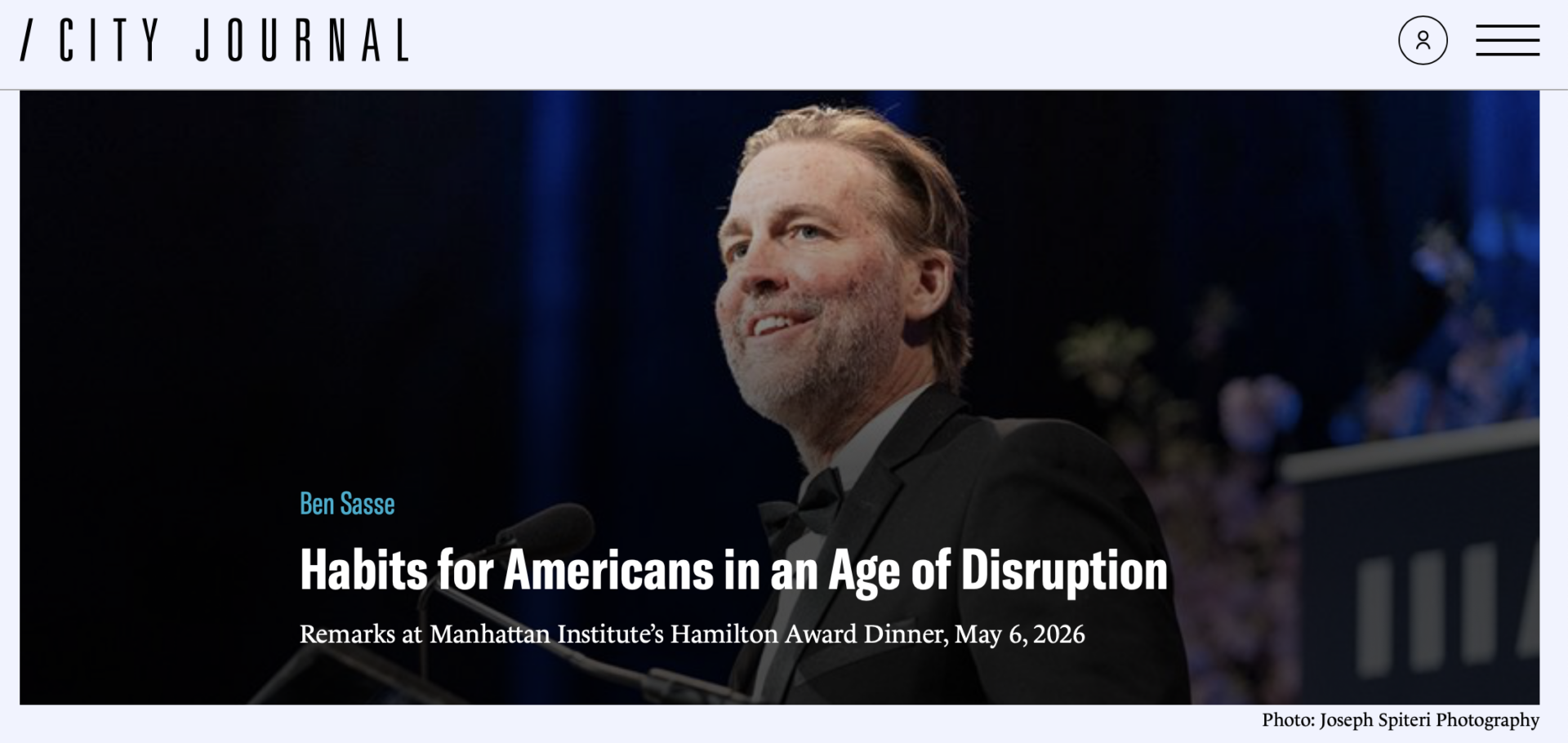 | | Habits for Americans in an Age of Disruption Ben Sasse | | Last weekend I spoke with an educator toward the end of his illustrious career. He has just finished reading Ben Sasse’s The Vanishing American Adult. He said he only wished he could have read that book at the beginning of his career and before he raised his children. If you read that 2018 book (and you really should), you’ll recognize much of what Sasse said in his remarks at Manhattan Institute’s Hamilton Award Dinner on May 6. I’m grateful Sasse is seizing his final days to speak to us from the future, using his historical training to identify the most important developments of our day. Nothing right now is bigger than the information age’s unprecedented rate of economic change, especially through artificial intelligence. The shift from hunter-gatherer to agrarian to industrialist took centuries, even millennia. But digital technology produces anxious generations who need to re-learn their jobs every few years, with little sense of stability or security. Sasse might be conservative but he’s no grievance-fueled nostalgic. He’s still alive with pancreatic concern thanks for biotechnology advances. He’s a champion of free markets and innovation. And now he’s become one of the most insightful observers about the challenges posed by AI, a technology that both requires virtue to harness its achievements, and also erodes the communities and habits that inculcate virtue. I spent this week with business leaders in Chicago planning together around AI. And I hope to spend part of this summer working with educators dedicated to preparing the next generation. Sasse is sounding the big notes they need to hear: - “Emotional intelligence and character are going to matter more than they’ve mattered in the past because the hardest things to automate are the things that depend on relationships.”
- “The biggest divide is going to be between people who figure out how to harness the tools of technology and the near-limitless information of AI versus those who outsource their affections and their habits to these tools and algorithms.”
- “We have to develop the intentional habit of reading. A nation that does not read will not thrive.”
Parents, pastors, educators, employers, students: We have no reason to fear. But we must act intentionally. We foisted smartphones, tablets, and social media on our children without anticipating the downsides. We must not do the same with AI. We can do this together! We must attend to the best interests of our children and grandchildren. Sasse says: Disembodied consumption, digital gluttony, and cultural lethargy will rob us of the joy at a moment when incredible discovery and adventure await. The digital revolution can bring big pieces of heaven, but it will drift toward hell unless we steer it and form the right kinds of habits. What good is it to gain the whole world if we forfeit the souls that we’re supposed to form? We cannot expect to remain free without being virtuous. We cannot be bold without being rooted. We cannot be great if our folks are not aiming first to be good and to build a home base from which to launch and build much more broadly. If we want to remain free, we must be good. We must read. We must write. We must not give up on relationships, on each other. We cannot outsource our future to computers. Listen to this man’s final words. They’ve been sent from our future. Next week on Unseen Things: The church as a rock collection, what makes America unique, and when the Devil reached toward the sky. | | | |  | |
|
