GOSPEL BOUND WITH COLLIN HANSEN
In This Week's Briefing

In this week’s briefing:

Why not many pastors should offer political commentary, why therapy can’t replace the church, and why Scotland and Britain’s House of Lords defeated assisted suicide.

What I'm Seeing
Of Pastors and Politics

Especially since 2024, some pastors with growing digital platforms have argued for more public and partisan campaigning in politics. In several ways this trend merely returns American pulpits to previous norms, from the revivals of the 18th and 19th centuries to the Cold War and the rise of the Religious Right in the 1980s. And even when some pastors shirked politics in favor of the spirituality of the church, as was common during slavery and segregation in the American South, they could assume their congregations shared political unity. Christians didn’t need guidance from the pulpit to perceive the pastor’s political proclivities.

You might wonder, then, why pastors such as Kevin DeYoung and Tim Keller have counseled against most political punditry. So did C. S. Lewis. He went so far as to reject a high British honor from Winston Churchill so that no one would confuse his apologetics with his politics.

The argument for more pastoral political punditry is simple and compelling. Between podcasts and YouTube, cable news and radio, demand for political commentary has maybe never been higher. Many great issues of the day are undoubtedly theological. If Christians don’t get guidance from their pastors, they’ll find it somewhere else. Would you rather them watch your YouTube channel or consume Tucker Carlson and Candace Owens without discernment? Not to mention, the hunger for right-wing political commentary, especially from young men, has opened a fruitful mission field, as identified by Charlie Kirk. Framed this way, you can see why some pastors have built out expensive multimedia studios, devoted much of their week to commenting on the news, and seen their churches and digital followings expand.

The argument against more pastoral political punditry is more complex. I’ll attempt to offer it in three points.

1. You don’t know as much as you think you do.

Some of the pastors most outspoken against political punditry actually follow politics most closely. It’s not that they don’t care about what’s happening on Capitol Hill and in the White House. It’s that sometimes they know that they care too much, at least in comparison with the glorious promises of God in his Word, or because they know too much of the inside and the wide disconnect with popular understanding.

Even when you’re on the inside of institutional leadership, you don’t usually know a lot, or at least as much as people think you do. Just consider one high-profile situation this week. You’d think I know a lot. By the looks of online commentary, a lot of people seem to know a lot. But I know they don’t. Because I know enough to know what I don’t know. And I don’t know hardly anything. (You know?)

We might be able to follow the partisan posturing on Fox News or affiliated pundits on X. We can download the talking points and add some spiritual gloss. But that’s not the same as changing the culture or winning political souls. It’s just posing as a Christian version of Sean Hannity.

2. You would be wise to focus on the eternal rather than the ephemeral.

Lewis actually followed the news, especially during the Second World War, more than he let on in his famous and frequent denunciations of journalism. You’ll see allusions to current events throughout his works, as in The Screwtape Letters, serialized in a weekly Anglican newspaper during the darkest days of the war. The subject of torment in those letters, you may recall, dies in a bombing raid.

But why do we remember Lewis? Why do we still read him? Because he focused on the eternal, not the ephemeral. And his focus on the eternal makes his writing feel contemporary in every age. Ironically, one of the easiest ways to fall behind the times is by trying to keep up with the times. Whatever “breaking news” purports to tell us, the pundits don’t know how their stories end. We do—with Christ’s triumphal return, the news heavens and the new earth. There’s your headline, today and every other day: Christ is coming again soon (Rev. 22:7).

3. Your only authority stands on the Word of God.

Years ago I caught a pastor in a frustrated moment. “Everything I said that can’t be directly found in the Word of God, I regret,” he said. Why? Because he changed his mind on some matters of vision and direction for his church. And he got tired of church members quoting those earlier words back to him. He wished he hadn’t been so confident when straying from the Word of God.

The words of pastors carry unusually heavy weight. That throwaway comment in a sermon becomes a seed of grievance growing against us. That light-hearted jab in casual conversation becomes a stinging barb, never forgotten or forgiven. Oh, for a time machine to take back these ill-considered words!

Whatever you say from the Word of God, you know it’s from God. But your views on the progress of the war against Iran? Your opinions on the best way to settle conflict between Jews and Palestinians? Your advice on how to end the stalemate between Russian and Ukraine? Not only do you lack adequate information. You lack divine authority for your judgements.

Speak against abortion. Denounce racism. Pray for peace. Sometimes we can’t—and shouldn’t—avoid commenting on issues directly affecting our community. Never shy away from applying God’s eternal Word to the ephemeral world where we live. Some pastors may even be especially gifted at matching timeless truth with timely delivery. God bless them!

But not many of us should aspire to that calling. Not many of us should deviate time away from meeting members and leading leaders and studying Scriptures. More often than not, punditry is a trap designed to distract us from the only solution that truly heals what ails our world.

COLLIN HANSEN
Editor in Chief
 
What I'm Hearing
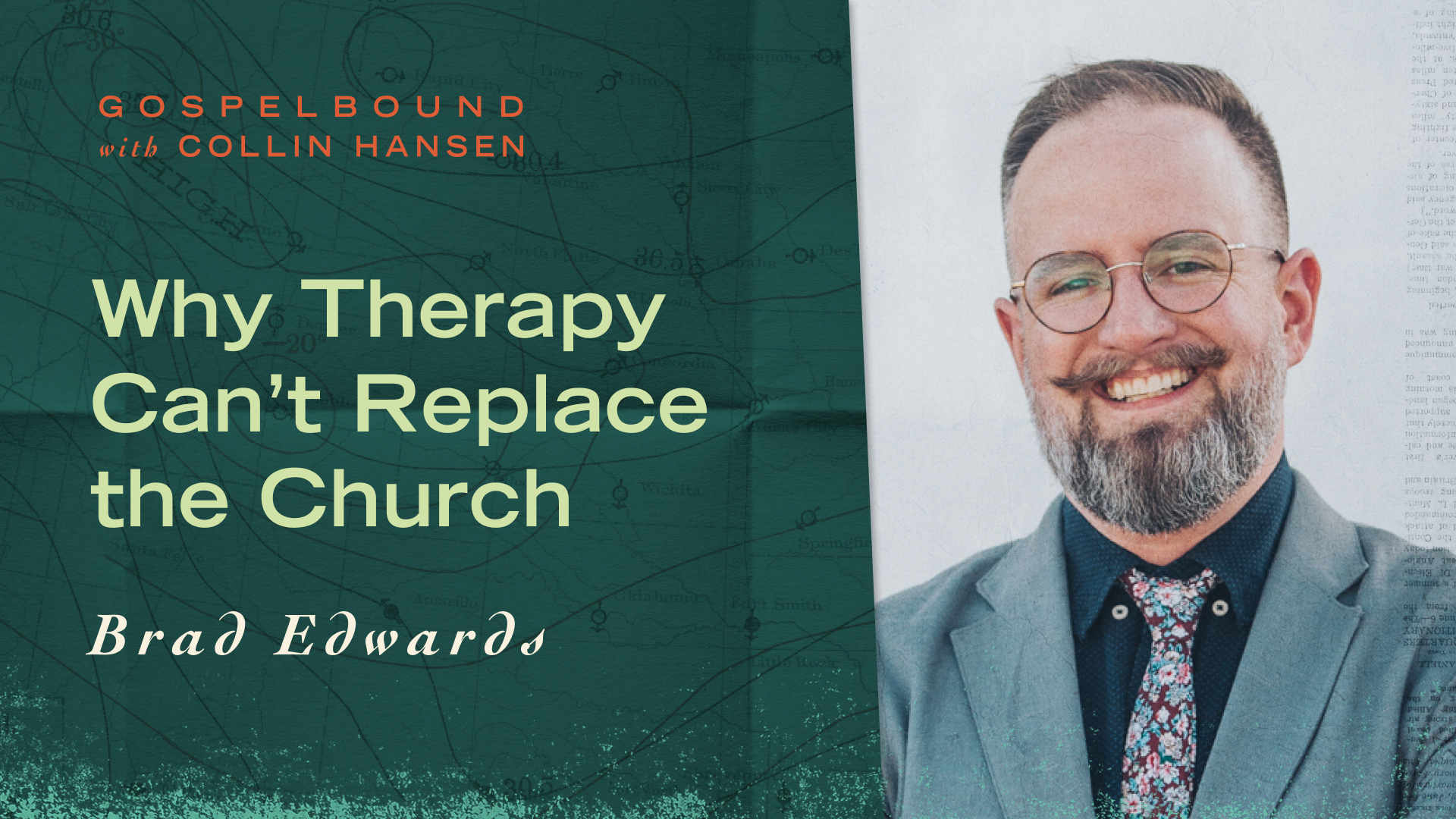
Why Therapy Can’t Replace the Church

You’ll find many books on the biblical and practical importance of the local church. I wrote one myself a few years ago with Jonathan Leeman called Rediscover Church: Why the Body of Christ Is Essential.

But few books can match the way Brad Edwards shows us the need for the church amid rampant anxiety, division, and individualism. Not only our churches but even whole societies would be transformed by implementing the wisdom found in this book, The Reason for Church.

Brad is the church planter of The Table Church in Lafayette, Colorado. His debut book has been justly acclaimed. He won the 2025 Christianity Today Book of the Year Award and also finished first in the Church and Pastoral Leadership category. He was the winner of The Gospel Coalition’s award for First-Time Author that year as well. I’m grateful that he joined me on Gospelbound to talk about everything from authority and institutions to anxiety and whether unity should be the goal for a church.

While Brad’s book ranges widely, I zoomed in on his observation about how many therapists have become the secular priests of our post-Christendom era. He related how a therapist told him that clients want a priest to mediate the truth, goodness, and beauty already inside them instead of directing them toward the transcendent, to God. Tragically, these clients don’t experience the release they expect but fall further into bondage to self, to sin.

Watch or listen as we explore the church as a bulwark against efforts to commodify us. I think Brad’s right that as social media commodified our attention, AI will commodify our agency. Promising us dominion, AI will instead rob many of us from our gifting to cultivate the world God created for us.

 
What I'm Reading
In Britain, 7 Unelected Lords Helped Block an Assisted Dying Bill
The New York Times

During our annual retreat for The Keller Center for Cultural Apologetics, we picked up prior conversations about the spread of assisted suicide across Western nations. When we met last year in New York, assisted suicide looked sure to pass in Scotland and, soon thereafter, England. They would join 13 U.S. states and Washington, D.C., along with such countries as the Netherlands and Canada, where assisted suicide has risen to account for 1 in 20 of all deaths.

Scottish Parliament, however, unexpectedly rejected assisted suicide by a 69-57 vote on March 17. Then, just a little more than a month later on April 26, the House of Lords in England failed to approve assisted suicide over the protest of seven lords, who proposed more than 1,280 amendments in order to run out the clock on deliberation. Rarely does the House of Lords fail to advance laws that pass the House of Commons, which approved assisted suicide by a narrow margin in June 2025.

You might wonder what assisted suicide has to do with cultural apologetics and evangelism. But I hope the connections become increasingly obvious as the debate continues in the UK and United States. Assisted suicide directly touches core Christian themes such as the dignity of all people made in the image of God at every stage of life, the reality of judgment and eternity, and our responsibility to protect and serve the most vulnerable, including the elderly. The rise of assisted suicide reflects a loss of hope in the future, a loss of trust in others to provide care, and the loss of faith and fear when it comes to the afterlife. Not to mention, assisted suicide depends on few people understanding what the process actually entails.

While Christians should argue against assisted suicide on all these grounds, I don’t believe the bills in England and Scotland failed for these reasons. Nor do I think lobbying from people with disabilities, concerned for obvious reasons that governments and even families might not value their expensive ongoing care, swayed enough politicians to drop their support.

So, why did the march of assisted suicide through Western legislatures halt in the UK?

Look to moral foundations theory, popularized by social psychologist Jonathan Haidt. In case you’re not familiar, Jonathan Haidt argues that every culture, and every political position across the spectrum, argues for morality across a common set of concerns. They include care, fairness, loyalty, authority, purity, equality, proportionality, liberty, honor, and ownership. Some places and parties care a lot about some issues and not much about others. And sometimes opponents will argue the same issue from different sides. But no one can avoid moral judgments altogether.

According to moral foundations theory, you can see why assisted suicide has become popular across Western cultures. We value liberty more than anything else. If we belong only to ourselves, then assisted suicide solves two problems: we want the freedom to end miserable lives, and we don’t want to shoulder the burden of caring for others who can no longer help us. With lower values on loyalty, honor, and purity, Westerners feel little obligation to venerate their elders or abide by abstract theological concepts such as dignity in suffering as Christ suffered.

Talking with one of the most outspoken opponents of assisted suicide in Scotland, he gave me an unexpected answer about why assisted suicide failed—at least for now. Several feminist politicians dropped their approval upon further consideration. Loyal to care for their families, they worried that the male authorities in their lives wouldn’t reciprocate that care if the women could no longer offer it. Under the guise of liberty, or even equality, assisted suicide appeared to these women a convenient guise to solve some men’s reluctance to forego their own personal liberty. In short, these women anticipated how men could coerce vulnerable women who “don’t want to be a burden” into opting for assisted suicide.

Even though we might not share the same theological views as all our neighbors, sometimes we can still find common ground in moral foundations theory. We’ll need it if, for the sake of the weakest among us made in the image of God, we’re going to halt and reverse the spread of assisted suicide.

Next week on Unseen Things:

Why I’m not elite, how COVID-19 changed Gen Z, why you shouldn’t read The Brothers Karamazov.

 
Desktop mobile image alt text