 |   | | | | If the freezing rain relents, I’m headed to Atlanta this weekend to lead a workshop on cultural apologetics. Then on Monday I’ll do the same in a staff meeting for a local church led by a pastor friend. I appreciate that this pastor covers more than logistics in his staff meetings. He engages the whole team in reflective discussions on big-picture topics that often provide context for the day-to-day challenges of ministry. Every few months he’ll text me with a question about what three subjects they should be thinking about in cultural apologetics. In early December I gave him three subjects: artificial intelligence, the rise of racism on the right, and Gen Z church attendance. If you’re following along at TGC, these choices won’t surprise you. But I think it’s important to understand the application of these issues for local churches, not just in abstract debates by polemicists on social media. That’s why I love to sit down with ministers in the trenches. Artificial intelligence hits church members in the workplace and schools before they’ve been able to reflect on the broader technological or theological implications. American pragmatism says if something makes our lives easier or at least more efficient, we’re obligated to do it. But what about the effects of cognitive decline when we outsource reading and writing to computers? As my friend and Keller Center fellow Alan Noble writes, we must save humanities from the slop. A society that forgets to read or write is a society that fails to think. And a society that fails to think is a society less prepared to encounter God as revealed in his Word, with major implications for how we practice expositional preaching. The erosion of moral reasoning, accelerated by short videos on social media, has led to the second topic, the rise of racism on the right. Some of the most influential media figures among young men don’t hesitate to praise Adolf Hitler and other notorious racists. As much as we want to think racism was defeated in 1945 or 1963, sin always tugs toward self-justification by classifying our visible, physical traits as inherently better than others’. Parents and pastors, don’t assume the podcast hosts and YouTube influencers your boys in church follow are benign. Learn. Engage. Warn. Don’t be so concerned about real threats from the left that you overlook real sin on the right. Follow trusted, biblically grounded voices who apply the gospel to this perennial sin of partiality. Third, some reports suggest that among Gen Z churchgoers, they show up for congregational worship more often than any other generation. Some ministries to college students are even experiencing what looks like revival. Overall, however, Gen Z is following their elder Millennials in continuing the decline of religiosity. Looking more closely into the data, however, reveals the application for church leaders. If you’re ministering near a college or university, or in an area popular among young adults, your experience probably looks more like revival. If you’re in a rural area or declining city, you’re probably worried about the lack of children compared to the abundance of white hair. American church attendance strongly correlates to successful life patterns, the progress from education to work to marriage to family. Fall off the assembly line of institutional progress, however, and you’ll likely conclude church isn’t for you. Churches looking for evangelistic need, then, should be searching the margins of society. In another three months these subjects will still be relevant. But my friend and I will text about a new set of challenges and opportunities. Engage your church leaders in regular, prayerful discussion over how these broader trends affect your local ministry. | | COLLIN HANSEN | | Editor in Chief | | |  | 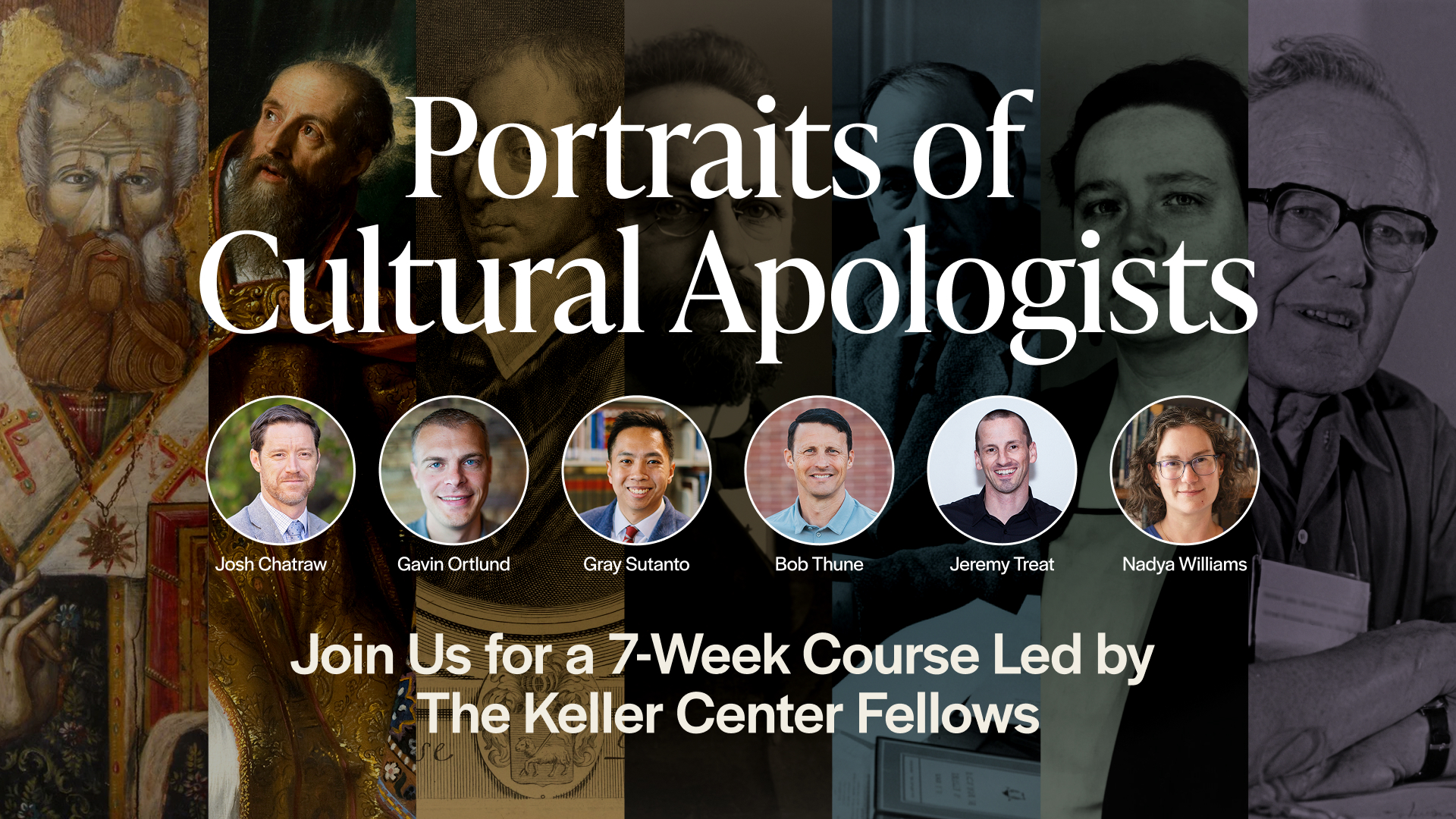 | | Portraits of a Cultural Apologist: What the Christian Tradition Teaches Us about Ministry Today | | I don’t always get to sit in on TGC’s online learning cohorts. But I’d make a priority of listening in on this one. Many assume cultural apologetics is focused on the cutting edge of contemporary ideas. But even when that’s the case, we need faithful models who effectively engaged their own times in the past. We’re not the first generation to discern cultural idols and present the gospel as a better alternative. For two millennia, God has raised up inspiring and insightful Christian leaders and apologists who can still speak into our own cultural moment. In this 7-week cohort led mostly by fellows of The Keller Center for Cultural Apologists, we’ll explore the enduring insights of key thinkers across Christian history—from the early church to the modern era. We’ll learn from Augustine about how to diagnose cultural worldviews and offer Christianity as the better fulfillment from our deepest longings. With Pascal as our guide, we’ll explore how to help non-Christians want the gospel to be true even before they fully understand it as good news. And inspired by Newbigin, we’ll seek another missionary encounter with the West. Be sure to check out the other apologists we’ll be covering and the presenters—including Gavin Ortlund and Nadya Williams—who will teach about them. We’re aiming to apply time-tested insights from the best historical examples for today’s changing world. I hope to see you there as we learn together! | | | | |  |  | | Stalingrad Vasily Grossman | | Last week I revisited one of my favorite novels, Vasily Grossman’s Stalingrad, originally published in Russia as For a Just Cause in 1952, the year before Joseph Stalin died. Only translated to English in 2019, Stalingrad hasn’t received the same attention as Grossman’s more popular sequel, Life and Fate, one of the great novels of the 20th century. It’s no mystery why the horrors of war provide the setting for so many powerful stories. In another book I’m reading about the American Civil War, one contemporary observer says that during war, weeks feel like years, and years feel like decades. Every moment takes on life-and-death significance. “The burning streets of Stalingrad were a testing ground for a true measure of man,” Grossman wrote in Stalingrad. His character Tolya transforms in combat from a boy to a man. “Never had he known that he could act with such daring, that there could be such joy in taking a bold decision, or that his voice could sound so loud and confident.” While Grossman’s Life and Fate is famous for identifying the similarities between Nazi Germany and Soviet Russia, Stalingrad aims more directly at the dangers of Nazi ideology. The manuscript for Life and Fate had to be smuggled out of Russia, while Stalingrad had state sanction. As well as any other writer, Grossman captured the descent into hell in Germany under Hitler. Grossman wrote, “He managed to bring together the personal amorality of post-war Germany’s many losers—shopkeepers, officers, waiters, even some despairing industrial workers—with the state amorality of a defeated imperialist power, ready to follow a path of unabashed criminality.” But even in this book readers can see between the lines as Grossman indicts the victorious Stalinist regime of many of the same evils they decried in the Nazis. Grossman shows us the path to freedom in the characters he commends. “In everyday life there are many people who have what it takes to be a leader, although their gifts are not always apparent,” Grossman wrote. “Their greatness lies not in their ability to respond adroitly to superficial social changes but in their strength of character, in their capacity to remain true to themselves.” To remain true to themselves. Grossman didn’t mean this in terms of expressive individualism. He meant that under pressure we’re all tempted to do whatever will bring release. If we need to lie, or point the finger at someone else, or adopt a new ideology, we will. To remain true to yourself, then, is to hold on to an unchanging standard of morality, no matter who’s in charge, no matter what you may suffer. You’ll find no better modern model than Grossman, who told the truth about totalitarianism in the 20th century. | | | |  | |
|