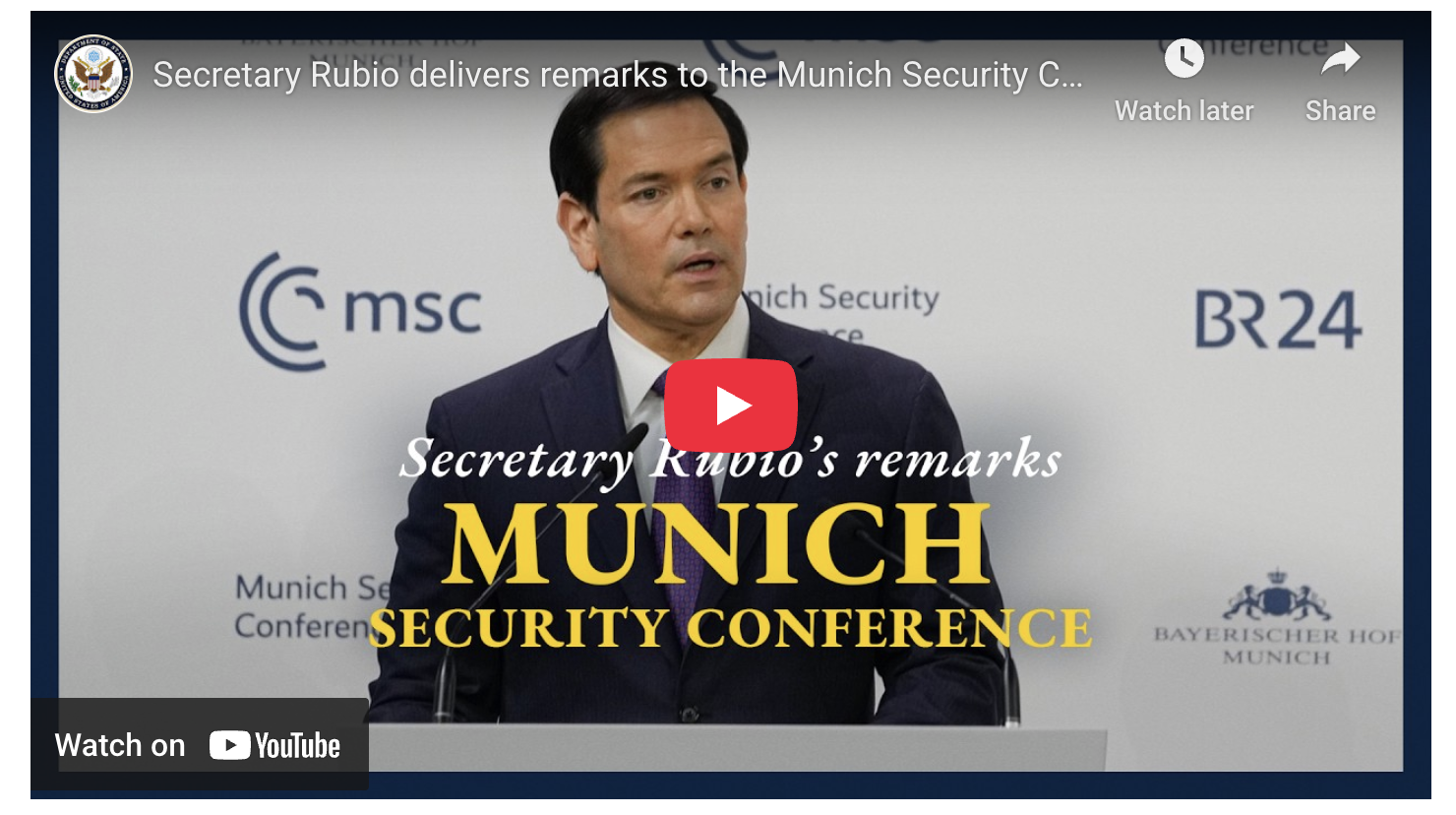
| Sometimes politics delivers the narcissism of small differences. And sometimes you get a divide as wide as the Grand Canyon. Standing on one side that canyon on Valetine’s Day at the Munich Security Conference was U.S. Secretary of State Marco Rubio. Representing the Trump administration, Rubio sounded themes familiar to those who followed his failed 2016 challenge to Trump in the 2016 Republican primary: We are part of one civilization—Western civilization. We are bound to one another by the deepest bonds that nations could share, forged by centuries of shared history, Christian faith, culture, heritage, language, ancestry, and the sacrifices our forefathers made together for the common civilization to which we have fallen heir. Rubio also struck a more conciliatory note than his colleague and potential 2028 rival, Vice President J. D. Vance, at the same event in 2025. Alluding to last year’s fallout, Rubio said: We in America have no interest in being polite and orderly caretakers of the West’s managed decline. We do not seek to separate, but to revitalize an old friendship and renew the greatest civilization in human history. Whatever the differences between Rubio and Vance they don’t come close to the chasm between them and Congresswoman Alexandria Ocasio-Cortez of New York. At the same event this year, Ocasio-Cortez offered a familiar, contrasting view of the West: Over the last five years, we’ve seen such a breaking and such a fraying of these alleged Western values that people wonder if it ever existed in the first place. So, I don’t know if it’s necessarily that we were in a post, if we are in a post rules-based order. I think it’s possible that we were in a pre-rules-based order. And we have an opportunity to explore what a world would look like if we upheld democracy, human rights, trade that actually centers working-class people instead of accruing overwhelmingly the benefits of trade to the wealthiest. I’m not sure if Ocasio-Cortez is referring to a breakdown related to COVID-19 or something else within the last five years. Whatever events she has in mind, she’s not making a new argument. As Allen Guelzo and James Hankins write in volume two of their brand new textbook The Golden Thread: A History of the Western Tradition, “In recent decades, the Western past has been widely condemned and even held in contempt, and surprisingly often from a position of near-total ignorance. Voices from outside and inside the Western tradition have condemned Westerners as oppressors, imperialists, colonizers, and appropriators.” Problem is, Ocasio-Cortez isn’t speaking out of ignorance. The Munich Security Conference would have adjourned before she finished recounting the innumerable offenses against humanity committed over centuries in the West and in the name of Western values. Neither side claims perfection. But the sides split over what to foreground and background. A few years ago a friend reading Howard Zinn asked me to describe the American political divide. I said the most basic divide is between those who think the United States is and has been basically good with some bad exceptions, or basically bad with some good exceptions. You could say the same of the West. But there’s another, wider divide. If we agree that we want a fair and just world for all (which is itself a Western value owing especially to Christianity), how do we achieve it? By reaching back into the Western tradition for inspiration and direction? Or by working toward a new order? Given the litany of Western sins, the promise of a new order always appeals. The Western tradition has often been challenged from within, especially since the 18th century when the United States kicked off the Age of Revolutions that spread to France in the 19th century and then to Russia in the 20th century. The true test of the Western tradition is how it handles conflict and failure. How did the United States build a nation without dissolving into endless factions, a nation that has endured for almost 250 years? The founders reached backed into the Western tradition. One century later, how did Abraham Lincoln save the republic from itself and its original sin of slavery? Look at his Second Inaugural Address. He reached back into the Western tradition. Another century later, how did Martin Luther King Jr. save the country from another civil war when the promise of civil rights had been denied? Look at his Letter from Birmingham Jail. He reached back into the Western tradition. Now again, we sense how with the widespread decline of Christianity across the West, democracy lacks solidarity. We’re standing on opposite sides of the canyon. How can we come together once more and move forward toward justice for all with malice toward none? Perhaps we could build a new order with new rules that would benefit everyone? That way madness lies, to borrow from one of the Western tradition’s greatest bards. The blood of the guillotine and gulag cries out. As utopian alternatives have proven, the perfect is the enemy of the good. Christianity has chastened the Western tradition with a sensibility that accounts for sin even as it hopes toward holiness. To borrow from one of the Western tradition’s greatest statesmen, “Democracy is the worst form of Government except for all those other forms that have been tried from time to time.” It’s not perfect. But Western civilization has been a force for good. |