 |   | | | | Alone in my office on December 23, I cried. I didn’t plan to cry. The news wasn’t fresh. I got the heads up a week earlier. Maybe I was missing my extended family and home for Christmas. Or maybe I was reaching the end of the year and reflecting on who and what we’ve lost. Maybe at 44 years old with a creaky body I’m coming to terms with my own mortality. But I couldn’t handle the news that 53-year-old former U.S. Senator Ben Sasse will die of stage-four pancreatic cancer. Thankfully he’s not dead yet. With ever-more advances in cancer treatment, he plans to fight. However, if we’ve learned anything from Sasse over his distinguished career, he doesn’t mince words. He isn’t putting his faith in doctors, however good and dedicated they may be. Pointing toward Advent hope “in a real Deliverer—a rescuing God, born at a real time, in a real place,” Sasse explained how optimism falls short when you receive a death sentence: Not an abstract hope in fanciful human goodness; not hope in vague hallmark-sappy spirituality; not a bootstrapped hope in our own strength (what foolishness is the evaporating-muscle I once prided myself in). Nope—often we lazily say “hope” when what we mean is “optimism.” To be clear, optimism is great, and it’s absolutely necessary, but it’s insufficient. It’s not the kinda thing that holds up when you tell your daughters you’re not going to walk them down the aisle. Nor telling your mom and pops they’re gonna bury their son. This response is just another reason why I took his diagnosis so hard. During dark days in the last decade, Sasse has been a role model to me and many others in public and private. It’s easy to become jaded about politicians—really, any public figures. It’s hard to know what’s real with them. What’s stood out to me in personal conversations with Sasse is his lack of pretense. For the smartest guy in any room, he doesn’t cast an aura of self-importance. In this sense he’s a lot like Tim Keller, whom we lost more than two years ago from this same terrible disease. Like Keller, even as Sasse has amazed me with his intelligence, he’s impressed me with his willingness to admit where he got things wrong. After he was elected to the Senate and then became president of the University of Florida, he was open about common struggles, how to maintain a family life, of health and travel and children growing and launching. Even though he’s the best of us, when he’s among friends, he feels like the rest of us. Now he faces the biggest challenge of all. We invite you to join us today as friends and family fast and pray for the Sasse family. Ben isn’t dead yet. And no matter what happens in the coming days or years, even as we all live under the inevitable sentence of death, we grieve as those who hope (1 Thess. 4:13-14). | | COLLIN HANSEN | | Editor in Chief | | |  | 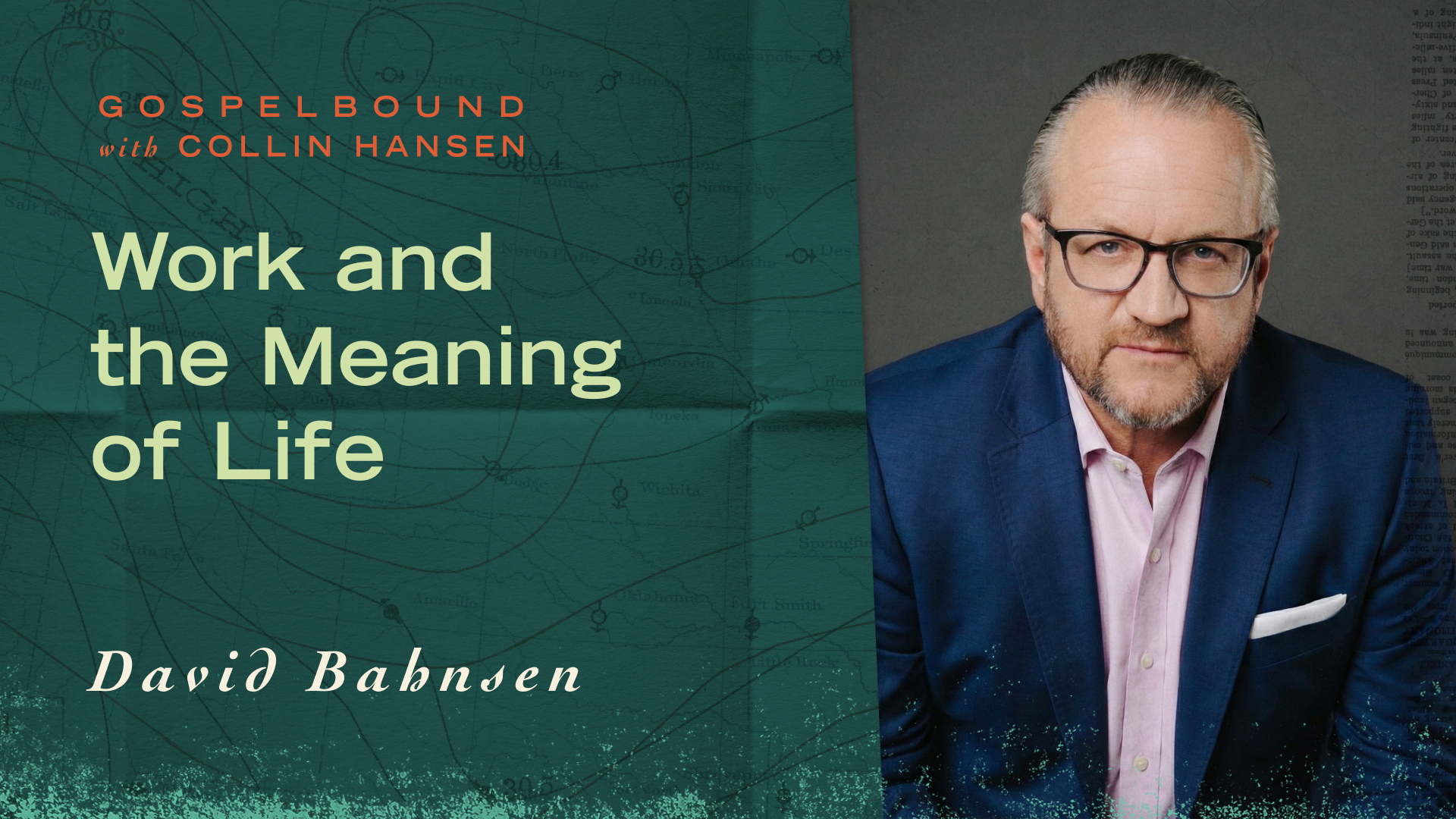 | | Work and the Meaning of Life | | Work is the meaning of life. Got your attention? Your identity is tied to what you do. I bet I have it now. So argues David Bahnsen in his book Full-Time: Work and the Meaning of Life. Bahnsen is the founder, managing partner, and chief investment officer of The Bahnsen Group, a national private wealth management firm. He’s also the author of several books, including Crisis of Responsibility: Our Cultural Addiction to Blame and How You Can Cure It. Informed by the example of his father, David stands out as an advocate for vocational ambition, including long working hours. In church we oft pit work against family, with a heavy emphasis on family, in a zero-sum contest. But David rejects that framing and offers examples for how work and family can support one another with better integration and appreciation. I admire David for his willingness to say things others won’t. Not everyone who poses as a courageous truth-teller says anything hard to their own tribe or supporters. In this interview I asked him why so few others can avoid this audience capture. I appreciated his honesty about financial independence. But his answer should also make us wonder whether the voices we trust, whether in this newsletter or anywhere else, have financial incentive to lie or otherwise deceive us. David was also an early advocate for the return to in-person work after COVID. Since then events have vindicated his skepticism that productivity could be maintained while working from home. While working mostly from home since 2010, I’ve enjoyed many benefits of staying close to my wife and children while writing, meeting, teaching, and planning. Especially since digital work—with staff and constituents around the world—requires long and odd hours, you can’t beat the flexibility during the day to help with dropping off and picking up children. When they’re sick and need to leave school, you can more easily adapt your schedule, so long as you have a job that’s largely computer based. But I’ve also experienced drawbacks and inflicted some burdens on my family, who overhear hard conversations and suffer some of my anxieties that I could have shed in prayer during the commute home. Even if I can stay at home, it’s often best that I don’t, for the sake of my family, so they don’t have to work around me in their only habitat. I often feel like we should be more openly discussing changing expectations of fatherhood, work, and faith. David helped me do that in this conversation and in his book. Even if you don’t agree with all his perspectives, which often reflect his hard-driving personality, you’ll probably still benefit from the interaction. | | | | |  |  | | The Land of Sweet Forever: Stories and Essays Harper Lee | | Maybe it’s because I live in Alabama. Or grew up Methodist. But I read everything by and about Harper Lee. Alabama’s most famous daughter is less mysterious than she was before the posthumous publication of Go Set a Watchman in 2016. But she remains one of the most fascinating figures in American literary history. We catch a few new glimpses into her wit and wisdom from this new collection, introduced by Casey Cep, who wrote one of the most fascinating stories of modern Southern history with her 2019 book Furious Hours. Cep describes the Lee we see in these stories and essays as a “daughter of the South trying to map its mores onto her emerging morals.” That’s what made Go Set a Watchman so important. We saw Atticus Finch not as the moral titan of young Scout’s imagination but more as a man confused and conflicted, coming to term with his times. Not many of us can relate to the Atticus of Mockingbird. All of us can see ourselves in the Atticus of Watchman. The eponymous story carries the freight of this collection, opening in Austen-esque fashion: “It is a truth generally acknowledged by the citizens of Maycomb, Alabama, that a single woman in possession of little else but a good knowledge of English social history must be in want of someone to talk to.” No story has ever felt more true to Lee’s particular personality, her defiant individuality and undying loyalty to Maycomb, er, Monroeville, Alabama. True to form the story begins with the unnamed narrator complaining of her married friends whose children “seemed to sap all their energy and imagination.” But it ends with poignant self-awareness, her pleasant surprise. Maybe you had to grow up in small-town Methodist churches, but Lee left me in stiches when the congregation revolts after the music minister changes the cadence of singing the Doxology. Poor Henry Hackett, by trying to “pep up” the Doxology, he committed the cardinal sin for a tight-knit community: “he was thought to be ambitious.” He should have known better than to listen to a music instructor from New Jersey who wanted to ban Calvinist classics such as “Rock of Ages.” Methodists, “notoriously short on theology and long on good works,” don’t care to be lectured about which hymns they can be allowed to love. Today’s music ministers bent on saving the classics ought to reproduce Lee’s homage of William Cowper: “There is nothing like a blood-curdling hymn to make one feel at home. All sense of isolation withers and dies in the presence of some two hundred sinners earnestly requesting to be plunged beneath a red, redeeming flood.” Lee can spin a morality tale out of a conversation after church when the narrator just wants to play golf. Her interlocutor, a young man named Talbert on break from Northwestern, “looked suspiciously as if he had returned from a tour and had picked up a Brooks Brothers suit on the way home.” By “bringing her heavy artillery to the front,” she intended to expose his literary defenses as hastily and weakly constructed. As cannon balls bounced off the walls of his formidable learning, she grew harsh in her speech, knowing “she was on losing ground: this boy was somehow outrageously right, insanely correct in his comparisons.” Humbled, the narrator tried one more trick. Homesick, she says, he must enjoy Faulker. “I find Faulkner completely unreal,” Talbert responded. Smitten, she offered him more coffee—and a round of golf. She never should have doubted, Lee concludes, that “all things happen for the best in this, the best of all possible worlds.” | | | |  | |
|