GOSPEL BOUND WITH COLLIN HANSEN
In This Week's Briefing

In this week’s briefing:

Why narration is our contemporary crisis, what keeps Carl Trueman awake at night, how gambling became the scourge of young men.

What I'm Seeing
Order ‘Making Sense of Us’

When you meet new people, you might ask where they live or where they work. You may want to know their last (or maiden) name and identify their family. In my neighborhood, you might be so bold as to ask where they go to church.

Whatever question you ask, you’re searching for the same answer.

What’s your story?

Stories are how we make sense of the world. They’re how we make sense of us. This thing we call “culture” is created by narrative. The stories we tell become the values we live by, together.

When I meet you, maybe I’m just asking for your last name to be nice. Maybe I want to know if we share mutual friends, if I know anyone else in your extended family. Maybe I’m just extending common courtesy, nothing more than small talk.

But what I really want is connection. I want to know if your last name gives me a clue about your beliefs, your hopes—maybe even your pains. Some drop that last name in conversation without even being asked. We know it opens doors. Others hope you’ll drop the question because they can’t stand the exposure, the embarrassment of association. They’re trying to conceal a story.

We make a life together in this world through the dialogue of shared stories. Where did we come from? Where are we going? What should we avoid?

As we celebrate 250 years of independence in the United States, we recognize how that story of freedom continues to resonate down through the generations.

Freedom is our shared narrative. Maybe our only shared narrative.

And this narrative doesn’t tell us what do, either individually or collectively. It only tells us what we don’t want others to do to us. We don’t want anyone else to constrain our freedom.

“Because we lack sufficiently strong communal narratives, our late modern societies are unstable,” writes Byung-Chul Han, a Korean cultural theorist living in Germany. “Without a shared narrative, the political, which makes shared action possible, cannot properly form.”

Han argues we’re suffering a crisis of narration. The very story that gives our society meaning makes is impossible for our society to enjoy unity. Writing in his 2024 book, Han made a compelling case for how our story of freedom unraveled our society:

Stories create social cohesion. They offer meaning and bear values that create community. They must be distinguished from those narratives that found a regime. The narratives on which the neoliberal regime is based prevent the formation of community. The neoliberal narrative of performance turns every individual into an entrepreneur of his own self. Everyone competes with everyone else. The performance narrative does not produce social cohesion—it does not produce a we. On the contrary, it destroys solidarity and empathy. By separating individuals from one another, the neoliberal narratives of self-optimization, self-realization and authenticity destabilize society. When everyone worships the self, is a priest of themselves, when everyone plays to the gallery, gives a performance of themselves, no stable community can form.

Freedom has led to worship of the self. No wonder this story has pushed us apart.

Thankfully, this is a problem Christianity can solve. Because we Christians are people united by a story, the good news of Jesus Christ. And this is no fairy tale, no fable. It’s the story that saves all who believe.

The Keller Center for Cultural Apologetics exists to help you share this saving story. That’s why we made Making Sense of Us, a seven-week group study that aids not only in evangelism but also in discipleship. Through videos and individual study, your group can meet the crisis of narration with the story of the gospel. Especially appropriate for 2026, we’ve included a session on freedom filmed in New York at the Statue of Liberty.

Everyone has a story. But not everyone is united to Christ, or each other. Help them find their place in the only story that can fulfill our deepest longings.

COLLIN HANSEN
Editor in Chief
 
What I'm Hearing
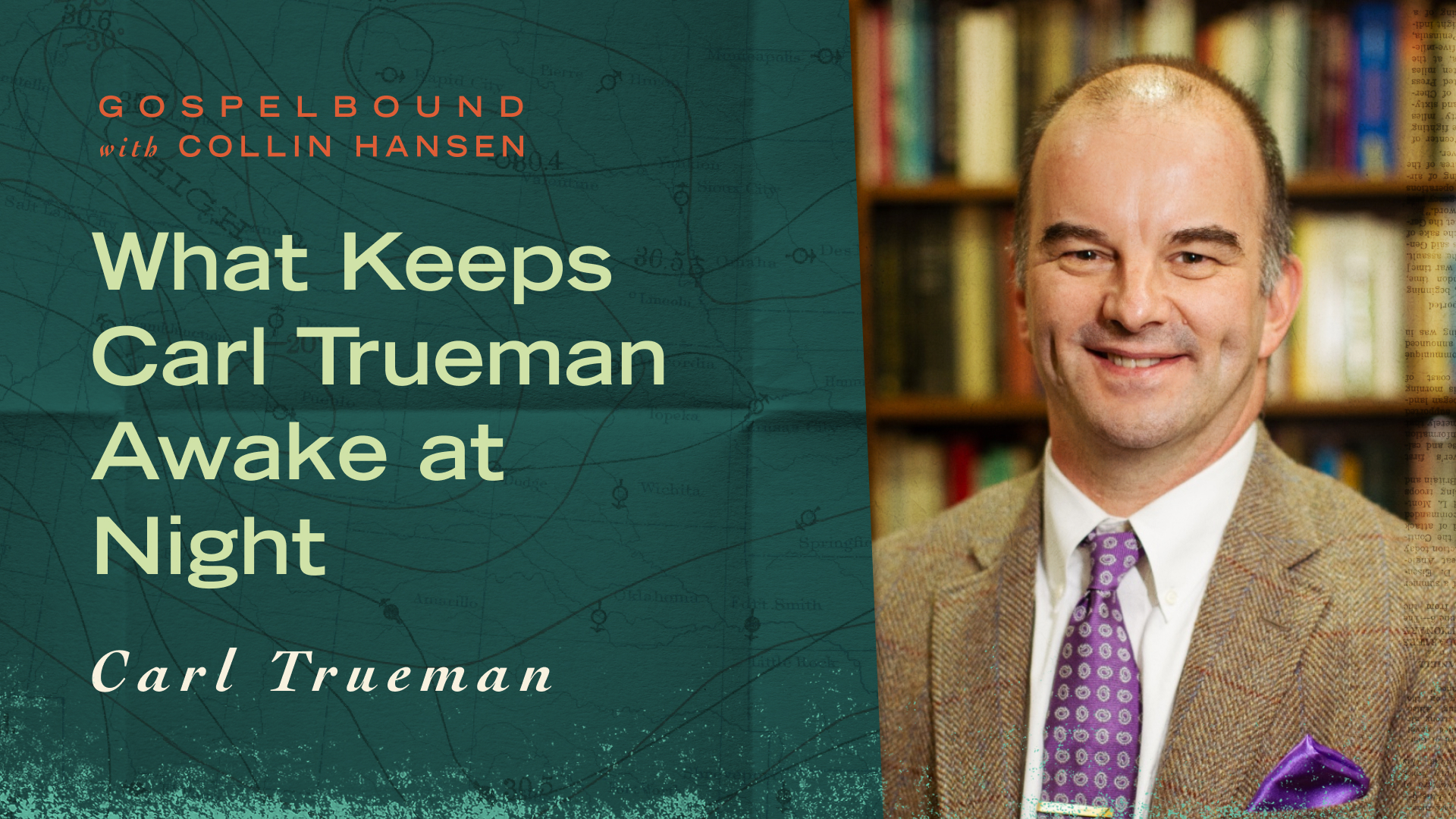
What Keeps Carl Trueman Awake at Night

Ten years ago I sat down for more than an hour with Ross Douthat of The New York Times and discussed everything from Donald Trump’s Republican Party to Pope Francis’s Catholic Church. I asked him whether Christians should be troubled. Back in 2016, from Douthat’s perspective, both offered plenty of cause for concern.

But neither one of them kept him up at night.

What did?

Social media and smartphones for his young girls.

Douthat anticipated Jean Twenge’s book iGen by a year and Jonathan Haidt’s book The Anxious Generation by eight. I never forgot his warning, and the lesson.

Talking to Carl Trueman for the release this week of his major new book The Desecration of Man, I decided to ask him the same question.

Ever since I talked to Douthat, I’ve mulled over my own answer. Mine is also related to parenting. I stew over the implications of genetic selection and artificial wombs. I worry that if and when we sever the biological connections between parents and children, and the givenness of our offspring, we’ll turn them—by the logic of the marketplace—into household goods meant to serve us. If we don’t get what we paid for, if the product doesn’t deliver on its promise, we’ll be inclined to return them or sue our supplier.

But that’s not the issue that keeps Trueman up at night. Listen to our interview to hear his answer and develop your own, as we turn to God in prayer for help only he can provide.

So often when discussing these existential challenges, despair looms overhead like a dark cloud. That’s not the nature of my conversation with Carl, however. We’ve both been studying these cultural changes for decades. And I couldn’t agree more with where he lands on a response. What often appears on social media, especially the political debates over Christian nationalism, reflects fantasy thinking. Better than tweeting our enemies, we kneel to pray the Lord will change the hearts of our neighbors, and ourselves. We ask that God would keep his promise and build the church. And we focus our energies toward serving our cities, our neighborhoods, our families, and our churches.

The problems may be civilizational, but under God, the solutions are spiritual and local.

 
What I'm Reading
Sucker: My Year as a Degenerate Gambler
McKay Coppins | The Atlantic

Credit The Atlantic for the journalistic innovation of 2026, at least so far.

They gave their Mormon staff writer $10,000 to gamble on last year’s professional football season. The big question was how much money he’d make, or lose.

The bigger question was who he’d become in the process.

The results weren’t pretty.

You probably aren’t surprised that he lost the money. I tell my son all the time: “There’s no smart way to gamble on sports.” If you’re gambling on your smartphone, then by definition you’re losing overall. Because when you start winning money, the apps won’t allow you to continue.

The house always wins.

A couple months ago I was teaching a class at my church about technology when a young man, formerly addicted to gambling, shared his recovery story. He got me thinking about the German sociologist Hartmut Rosa’s theory of resonance. Rosa describes why we enjoy hiking, or watching a soccer match. Unlike so much of the rest of our world, it’s unpredictable, uncontrollable. So often inclined toward maximizing our place in the world through manifest destiny, we’re forced to go with the grain of what we’ve been given.

Then it clicked: gambling is our vain effort to bring manifest destiny to the resonance of sports. Gambling is how we trick ourselves into believing we have control.

This week, like so many others, I’ve been captivated by the Artemis II mission. No example of manifest destiny could surpass this scientific marvel, the farthest distance ever traveled by humans into space. Nothing seems to fly in the face of resonance like planning a future mission to Mars and beyond.

But what is the experience of these astronauts themselves? Resonance. They don’t feel big for boldly going where no one else has gone before. They feel small, but special, as they look back on Oasis Earth, alone with its beautiful blues in the vastness of space.

We’re so often dissatisfied in this world because we feel we deserve more, that we’ve been denied what rightly belongs to us, in ever-increasing measure. We look at the world as territory to conquer. But what do we learn from the warnings of gambling, of the example of these space pioneers?

Be grateful for what God has given. Find contentment in how God has abundantly provided a world of joys with no purpose but to delight. In Christ we’ve been spared the judgment we so justly deserved. And in Christ we’re headed to a forever we could never have earned.

Next week on Unseen Things:

How COVID changed Gen Z, why conservatives are happier, and the making of C. S. Lewis as a Christian apologist.


Sponsored Ad

Desktop mobile image alt text