 |   | | | | What’s the biggest problem you see in your church—and the church—today? Do you lament what feels like growing division over politics and culture? Or do you look for more bold leaders who will confront the people and ideas wreaking havoc on our world? Biblically speaking I don’t think there’s a wrong answer to that question. Jesus prayed for unity (John 17:23) and three times condemned the corrupt rulers of Israel as a “brood of vipers” (Matt. 3:7, 12:34, 23:33). He didn’t call for unity at the expense of truth. He didn’t demonstrate courage with a lack of love. Why does it seem like we have to pick one or the other? Why do our churches seem to be lining up on opposite sides of the aisle and forming Team Unity vs. Team Boldness? This week I hosted Christopher Watkin in Birmingham, Alabama, for preaching at Beeson Divinity School and several talks for my congregation, Redeemer Community Church. Author of Biblical Critical Theory and fellow at The Keller Center for Cultural Apologetics, Chris can match wits in any academic debate. But his godly, gentle character exceeds even his depth of insight. He was even so kind as to accompany me to the Alabama vs. LSU football game. I didn’t check the records, but he might be the first Cambridge PhD who teaches Francophone philosophy in Australia to step foot in Tuscaloosa’s Bryant-Denny Stadium. Maybe we’ll see some of his thoughts on the experience in the next edition of Biblical Critical Theory. 
In various lectures Chris returned to the experience of our unusually (though not uniquely) divided times. The cultural narratives told by politicians and journalists line us up behind oppositional identities, as if we’re clad in purple or crimson cheering on our state’s football team. What if instead we framed our narrative as neighbors and sought to love our enemies (Matt. 5:43-44)? What if we understood our narrative in the church along the lines of 1 Corinthians 12:12 as the body of Christ with many members, gifted in complementary ways? Several times in our talks Chris clarified that he doesn’t believe in unity at the expense of truth, or advocate a “third way” that eschews the binary reality of democratic politics, especially in the United States. But he did insist that we tell a better story, a biblical story, that critiques from the outside the false dichotomies on offer. Christians make for the best cultural critics, because we have a transcendent frame of reference in God’s Word. When we stray, the Bible calls us back to an authoritative standard. Otherwise we’ll be subsumed in an oppositional identity, and we can’t help but follow the crowds wearing the same color as our favorite team’s jerseys. Bold leaders call us to biblical obedience, where we find spiritual unity. P. S. — Chris Watkin is one of the most gifted teachers I know when it comes to exposing cultural narratives, the stories we tell each other—and ourselves—that make sense of the world and our place in it. This week The Keller Center unveiled a trailer for our new group study on cultural narratives, called Making Sense of Us. With teachers such as Rebecca McLaughlin, Trevin Wax, and Glen Scrivener we see how these stories of happiness and progress and identity fall short and how the one true story of the gospel fulfills our deepest longings. You can download a free sample and pre-order the curriculum, which publishes in February. | | COLLIN HANSEN | | Editor in Chief | | |  |  | | The Spiritual Cost of the Digital Age Paul Kingsnorth and Bari Weiss | | No podcast comes up more often in my everyday conversations with parents, as we walk to and from my children’s elementary school, than Honestly with Bari Weiss. This recent episode with Paul Kingsnorth, a convert to Orthodox Christianity, sparked new urgency behind the rapid advance of generative AI and the slow response from the government and church. I don’t belong to the AI doomer camp, and I haven’t taken the same steps as Kingsnorth to escape the grid in rural Ireland. But I wholeheartedly agree that many Christians have been slow to discern not only what new technology adds to our society but also what it takes away. If we really are the best cultural critics, then why does it seem like we so often lag in addressing emerging social problems? We need to get ahead. No one knows exactly what to expect from generative AI. But just this week I’ve heard claims that AI will be the most significant world event since the resurrection of Jesus Christ. I’m often skeptical of such unsupported bold claims, especially when posted on social media. But I saw readers on the opposite side of the political spectrum from Matt Walsh nevertheless acknowledge these predictions as plausible: 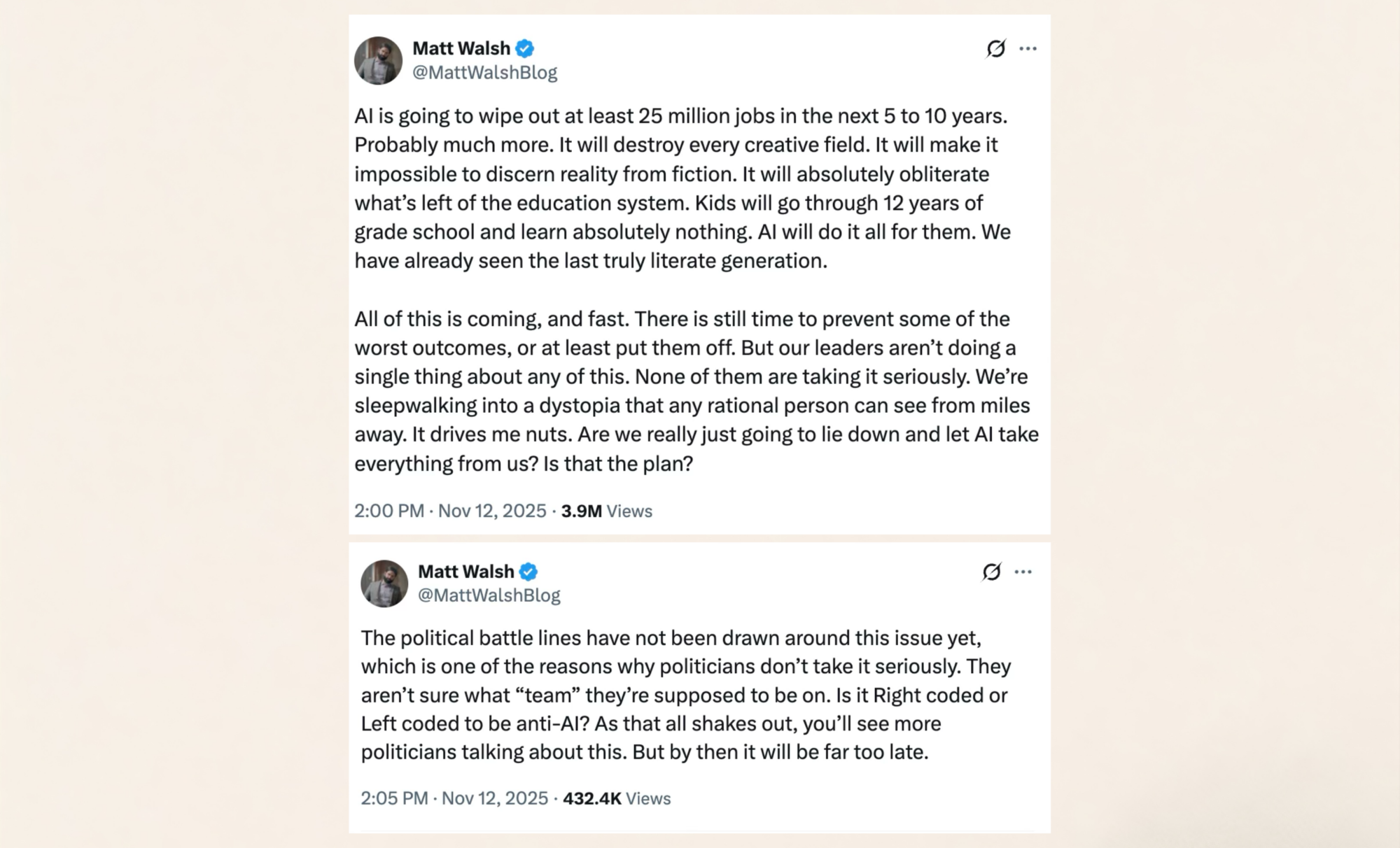
I wish I could say he’s wrong, but in The Keller Center’s efforts to raise awareness about AI alignment, we’re seeing the same lack of organized, intentional response. We’re looking to help educators, government officials, business leaders, and parents prepare for the AI apocalypse, as Chris Watkin describes it. We’ll have more information to share (podcasts, books, cohorts) in the new year. But if you’re not already working in your local community, church, and school on the purpose of education in a world where AI will do all the reading and writing, then now is the time to get a group together. You may not choose to escape “the machine” the way Kingsnorth commends. But you need to know what the machine is doing to you and your family—and where it’s going next. As Watkin shared this week in Birmingham, AI exposes how modern life falls short of the hope we find in the gospel. It’s encouraging to hear a Christian like Kingsnorth, in an event hosted by Redeemer Presbyterian Church in New York City, highlight those shortcomings in an interview with Weiss, the most powerful person in media as the new editor in chief of CBS News. If you have expertise in AI, please reply to this newsletter and let us know how you can help. We’re also seeking to raise $500,000 to rebuild and redesign TGC.org so we can get ahead of AI-powered search and the dramatic decline of legacy websites. If we don’t succeed, we could lose the largest collection of digital theological resources, serving 30 million Christian leaders around the world, to whatever the alignment engineers at Google/Alphabet and Meta/Facebook think our children and grandchildren should know about Jesus Christ and the Word of God. | | | | |  |  | | Catastrophe 1914: Europe Goes to War Max Hastings | | Last week our school’s 5th grade performed an excellent Veterans Day program, where my son honored his grandfather and two late great-grandfathers who served in the U.S. Armed Forces. Birmingham, Alabama, hosts the oldest and longest-running Veterans Day parade, which my family attended this week with school out of session. It’s worth remembering not only the original 1918 armistice that ended the First World War on November 11 but all men and women who continue to answer that call to duty. This week Veterans Day gave me to excuse to finish reading a fast-moving account of one of the most consequential years in world history. Max Hastings, one of the most capable writers about 20th-century warfare, challenges the popular narrative that Allied victory meant nothing in light of the European war’s resumption in 1939. Hastings claims that while Allied victory in 1918 didn’t deliver the “war to end all wars,” German victory in 1914 may have delivered a fatal blow to democracy in France and Great Britain. It’s common to study the First World War and wonder, How could so many smart people have been this stupid about something so important for so many? But that’s the wrong way to read history. It’s more accurate and helpful to wonder, What do I think so many smart people are being so stupid about today with importance to so many? HINT: This week’s Unseen Things newsletter offers but one suggestion. | | |
|