|
|

|
|
|
Dear Reader,
“Here’s what happened.” When the fictional detective Adrian Monk said that line in an episode of his eponymous show, the audience knew the mystery was solved. The image would go to black and white as Monk filled in the clues we were missing. Suddenly, the whole story made sense.
That’s what it was like when I discovered biblical theology in seminary. The seemingly fragmented storyline of Scripture finally made sense. But, unlike in Monk, my understanding of the Bible went from black and white to vivid color.
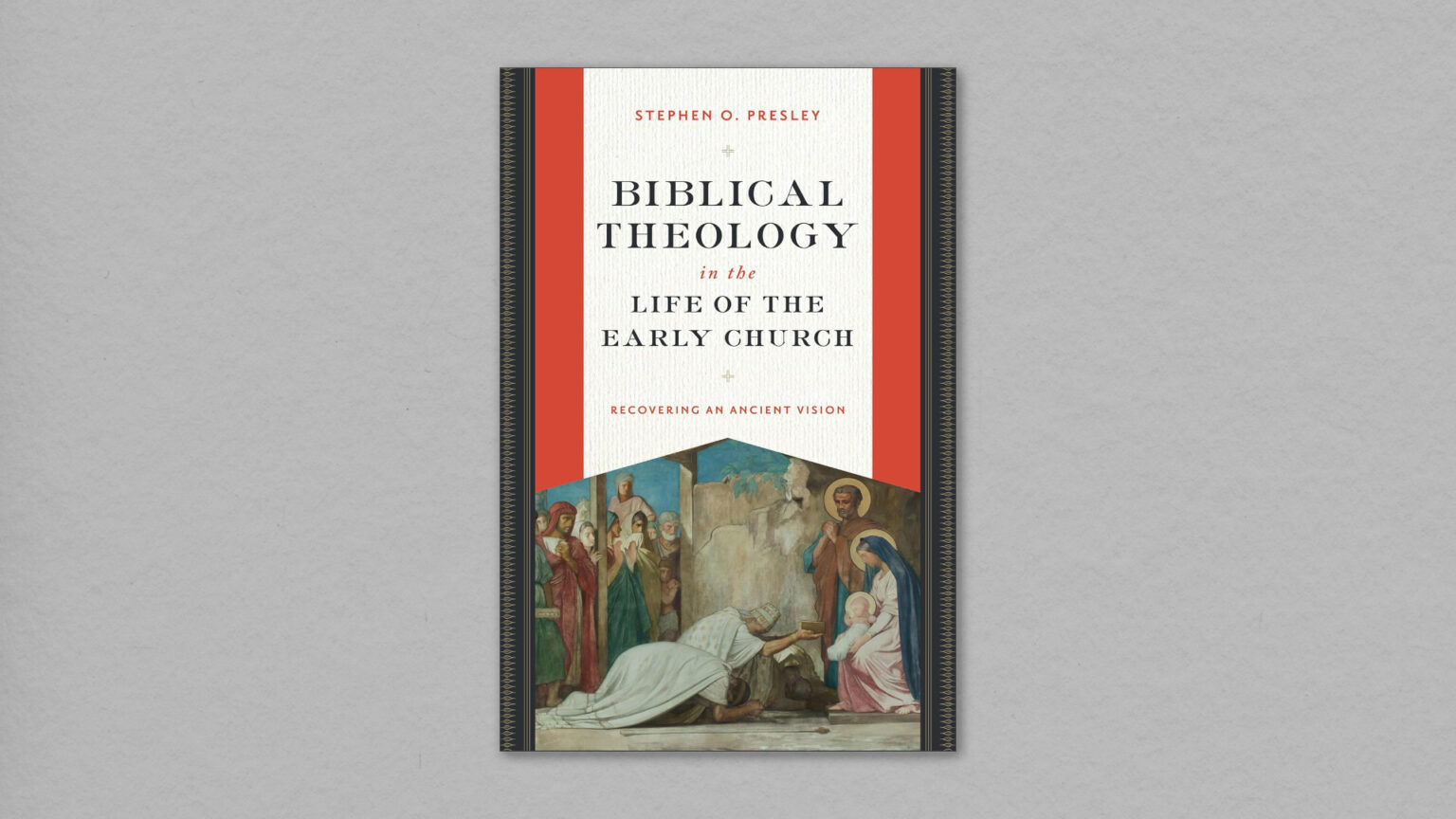
I learned about biblical theology from the Reformed tradition. Yet Stephen Presley shows in his book Biblical Theology in the Life of the Early Church that the early church recognized Scripture’s single, Christ-centered storyline.
Biblical theology in the early church wasn’t just for church leaders. It shaped the discipleship of every believer. As Ched Spellman argues in his review, “Fundamentally, biblical theology is about understanding and living the story of salvation together.” That approach could enliven our discipleship programs today.
Happy Reading!
Andrew Spencer
Associate Editor
|
New from TGC
|
|
|
Book Review
Ched Spellman
|
|
“Contrary to some critics, the early church fathers’ biblical interpretation was neither unsophisticated nor purely allegorical. Instead, they practiced a robust form of biblical theology. They approached the entirety of Scripture through a Christ-centered lens, were guided by the church’s core teachings, and saw the Bible as a unified divine revelation.” Read the review.
|

|
|
Book Review
Jonathan Six
|
|
“‘The Body God Gives’ provides a persuasive argument for holding biological sex and gender identity together. Smith’s critique is rigorous yet compassionate. He shows how many, like those with an intersex condition, are harmed when the culture adopts transgender theory. He also recognizes that real people experience gender dysphoria and that the gospel can help. The arguments about transgenderism have real-world implications.” Read the review.
|

Book Review
Chad Huffman
|
|

Book Review
Daniel K. Williams
|
|
|
Links for the Reading Life
|
| 1. |
Joel Miller, “The Quiet Collapse of Reading—and the Only Real Solution” (Miller’s Book Review)
“So let’s take encouragement from those around us and do the one thing we all control and which will make a significant difference: Read a book, and, if you have kids, do it in the living room so they can see you. If you find a fantastic passage, stop them passing through to the kitchen and grace their ears with it. Reading is a transmissible condition, communicable by the ears and eyes.”
|
| 2. |
Alan Noble, “How to Read a Novel” (You Are Not Your Own)
“With humility you accept that if this is good literature, there is something for you to learn here, regardless of whether it was written by a Christian or a non-Christian. I have learned a great deal about the nature of guilt, shame, and sin from non-Christian authors, even if they couldn’t tell me about redemption. With grace you accept that there will be inaccuracies and even falsehoods about reality. Characters will say things unrealistically (I think the mother’s dialogue in The Road is powerful but unrealistic, for example). Views will be promoted by authors or characters that are harmful or simply false. And this is also where the importance of discernment comes in, the ability to sift through the truth-telling and the falsehood to understand when the author is communicating something true and meaningful about the reality of God’s creation and when they are wrong.”
|
| 3. |
Neil Shenvi, “Don’t Let the ‘Friend-Enemy Distinction’ Derail Your Faith” (The Gospel Coalition)
“If you’ve wandered into certain back alleys of the internet, you’ve likely run across discussions of the ‘friend-enemy distinction.’ Carl Schmitt, a German political theorist, introduced the phrase in his 1932 book The Concept of the Political. That text has become a staple of the Dissident Right, an amorphous collection of right-wing theorists, activists, and YouTubers, and the disaffected young men who follow them online.
“Schmitt’s philosophy now plays a central role in how many people—including some Christians—think about politics, relationships, denominational affairs, and social media interactions. It frames politics as a life-and-death struggle between friends and enemies: those who want to preserve the American Anglo-Protestant way of life against those who want to destroy it.”
|
| 4. |
Andrew Limbong, “Most Americans Want to Read More Books. We Just Don’t” (All Things Considered)
“51% of people read a book in the past month, according to the poll. In comparison, about 80% of people watched streaming services, used social media or watched a short-form video.
“Interestingly, respondents who classify themselves as readers are also more likely than non-readers to consume other forms of media. So it’s not necessarily a direct competition between, say, reading and scrolling on your phone. When asked about the ‘reasons you don’t read more,’ ‘other life activities’ was the most common answer, which could mean anything from doing chores to sleeping to hanging out with friends.”
|
| 5. |
Kevin DeYoung, “Is This the Way? A Review of Practicing the Way By John Mark Comer” (Clearly Reformed)
“I know Comer believes that Jesus is the Messiah, that he is God, that he died for our sins, and that he rose again from the dead. Comer acknowledges all this in the book, but these essential truths have almost no bearing on the overall project Comer is putting forward. What’s important is that the way of life in Jesus is beautiful and healing and what is best for us and for the world. Throughout the book, it is hard to see what difference it makes who exactly Jesus is and what he objectively accomplished for sinners. There is certainly no sense that ‘the Way’ is about the way of salvation that saves us from coming judgment and from the wrath of God.”
|
|
| |
|
|

The Gospel Coalition
8520 Allison Pointe Boulevard, Suite 220, Indianapolis, IN, 46250
Take control of your inbox
Manage your preferences and choose which newsletters you want to receive or unsubscribe from all emails.
|
|