Written by Collin Hansen, vice president for content and editor-in-chief at The Gospel Coalition.
In the face of evil and suffering, it’s common to question God’s goodness. Amid maybe the greatest horror of the 20th century, Holocaust survivor Elie Wiesel asked, “Where is God? Why is he silent?” You may be able to draw parallels to your own questions and doubts, or those members of your congregation experienced, on September 11, 2001, or after Hamas’s brutal attack on Israel on October 7, 2023. History abounds with other examples. And when you look through the Scriptures, you see the evil and doubts don’t end until Christ’s return.
At the end of every major conflict, there’s a strong impulse, especially in the West, to say, “Never again.” That’s why the United Nations was established after World War II. But human organizations like the UN are unable, and sometimes unwilling, to deliver us from evil and suffering. Sometimes those who are supposed to be peacekeepers are complicit in evil, as seen in a new book I’m reading by Douglas Murray, On Democracies and Death Cults. When suffering multiplies and peace eludes us, it can be hard, even for faithful Christians, to see God’s justice amid the heartache, pain, and tragedies of our fallen world. With Wiesel, we ask, “Where is God in a world with so much evil?”
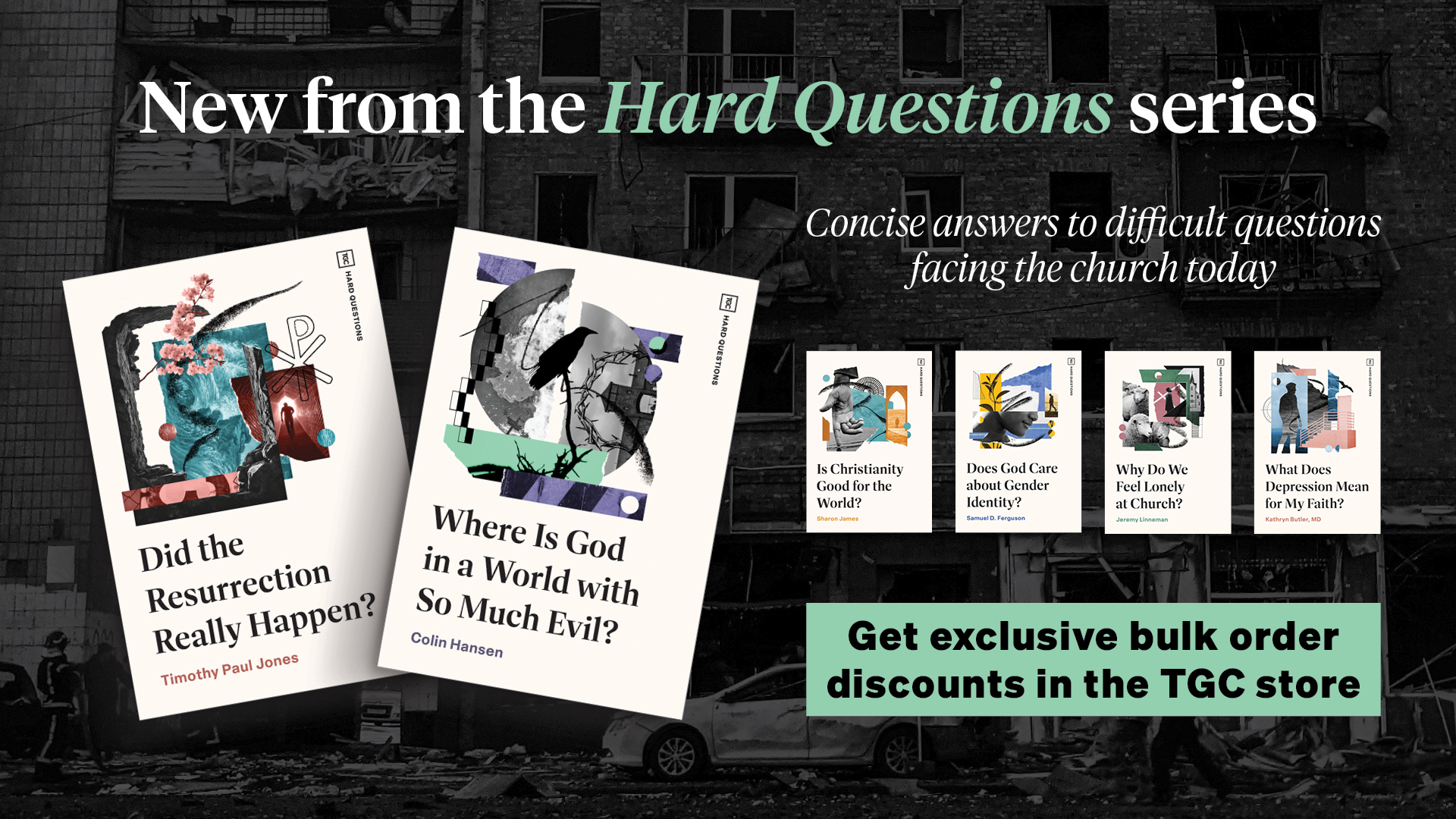
I wrote the newest addition to the TGC Hard Questions series to address that very question. In this short booklet, I explore the stories of Job, of Jesus, and of the Jewish people during the horrific events of the Holocaust. My goal is to remind you that God speaks through the cries of his people and offers us the gift of his Son, the Suffering Servant who makes all things new.
—Collin