




Guest Post by Robert Sagers
How can a movie help people in Africa suffering with HIV? How can a documentary equip pastors in villages where people die from lack of clean water? And what does any of it have to do with the gospel?
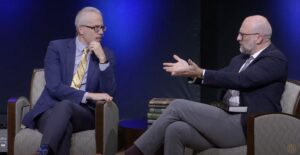
Those were some of the questions addressed a few weeks ago when I sat down with Coury Deeb, the founder of Nadus Films and the director of the feature-length documentary, The New Sudan. (You can watch the film’s trailer, below.)
The entire interview (with one follow up response sent via email), edited in such a way as to maintain something of the conversational feel, is below. And if you think of it, please pray for Nadus Films, and for their work!
RES: Coury, might you be able to tell the “Between Two Worlds” readers a bit about yourself—where you’re from, your family?
CD: I grew up here in Louisville, but lived in Philadelphia for many years. We were just talking about my really enjoying the city and being in close proximity to everything we experience here in Louisville. My wife and I live in old Louisville; we’ve got three boys—Abel (4), Elias (2), and Roman (7 months). We’ve got a dog, a fish, and seven chickens we live with. (The animals live outside mostly.) We go to Sojourn Community Church, a great church here in Louisville, a multi-campus church body, and we go to the Midtown Campus here in Louisville.
I have been involved with ministry work for many years, and really strongly while I was in Philadelphia. I felt called to go up there to Philly and to serve alongside an organization that focuses on inner-city missions work. And so I did that. And I also worked with Young Life up there, inner-city Young Life, for a few years and really enjoyed that. I got engaged, then married back here in Louisville. Then that’s kind of when the chapter of Africa opened up in my life, starting in ’05.
RES: Perhaps you could give a little bit of background about the Lord’s giving you a heart for the African nation of Sudan.
CD: I’ve been a Christian for many years, and like so many other Christians we kind of get into this rhythm, this mundane rhythm, of our lives—which is good and bad. It’s good in the sense that we’re staying connected, we’re disciplined, we’re involved in a church community and a body and hopefully being responsive to the convictions in our lives to always be growing and being changed. It’s bad too sometimes because you may miss out on things, opportunities in your life, especially if those opportunities are ones that would challenge you.
So fortunately, when I was sitting in a church service with my wife in Philadelphia one Sunday morning in ’04, I was challenged. I heard a gentleman by the name of Celestin Musekura speak about Sudan and the needs there. And so I felt convicted, I felt, “Hey, yes, I’m a Christian but I’m focusing way too much of my energy on things inside of my own life.” At that time my wife and I were renovating a three-story row home in Philly. We’d moved there and were enjoying the things in life that are kind of, “Me.” So there was an imbalance there, I think, to a large degree. We weren’t doing much in terms of things outside of our own life, our rhythms in our daily life. So I walked up to Celestin after hearing him speak that Sunday and I said, “Look, I don’t know exactly what you all need, but what I do know is that I’m a photographer and I would love to use my gifts and abilities to serve you, your organization, the people of Sudan. Tell me what to do.” Really, I just laid it out there. He said, “Praise God!” He said, “Go, serve the Sudanese people by capturing their story, bringing it back here to the States and share that story, raise awareness, raise money, raise other resources, to then help empower and equip the Sudanese people.”
And it kind of blew me out of the water. Growing up, I went on mission trips and served locally, blah blah blah, things that we’re all familiar with. But all of sudden, for whatever reason, there was this realization that I could do better, greater work through the things that I was gifted at. So that was just an eye-opener. And I was a photographer. I am a photographer. So why not use those gifts that God has given you to serve? 1 Peter 4:10 tells us to use the gifts that God has given us to administer his grace and to work faithfully in honoring God in all of those things. So I said, “Look: why not use what I have been given to serve not just myself, not just to put food on my wife’s and my table—and eventually my kids’ table—but also the tables of other people?”
RES: So you went over there for two weeks?
CD: Yeah, it was a short trip.
RES: So then, you know, a lot of people go on a short-term mission trip, and they’re there for a week, two weeks, but there was more to it when you got back in terms of the Lord’s continuing to work in your heart.
CD: There was. I went on a trip with six other people and to this day, nobody else is really doing anything in the Sudan. I don’t say that negatively, but there are good short-term trips and there are bad short-term trips. I am a fan of many short-term mission trips because I wouldn’t be doing what I’m doing if it wasn’t for that short-term trip. What was different for me was that I captured all this photography—still and video—while I was there, so I had work to do when I got back. And so it kind of sunk its teeth into me. When everyone else was coming back and enjoying themselves I was still working.
After that project was done, I felt a calling to continue using my gifts for a couple of reasons. One is it was needed, and there wasn’t anybody else stepping up in that area—not just that area of need, but that area of Sudan. And secondly, I enjoyed it. It is so much fun to use your gifts and abilities to serve, not only the things that you’re advancing in your own life but to serve those who are in need—and there is a huge need in Sudan for telling stories.
RES: What is the The New Sudan?
CD: Personally, The New Sudan is a film, a documentary, a feature-length documentary that Nadus Films has successfully produced.
If you ask the Sudanese what “the new Sudan” is, it’s the prospect of a new, upcoming Southern Sudan—and that is very important. In January of 2011, Southern Sudan hopefully, prayerfully, will be given the opportunity to vote for their independence. And the reason that is so important is because they just emerged out of Africa’s longest running civil war, between the north and the south. The north is, unfortunately, a very barbaric regime in the sense that is under sharia law—it’s a very hard-line Islamic law there, a government with no freedoms, especially for anyone not Muslim or one who’s not male—women and Christians are given very few freedoms. And so they impose much of their beliefs, forcefully, on the south—which is not all Christians, but there are a lot of Christians in the south, and people of various tribal religions and things of that nature.
And so the south said, “No, we do not want to be forced under sharia law.” And so in 1983, a civil war broke out, where over 2.5 million people died and 4 million people were displaced. And that was Africa’s longest running civil war. That ended in ’05. So the new Sudan is this prospect of hope that they could become their own country, starting in January of 2011. There will be difficulty to get there, absolutely, but if it should happen, over time, we’ll hopefully see democracy spread there, and freedom of religion, and the opportunity to worship freely and not be persecuted for their beliefs, and people will live their lives as they want.
RES: So in terms of you personally, what is the feature-length documentary—what would somebody get if they watched it—and what are you hoping to accomplish with that? What role did you play in creating it?
CD: The film, The New Sudan, covers a multitude of angles for the viewer, which is important because Sudan is a very complex situation—as are most emerging countries in the world that have been victims of wars, and things like that. So we realized that we had to tell the story accurately, and that had to go back from the beginning of why Sudan is where it’s at. For anybody to appreciate why there’s no schools and hospitals and clean water, you ask yourselves, “Why?” So as a documentary film maker, we had to tell that story. That is carried out through stock footage that we had to purchase, through interviews—presidential and non-presidential interviews—that we got, that we captured while were there. We successfully told the story of Sudan. And we’ve been told that we’ve told the story successfully—and that’s a huge feat for us, because again, it’s very complex.
So we tell the story of the war, and we also talk about what’s ahead—things that I’ve already touched on with the vote that comes up in 2011, their being a potential for an emerging country, a new country, something you’d see on a map: the new Sudan. We tell all of that. And there is a political realm there. Now, we’re not a political organization; however, to be involved and to serve in Sudan, you have to know politically what’s going on—or it will affect you in the wrong way.
Then from there, after educating the viewer on the story, the very powerful story, we then show them the personal, intimate lives of the people of Sudan. And we do that through a schoolteacher who’s pregnant—who’s struggling in training and equipping her students; a 13 year-old girl who everyday and every evening has to go and draw contaminated water that people die from; an old man who’s an elder there in the church in the village, and how he serves and teaches and equips those men and women there to better serve and to better love and to better be good stewards of the gospel; and a man who is a victim to HIV.
So these are all very real things—that’s why we’re telling these specific stories of the areas that we focus on as an organization, which is water and medical and education and church development. They’re kind of chapters in the film that we tackle, and we show the real, tangible needs that these people have requested to help them.
RES: Why those four things—the water, the medical, the education, and the church development—and why the four of them together?
CD: There are definitely other areas in Sudan that need attention. Microbusiness is something that we’re interested in, that we have supported, but it’s not necessarily a primary focus. Roads—roads sounds so stupid, “Why would you ever want to give money to roads?” Well, they’re super influential in the rebuilding of a country and in seeing schools develop. People die because they can’t get to a hospital because ambulances or vehicles can’t make it there. We’re passionate about other things, but we had to target on primaries, and these primaries are ones that were requested, largely from the Sudanese themselves.
Nadus does nothing on the ground without the blessing and support of our Sudanese partners. It’s just too much work to try to do anything there on your own, so why try? And so when they tell us to focus on something, and we discuss it, and we agree with it, then we move forward. And these are the four areas that we are investing in. We drill wells—that’s how we focus on clean water. This year alone we’ve already done four wells. Because of Nadus Films, there’s upward of 8,000 people drinking clean water every day for many years to come.
RES: So with the documentary you’re not only educating people as they’re watching; you’re also raising money to do some of these things.
CD: Exactly. And that—if for no other reason, that’s exactly what separates Nadus Films as a production company from most other production companies.
Most film organizations, production companies, do a really good job of telling a story—or else they wouldn’t be doing what they’re doing. The difference, though, is that Nadus does not want to see its work done at making someone’s evening better because they saw a good film. That’s important, because in order for anything to be done, awareness must be raised. So we do a good job at that. What makes us different is that we give opportunity for people to get plugged in where they feel led and where they feel called. Whether that may be donating directly from their pocket or their bank account—you know, we encourage that, because regardless of how sensitive the issue of money is, we’ll all agree that you can’t rebuild and support and equip people without money. We’re not ashamed of that. We also take trips there. This fall we’re doing a pastoral training trip where we’re training over 80 pastors there in the area to better serve and equip their body. So we’re training them, and we’re taking people from here in Louisville to train and equip the men there who are traveling from all over the area to come and learn for four days.
So those are a few things that we’re doing, and so we drill wells, we help build schools, we help train teachers to train their students better, we provide medicine. Also this fall we’re taking a trip where one of the things we’re doing is handing out mosquito nets and we’re hanging those mosquito nets, and with permission we’re praying with the families in the homes that we’re investing in. It’s a great opportunity, perhaps the perfect example of both word and deed ministry, mercy ministry.
So we’re there doing exactly that: we see the physical need—which is everything that you see through Nadus—we show the need, and then we follow through, working with people to fulfill those needs. And the Christians that go over there, it’s both an example of the gospel visually and audibly, speaking and loving those people.
RES: It’s my understanding that William Mapother, who played Ethan on the television show “LOST,” narrated the documentary. How did he get involved in the project?
CD: William Mapother and I have a mutual friend here in Louisville, a gentleman by the name of Gil Holland, who has been supportive of the project and pretty instrumental from A to Z. Gil and I were meeting one day, and talking about, “Yeah, we would need a narrator for the film”—we were kind of brainstorming—and Gil Holland suggested Mapother. And so Gil sent him a DVD screener of the film and Mapother called me within a couple of days and said he enjoyed the film, he loved it, and wanted to talk about what it would look like for him to get involved. Nadus works with all different people to see change there on the ground in Sudan, and we were super excited to invite Mapother on to the team for that season, to serve the Sudanese people and to use, again, his gifts and abilities. He’s a phenomenal actor and narrator, and he did a great job. And he came in, we worked together for about a day, between two sessions, and he did a great job. He’s a good example of someone who learned about Nadus, knew he had a gift and ability, and wanted to use it to serve the Sudanese people. So that’s what we capitalized on.
RES: How is the gospel informing your work and what you’re trying to do, both in terms of The New Sudan and the organization you founded, Nadus Films?
CD: We look through the lens of the gospel in everything that we do. We absolutely do—especially, for me, as being director. Nadus is a non-profit, it’s a 501(c)(3). The work that it does on the ground is definitely gospel-focused, and gospel-centered. We conduct ourselves with that mentality in the things that we carry out on the ground in Sudan through partners.
Largely, the people we partner with on the ground are the church, for a couple of reasons. It’s a desire of mine, of course, to have the church equip and empower the area, the village in which it’s serving. But what also makes Sudan a great place to serve and work is the fact that the church, in many areas of Southern Sudan, is doing more work than the government. That’s great news for us, because though the government does play a role, and should play a role, in protecting its people, etc., the church should be largely responsible for the well-being of a person wholistically. Nadus believes that, so we go in there wholistically, wanting to see them healthy—their lives physically improved and their villages physically improved, but also the heart. Going in there, not forcefully—being culturally sensitive—but sharing the gospel, and talking to them about that, and being very wise in how we build relationships with them.
RES: So you see it in terms of the church’s mandate to care for the whole person, and caring for the whole person includes all kinds of things beyond the spoken word of evangelism and preaching.
CD: Absolutely. And I think that the church has missed that mark—and not just the church, but the Christian has missed that mark for many years. Not all Christians are this way, of course, nor Americans. But I think the overall American church mentality is to go there and just preach, and not to feed and clothe those widows and orphans—which we’re directly called to do through the gospel. That is a focus of what Nadus is doing. We don’t want to go there and speak about love and preach about love, and not actually love—by educating them, and providing clean water. You might save a soul but then they die the next day from dirty water. Where’s the mentality in that? Where’s the justification in that? We believe striking that balance between word and deed ministry is really important.
I know that Tim Keller uses the analogy of the plane, with one wing being word and one wing being deed. And I think that’s a great visual analogy of how Christians should fly in to an area of need.
RES: The “Save Darfur” bracelets were really popular on college and university campuses in years past (and may still be!). What would you say to someone who wants to go beyond what I think I’ve heard someone call “wrist-wearing sloganeering,” who feels called to help? Social justice and social injustice can be big, abstract words—but you’re talking about specificity. So if somebody said, “I really want to help Sudan,” or, “I really want to help somehow, I know that my calling as a Christian is bigger than perhaps I’m seeing right now, and I’m wanting to help—”
CD: “—It’s bigger than wearing a trendy, consumeristic bracelet.”
RES: Yes. So what would you say to that person? They’ve got that passion, but they don’t really have an outlet yet.
CD: Our desire at Nadus Films is to create an outlet for their creative ideas and passions, and to see those lived out. And again, that can be in the form of raising awareness in their school or their church or their business—those are three areas where we can raise money. And again, let’s not ignore the fact that to help rebuild a country and equip a church and someone wholisticallly, it takes money, period. We need and we want money, and we, as American Christians, who are very privileged and spoiled, we have have money, we have resources. When we have a bad day, what do we do? We usually go out to eat, or order a pizza, and watch a movie. So we have that luxury, and that is a luxury that in seasons we can give up.
Now, I go out to eat and I order pizzas and watch movies, so I’m not saying, “Give those up entirely.” I’m just saying that we have that luxury and we do it too often. So why not give that up and sacrifice financially to help an organization that’s truly impacting the lives through its partners on the ground in Sudan?
Nadus is a great place to start, but it’s not the only place to start, and to serve. And so I would encourage you, if you’re involved in a church, to meet with the missions pastor and maybe get involved in a short-term trip, and see if it really is an area that you feel called to do. Those are just a couple of things. And then, of course, for you photographers and other artists out there, step up. Use your gifts and abilities to serve others than just yourselves—because I promise you, it not only is rewarding, but it’s what we’re called, as Christians, to do.
RES: So both the person who is unable, say, even physically to go on a short-term mission trip overseas—there’s the financial component, but there’s also the creative component that you would welcome.
CD: Absolutely. And, you know, we can’t take everybody to Sudan, and nor do we want to. There’s a lot of wasted time and resources in short-term mission trips. It’s a love and hate relationship that I have with them. It’s a love relationship because if wasn’t for them, I and others wouldn’t be doing what we’re doing. So they’re very, very important. But a lot of times churches, I believe, waste a lot of money on plane tickets and safari adventures and things like that that they tack on at the end, when those could go to something much better through a struggling church or an organization that’s on the ground there, doing the work, but knows that they’re not going to get money unless this church is coming there every month or whatever. But at the same time there is that great need of pastoral training. We can’t do that from here; we need to go there and serve and love them and do medical mission trips. Again, there’s that balance that needs to be struck between going and staying, but through that serving and equipping Sudan. We’re always looking for that balance, and sometimes we hit it and sometimes we don’t.
RES: What should someone do should they like to know more about The New Sudan?
CD: Our Web site is a great resource. We’ve spent a lot of time on the Web site, and so you can go there and learn about the areas that we’re involved in—water, medical, education, and church development. You can also, of course, see the trailer there that’s also narrated by Mapother.
We are booking screenings of the film currently, so we are asking that churches and schools and businesses or just groups of people, whether it be Christian or non-Christian—we’re really inviting all people on board to help impact Southern Sudan—we’re asking people to invite us in and allow us to do an event, where we show the film, we speak about what Nadus is doing and why it’s doing it, and we open up a Q&A session, which we’ve done many times and it’s been hugely successful. And it makes for a great evening of both raising awareness and raising support for the work we’re doing in Southern Sudan.
As far as purchasing the film, we’re currently working on distribution. When, exactly, I don’t know when it will be available—I’d say sometime in the fall is when we’re looking to distribute the film. And all I can say about that is sign up for the newsletter online at the Web site or check back at the Web site to see when the film’s available.
RES: You said something interesting there in terms of Christian and non-Christian—so you’re not coming in, under the radar, saying, “Hey, surprise! We’re Christians, by the way.” But at the same time you’re willing to link arms in terms of your helping with some of the tangibles of clean water and education and these kinds of things with people who don’t know Christ.
CD: Absolutely. Absolutely, 100 per cent. I’m a Christian, unapologetically, and I will share my faith with anybody, with whoever is in the room. But we’re an organization that serves the Sudanese people and we are not specific on who we serve there. We largely go through the church, because they’re responsive and they’re organized and structured and it’s our desire—
RES: —and you’re able to point to a gospel foundation for what you’re doing, and you’re appealing to that.
CD: Yes. And we know Galatians 6:10, “Therefore, as we have opportunity, let us do good to all people, especially those who belong to the family of believers.” And so we know that, and we largely do that through there, but it would not be a Christian thing to do to deny somebody a well just because they’re not in a church community or there’s not a church there in the village. And we’ll do that locally here—we work with non-Christians gladly; we’re not exclusive in the things that we do, and I think, again, not to go on too much of a tangent, but the church and the Christian world has kind of created these divided markets, and we do not want to be subject to just one market, especially as a film company. Again, we don’t change, or we’re not steered by the culture here—we’re Christians, and we’re doing the stuff that we do as gospel-focused, but we invite all people on board to come along and serve in certain areas.
RES: As you’ve shown the film, and you’ve been working with Nadus Films, what have you found encouraging along the way?
CD: One of the things that I think is encouraging and eye-opening for a prideful Christian, at times, is that God is in Sudan with or without Nadus Films and myself. And you will see that when you go on visits. People who live in the bush, in the forest, have practically nothing, and people are dying all around them. God is there. And he was there before, and he will be there after, we are there. And that, to me, is really encouraging—not because I think I can then leave and other people will step up, but because God is in control, he’s sovereign. It’s not an excuse to not be involved there; what I mean is that it’s encouraging to see a faith stripped down of material possessions and dependence on things that we cling to, that we’re familiar with in our days, and they have God still. And it’s really encouraging. 2 Corinthians 12:9—they glorify Christ in their weakness. And in their weakness, Christ is made strong. It’s always a testimony to me, visiting them, seeing their faith and being challenged by it in a manner that I’m not used to.
RES: Are you seeing people come to Christ in Sudan because of what you’re doing?
CD: Absolutely. We are there supporting and equipping our partners, which is largely the church there. So by us empowering and equipping them, they’re doing their job better. So the work that we’re doing there is fostering Sudanese to do their jobs better. We’re not there doing our own thing; we never will be. It’s not sustainable, it doesn’t make any sense, and it’s a failed model. I’ve been a part of it at times in my life. So we’ve thrown that model out the window. We’re only equipping and empowering the Sudanese church there, and what they’re doing, do to their job better.
RES: Is there anything that Nadus Films is working on currently?
CD: Since Nadus Films is an organization that uses film to raise awareness and action in Sudan, we’re always working on the next project. We’re excited to announce that this fall Nadus Films will be traveling to Sudan twice to begin production for its next film. This film will be different than our current project, The New Sudan. As you know, The New Sudan is a feature-length documentary that teaches the viewer of Sudan’s history, current state, and the needs there of the people.
This next film will be a 60-minute narrative that will primarily be built for a live performance. We’ve already hired a music director that will compose the score for the film that is to be performed live alongside the projected film. We’re fusing both worlds of film and music for live performance! A band will be touring the country beginning in spring/summer of 2011 and playing at all types of venues. This film (yet to be named) will still show the tangible needs of the Sudanese people, primarily in the areas of clean water, education, medicine and church. However, it will be done so in a powerful story that is guaranteed to grip the audience in a compelling way. Not only will this project be set for live tours, but also be packaged and distributed and prepped for the film festival circuit. We’re excited about this project and the opportunity to use our gifts to yet again serve the people of Sudan!
RES: Is there anything else you’d like to leave with the “Between Two Worlds” readers?
CD: My challenge is a big one—for those that feel led to be challenged in their faith, in their service, in their work—and that’s to check out Nadus Films or another organization that’s doing good work, and invest yourself in what they’re doing, because I promise you that they need you in some area, whether it’s financial or whether it’s physical—going and serving, or here locally. You can start by booking a screening of the film. We’re looking for churches to host events where we can go in there and they promote it and we show up and show the film and talk and challenge and do a real good job of just letting people know the needs.
And then, of course, if people are interested in going, we do take trips there and look for people in the medical world or the teacher training world or the pastoral training world (for church development). If you’re interested in that, definitely contact us.