






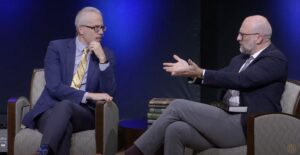
Last week, into the weekend, I was at New Orleans, which was hosting the academic conferences ETS, IBR, SBL. I was reminded of something Fred Sanders wrote in his thoughtful chapter for the book The New Media Frontier, ed. Roger Overton (Crossway, 2008), pp. 170-171:
The real showpiece of professorial old media, however, has to be the academic conference. They are almost too easy to mock. Once a year most academics travel to a major city for a multi-day extravaganza of meeting others who work in their field. Armies of tweed-clad experts converge and confer with each other. The heart of these conferences is “giving a paper,” an event in which one professor stands in front of a roomful of other professors reading aloud a drastically shortened version of a scholarly article. Meanwhile, dozens of other professors are doing the same in dozens of other rooms to thousands of other listeners who had to decide which paper to hear and which ones to skip.
Considered simply as information exchange, it would be hard to invent a less efficient system. If ever a system needed to be re-imagined in light of new technology, it is the academic conference. Sitting in a conference room listening to somebody read a paper, all scholars must have had the question occur to them, Why wasn’t this paper just e-mailed to me? Why did I have to fly to this city and stay in a hotel for three days to hear this research presented orally? . . .
But then Sanders turns a bit more serious, noting a paradox at play:
Here at academic old media’s weakest point, the bloated academic conference, we can see the thing that can never be replaced by new media: the human contact of scholars meeting each other. You can look around you in a paper presentation and see who else made the same decision you did, to attend this particular paper out of all the options being offered in this exact time slot. The third time you see the same person shuffling into a room you are shuffling into, it begins to dawn on you that here is a person who is interested in what you are interested in, and a scholarly friendship forms. The academic conference is a dreadfully inefficient way of exchanging information, but it is a place where you can take the name you’ve been reading books by for years and attach things to it like a face, a voice, and mannerisms. It is remarkable how much more intelligently you can read a dry scholarly book after hearing the author present some of the ideas in person.