Two decades have passed since the appearance of James Davison Hunter’s acclaimed volume Culture Wars, a seminal consideration of the American “struggle to control the family, art, education, law, and politics.” Since 1992, culture warriors have been lumped and split geographically into “red states” and “blue states,” politically into “tea partiers” and “liberals,” and theologically into “conservative” evangelicals and “liberal” secularists. The scholarly efforts to slice and dice the culture wars according to such categories as gender, race, and region continue unabated as an academic cottage industry.
Witness the latest unnecessary monograph to issue from this scholarly sausage machine, Jeffrey Moran’s slim volume assessing one perennial battlefield in the wider American culture war: the antievolution theater. Moran’s objective in American Genesis: The Evolution Controversies from Scopes to Creation Science is to provide perspectives—particularly concerning gender, region, and race—often sidelined in other historical accounts of the “creation-evolution” debate. While books assessing the post-Darwinian controversies abound, most approach the quarrel with an arsenal of arguments mustered from science, law, theology, or philosophy. And while several excellent historical accounts have been written—none, by the way, rivaling Ronald Numbers’s definitive treatment, The Creationists—this one is tailored to view the evolution wars through the restricted lenses of gender, region, and race. Moreover, along the way Moran adds his own assessments of antievolutionism as it has evolved in various contexts, especially in that highly contested space, the American classroom.
Moran is a Harvard-trained professor at the University of Kansas and a cultural and intellectual historian with a particular fondness for sniffing out hot spots in the American culture wars. His first book, based on his doctoral dissertation, appeared in 2000 as Teaching Sex: The Shaping of Adolescence in the 20th Century. In that volume, he correctly concluded that American sex education “became a potent symbol of contention in the ‘culture wars’ over the moral direction of the United States.” After surveying this ground of adolescent-development Kulturkampf, Moran turned his attention to other battlegrounds. This led him, perhaps predictably, to the Scopes trial of 1925, the event that most touched every sensitive cultural nerve of the roaring twenties, be it religious, political, educational, or scientific.
Since Edward Larson had already won the Pulitzer Prize in 1998 for his definitive study of the trial and its legacy, there was little of substance left for historians to add. Undeterred, Moran published a little book in 2002, The Scopes Trial: A Brief History with Documents, that offers college professors a useful classroom tool for teaching Scopes and its cultural contexts. He followed this with two respectable scholarly articles, appearing in The Journal of American History (2003) and The Journal of Southern History (2004), that dealt with race and regionalism as they pertained to the Scopes Trial. These articles became the basis for American Genesis, this new brief monograph of five loosely related chapters, each of which attempts to deal with an allegedly heretofore understudied dimension of what the book’s subtitle calls “the evolution controversies.” Moran asserts, reasonably, that “the fight over evolution in America has been a mirror . . . of the culture itself” (24), and he surmises that three principal features of American culture have determined the course of the nation’s antievolutionary activity: “the dominance of Protestantism, the traditions of democracy, and the unique cultural diversity of the nation itself” (17).
Sex, Region, Race
The book’s opening chapter, “Monkeys and Mothers,” considers the role of gender, asserting that opposition to evolution in the culture and the classroom was the labor of a “female-dominated reform movement that enlisted the state as an extension of maternal influence” (40). From “the crisis in sex roles” of the 1920s, during which thousands were “propelled” (38), according to Moran, into the fundamentalist ranks, through the 1970s, under the influence of Phyllis Schlafly and Beverly LaHaye, “gender continued to play a critical role in the antievolution movement” (45).
If sex roles influenced the shape of American antievolutionism, so did region and race, as the second and third chapters respectively report. “Regionalism,” explains Moran, “has always been a significant factor in the struggle over evolution” (48). This was due, in no small part, to the South’s relative isolation from the influence of elite northern urban culture, university learning, and modernist theology. The connection between racial attitudes and evolutionary ideas was more nuanced. While many black evangelical preachers championed an antievolutionary biblicism, black intellectuals often embraced Darwin. These black elites discerned ways that evolutionary theory called for racial unity and undermined white racist ideology that denied the common ancestry of humans. The result was that the evolution warriors did not separate along racial lines. Instead, black intellectuals allied with white scientists against antievolutionists whose ranks included both white racists and black fundamentalists. Moran’s account is fascinating as he weaves into the discussion numerous colorful personalities ranging from H. L. Mencken to Billy Sunday and from Aimee Semple McPherson to J. Franklyn Norris.
Three Sets of Flaws
And yet, the book suffers from no fewer than three sets of flaws. First, while not devoid of archival or original research, too much of the scholarship is a rehash of other secondary literature, nearly all of it well-known to those versed in the cultural history of antievolutionism. Why, the reader might wonder, was this book needed with so much else already written? Second, for all the interesting historical generalizations and the intriguing stage appearances by crusaders from the battle’s frontline, the narrative thread is far too thin. Good history books tell a story. The reader wants to know what happens next. This volume has insufficient narrative horsepower to drive a good read.
Finally, the book has just too many mistakes. These range from sloppy inconsistencies to simple errors of fact, from glaring omissions to confused generalizations that can leave the reader wondering how much homework was left undone. Although not limited to the final two chapters, these weaknesses are most evident there. Chapter four, “Descent with Modification,” is an attempt to show ways antievolutionary tactics have evolved from Bible-based antievolutionism to “creation science” to “Intelligent Design.” Here topics range from the Dover, Pennsylvania, “Intelligent Design” school board trial to Kentucky’s young-earth Creation Museum to the “Church of the Flying Spaghetti Monster,” which Moran gets exactly wrong, as he calls it the brainchild of “antievolutionists” (114). The final chapter, “Creationism on Campus,” ostensibly considers “the complexities of the antievolution struggle in higher education” (125) by selectively touching on or omitting key players in the recent evolution kerfuffles.
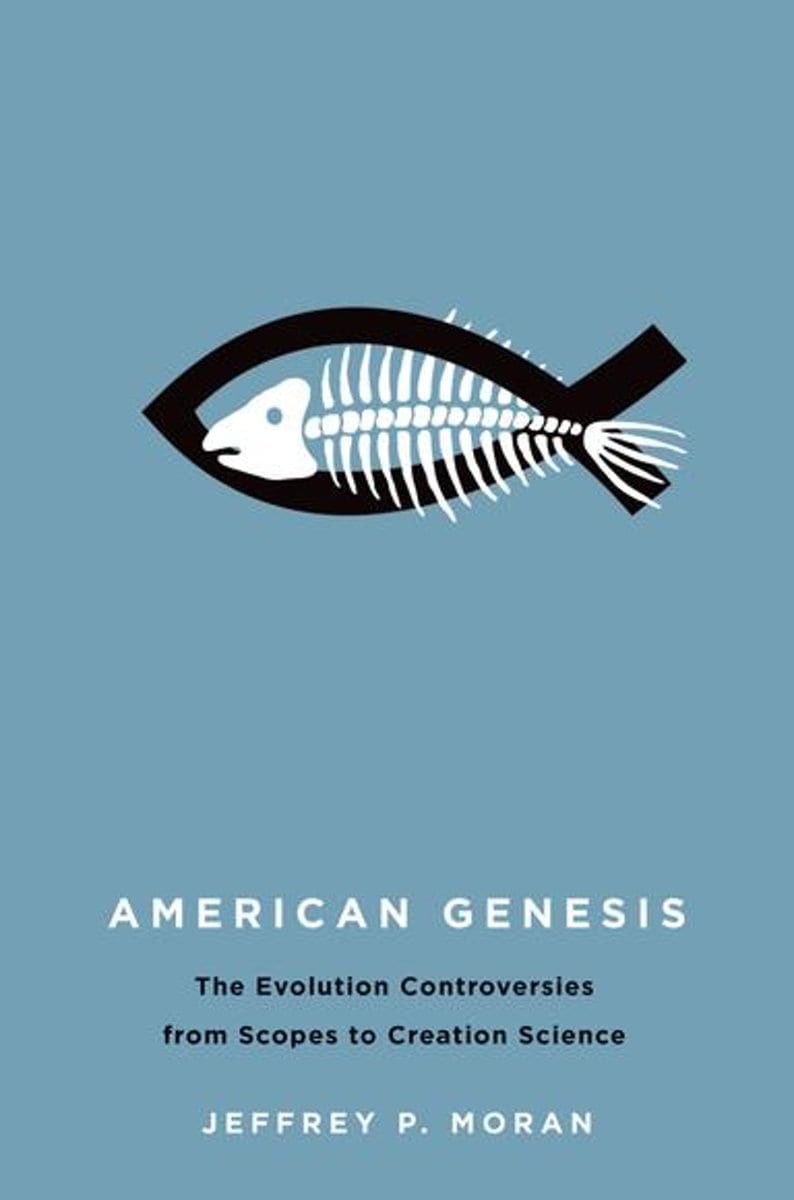
American Genesis: The Evolution Controversies from Scopes to Creation Science
Jeffrey Moran
American Genesis: The Evolution Controversies from Scopes to Creation Science
Jeffrey Moran
In American Genesis, Jeffrey P. Moran explores the ways in which the evolution debate has reverberated beyond the confines of state legislatures and courthouses. Using extensive research in newspapers, periodicals, and archives, Moran shows that social forces such as gender, regionalism, and race have intersected with the debate over evolution in ways that shed light on modern American culture.
Permit an incomplete, but representative, roster of problems the reader will meet. One repeatedly encounters the term “the antievolution movement,” despite the author’s prefatory explanation that “the book refers to the antievolution ‘impulse’ rather than the antievolution ‘movement’” (x). A small point, perhaps, but it is indicative of the loose way in which labels are used. Although Moran promises that the term “creationists” will be used “to designate those who specifically disallow the Big Bang theory and evolution” (xi), the text permits readers to regard spokesmen for the Intelligent Design (ID) movement, such as Michael Behe—who affirms both evolution and the Big Bang—as a kin with their “creationist brethren.” Further, “the ID community” is referred to as a group of “Christian conservatives,” an odd moniker for a group embracing theological liberals, non-Christians, and agnostics (134). In the chapter on regionalism, Moran lumps the two separate movements of Southern intellectuals, the “Fugitives” (fl. 1921–1925) together with the “Agrarians” (fl. post-1930). The two groups, despite a few common members, were entirely distinct in time and focus, a fact one could never know from the text’s repeated confusion and misidentification the two (63, 65–66).
Such confusion becomes risible when it comes to the history of American creationism and the evangelical Christian engagement with evolution. Moran wrongly identifies the Scofield Reference Bible as the source of the “day-age” theory of creation in which the Genesis days “might correspond to epochs of thousands of years.” To the contrary, the Scofield Bible was the source of the “Gap Theory,” which Moran tries to explain, but clearly doesn’t understand and gets wrong, too (101). Although he cites the authoritative history of creationism by Ronald Numbers, it seems Moran has not read the book, for if he had, he would never have claimed that young earth creationists had achieved “triumph among their compatriots in the American Scientific Affiliation,” the principal and longest-lasting group of evangelical Christian scientists, whose repudiation of young-earth flood geology actually prompted Morris and Whitcomb to flee the American Scientific Affiliation (ASA) and launch the independent movement of modern creation-science (102).
Unconscionable Omission
Which brings one to the glaring omissions. Moran’s mistaken reference to the ASA as the locus of young-earth “triumph” is the book’s only mention of the ASA, one of the most important organizations in the post-Scopes evolution controversies. Such an omission is unconscionable in view of the final chapter’s professed objective to discuss the creation-evolution struggle in view of science education, the concern has that animated the ASA from its 1941 founding to the present day. When, in 1984, the National Academy of Sciences distributed to American teachers more than 40,000 copies of its touted booklet, Science and Creationism: A View from the National Academy of Science, the ASA responded with a similarly formatted volume, Teaching Science in a Climate of Controversy: A View from the American Scientific Affiliation. It was an evangelical publishing effort positioned to stake out an orthodox middle ground between young-earth creation science and atheistic evolution. The story is fascinating and important, but it is entirely absent from Moran’s book, as are, for another example, many of the lead players in the Intelligent Design movement like Stephen Meyer, Jonathan Wells, Michael Denton, Paul Nelson, et al. In fact, rather than acknowledging that the Fellows of the Discovery Institute number into the scores, Moran lets stand the gross underestimate of “seven or eight” offered to him by one prominent evolutionist and opponent of ID (148).
But such omissions would cloud the impression the book unmistakably permits: that whatever nuances and curiosities obtain in the antievolution sagas, there remain, in the end, very few shades of gray; because this battle of the culture war is a Manichean struggle between the enlightened “mainstream” defenders of evolution (112), such as the National Center for Science Education run by atheist anthropologist Eugenie Scott, and religionists who question, however carefully, evolution’s hegemony, such as “Concerned Women for America and other far-right groups” (103). Yes, Moran admits, there are Christians like Francis Collins, Denis Lamoureux, and Kenneth Miller who have seen the light, kept the faith, and embraced evolution, but such folk are remarkably underrepresented in Moran’s tale. The unfortunate upshot is that few readers will discern the robust spectrum of opinion existing on the creation-evolution question as they are led to conclude that the choice is between God and Darwin.