


On average, we publish around 150 book reviews a year at The Gospel Coalition. Ecclesiastes 12:12 rings true: “Of making many books there is no end.” And many a publisher said Amen.
It’s impossible to read every book, let alone review each one. But in addition to our steady line of reviews, we want to highlight other books—some old, but most new—you should know.
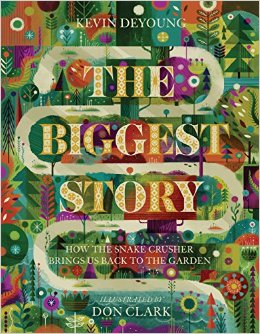 Kevin DeYoung, The Biggest Story (Crossway, 2015). I read everything DeYoung writes. He’s always clear, witty, convictional, and simple in his writing—even when branching out to write an illustrated children’s book. DeYoung delivered this first as a Christmas sermon for his church. He writes, “I wanted to tell the familiar advent story in a way that was fresh and faithful to the biblical text. I tried to deliver the message like I was reading a book—a book for children sitting by the fire on Christmas morning” (118). With creative and colorful ilustrations by Don Clark, the book beautifully presents the storyline of Scripture—the “Biggest Story” of them all. Consider it a crash course on biblical theology for young hearts. Many parents and kids will treasure The Biggest Story as they time and again read of our “snake-crushing King” and “destined-to-die Deliverer.” It’s a story that never grows old.
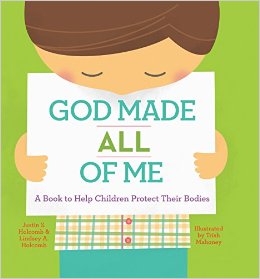 Justin Holcomb and Lindsey Holcomb, God Made All of Me: A Book to Help Children Protect Their Bodies (New Growth Press, 2015). This is an excellent book to use with kids to approach what can be a daunting topic. Many parents don’t know where to begin to talk to children about the topic of sex and sexual abuse. Thankfully, Justin and Lindsey Holcomb have written in a thoughtful and approachable way that even the youngest of children will understand. This book will help give language to both parents and children whereby they can start a dialogue about their bodies, God’s good design, and protection. The careful yet clear wording makes this an appropriate, helpful, and vital resource for the home. If you find that the topic of sexual abuse is a difficult one to broach, and I imagine most of us do, God Made All of Me is a kid-centered springboard that will help make the conversation a bit easier. It’s certainly a conversation we all need to have, at some point, with the precious gifts of life God has entrusted to us! – Written by Susan Wall
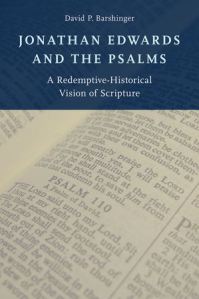 David Barshinger. Jonathan Edwards and the Psalms: A Redemptive-Historical Vision of Scripture (Oxford University Press, 2014). For many decades the view often portrayed of Edwards has been that of philosopher, theologian, and revivalist. But what’s often missing is that first and foremost Edwards was a student of the Bible—“he was at his core devoted to the glorious God of Scripture and to mining that Scripture for truth” (3). Barshinger seeks to amend this scholarly oversight of Edwards studies by offering the first book-length treatment of Edwards’s approach to a book of the Bible. The Scripture index is of particular use for preachers and students who will appreciate the ease of a ready resource on what Edwards thought on any given psalm (the only psalms not referenced are 54, 83, 120, and 150). This is a wonderful study that is not only intellectually profitable but also exegetically informative. Many pastors and students of Edwards will appreciate this work. One only hopes other scholars will take up similar studies on Edwards’s approach to other biblical books.
(Along these lines is Douglas Sweeney’s work on Edwards’s exegesis of the whole Bible which releases later this year: Edwards the Exegete: Biblical Interpretation and Anglo-Protestant Culture on the Edge of the Enlightenment.)
 Joel Beeke, Alistair Begg, et al. You Must Read: Books That Shaped Our Lives (Banner of Truth, 2015). Few bibliographic delights compare to a book on books—bibliophiles always revel in literary suggestions. This book is a Festschrift of sorts in honor of Iain Murray, founding editor of the Banner of Truth Trust, which celebrates its 60th anniversary this year. (Mark Dever lists the Banner of Truth as one of 12 sources God has used to reawaken an interest in Reformed theology in our day.) Each of the 32 entries is written by a theologian or friend who writes about a Banner of Truth book that’s been a “significant help” in living out the Christian faith. As the editors explain, “We hope that these pages will encourage many to discover the riches of Christian literature which over these six decades the Murrays have helped to recover for our own generation and for any generations that are still to come.”
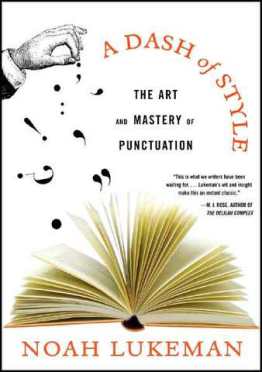 Noah Lukeman, A Dash of Style: The Art and Mastery of Punctuation (W. W. Norton & Company, 2006). This is a beautifully written, engaging, helpful, and concise book on an easily overlooked aspect of writing: punctuation. While each decision is relative, it doesn’t mean it’s thoughtless—at least it doesn’t have to be. Here’s a taste: “This book will offer a fresh look at punctuation: as an art form. Punctuation is often discussed as a convenience, as a way of facilitating what you want to say. Rarely is it pondered as a medium for artistic expression, as a means of impacting the content—not in a pedantic way, but in the most profound way, where it achieves symbiosis with the narration, style, viewpoint, and even the plot itself. . . . There is an underlying rhythm to all text. Sentences crash and fall like the waves of the sea, and work unconsciously on the reader. Punctuation is the music of language” (13–14). Those who care about the craft of writing will appreciate and learn a lot.
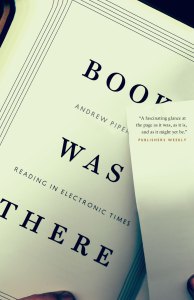 Andrew Piper, Book Was There: Reading in Electronic Times (University of Chicago Press, 2012). The aim of Andrew Piper (no relation to John Piper) is to “understand the relationship between books and screens, to identify some of their fundamental differences and to chart out the continuities that night run between them” (ix). In laying out the terrain of reading (its past and present) he reminds us “how much work reading requires to sustain itself” (149). My favorite discussions included note-taking, commonplace books, the importance of penmanship, where one reads, “social reading” and sharing in a digital age, the “art of pseudonymity in a world that has largely given up on anonymity” (43), and how books change us. There are many more thought-provoking discussions like these. This book is like a buffet for book lovers. Piper writes with clarity and with an impressive wealth of knowledge without being cumbersome.
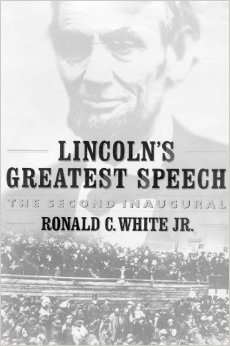 Ronald C. White, Lincoln’s Greatest Speech: The Second Inaugural (Simon & Schuster, 2003). This year marked the 150th anniversary of Abraham Lincoln’s Second Inaugural speech on March 4, 1865, only 41 days before his assassination. Before reading this book, I didn’t know much about Lincoln’s famed address. I can now not only appreciate the speech, but also see the brilliant simplicity of these words that have long captivated the American imagination. He was heard by 8,000 people without amplification. Frederick Douglass, the African American abolitionist and orator, reflected: “The address sounded more like a sermon than a state paper.” Any lover of history will find this an enjoyable read.
.jpg) Moisés Silva, ed., New International Dictionary of New Testament Theology and Exegesis (Zondervan, 2014). Pastors can never have enough tools in their toolkit. One such tool for many has been the New International Dictionary of New Testament Theology (NIDNTT), edited by Collin Brown, published nearly 40 years ago (1975–78). With this new update and revised title (NIDNTTE), editor Moisés Silva has vastly improved a classic reference work for understanding New Testament words. For preachers and students, this is a investment worth making. While five volumes they are strangely light. For reference works like these I’d much prefer Smyth sewn binding that can absorb more usage (especially in theological libraries), but for a personal library it doesn’t make that much of a difference.
Moisés Silva, ed., New International Dictionary of New Testament Theology and Exegesis (Zondervan, 2014). Pastors can never have enough tools in their toolkit. One such tool for many has been the New International Dictionary of New Testament Theology (NIDNTT), edited by Collin Brown, published nearly 40 years ago (1975–78). With this new update and revised title (NIDNTTE), editor Moisés Silva has vastly improved a classic reference work for understanding New Testament words. For preachers and students, this is a investment worth making. While five volumes they are strangely light. For reference works like these I’d much prefer Smyth sewn binding that can absorb more usage (especially in theological libraries), but for a personal library it doesn’t make that much of a difference.