




Oh dear. How am I to review this book? ringing the Gospel Home: Witnessing to Family Members, Close Friends, and Others Who Know You Well is the latest book by Randy Newman, who works for Campus Crusade and is the author of the excellent Questioning Evangelism.
There is one issue with Bringing the Gospel Home, but I do not want that to put you off reading the book. My issue with the book is that it is not really a book on evangelizing your family. Or at least, it is not a book specifically on evangelizing your family. True, most of the illustrations and stories are from family life. But the actual content is true of all evangelism with very little that is specific to families. Newman concedes in the conclusion, saying, “Witnessing to family is just like witnessing to everyone else . . . only more so.”
My problem is I know how I would react if I were reading this review. I would decide I did not need to read the book since, according to the reviewer, it does not do what it purports to do.
That would be a mistake for two reasons. The first is that this is a very good book on personal evangelism. The second is that, because it is a good book on evangelism, it is a good book on evangelizing your family.
Evangelizing your family is tough. I think there are two main reasons for this. First, it is often hard to break out of established patterns of relating. Second, evangelizing your family, especially parents, subverts the God-ordained order of things. We are meant to live under the authority of parents, but evangelism is an exercise of the kingship of Christ. However gently we might say it, we are in essence declaring that our parents are wrong and that they need to submit to what we say. That’s difficult for everyone concerned, even in the most functional of families. So evangelizing family can often be emotionally fraught.
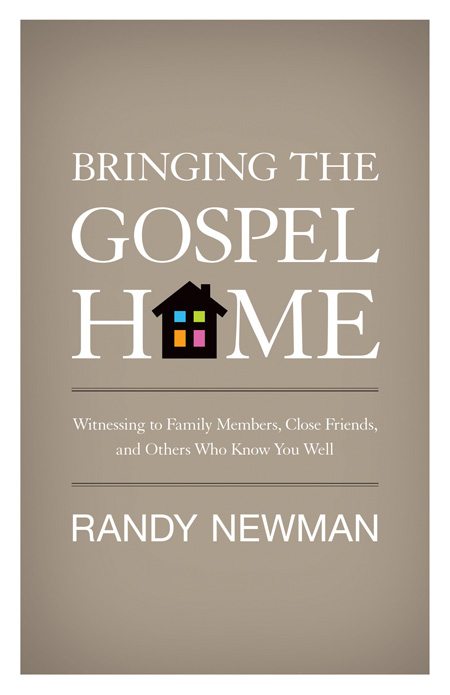
Bringing the Gospel Home: Witnessing to Family Members, Close Friends, and Others Who Know You Well
Randy Newman
Bringing the Gospel Home: Witnessing to Family Members, Close Friends, and Others Who Know You Well
Randy Newman
For the vast majority of Christians, evangelism does not come naturally. We find ourselves sounding like someone we’re not or beating ourselves up for not being bold enough, smart enough, or quick enough.
Randy Newman understands the complexity and consequences of this all-important task. As a messianic Jew who has led several family members to Christ, he gives insights from the Scriptures, stories of others who have learned some lessons along the way, and specific steps you can take to make progress in engaging with others.
Thankfully, rather than suggest some kind of technique, Newman focuses on our attitudes in a way that will help navigate through these difficulties. This focus on attitudes is revealed in the chapter titles: grace, truth, love, humility, time, and eternity. But don’t think this makes the book “impractical.” Newman skilfully applies his material through stories, sample conversations and “steps to take” sections.
Of course very few people, family members or not, are queuing up to submit to the Word of God. And this is why the book is a good book on personal evangelism regardless of your relationship. Even if all your family are Christians, I strongly commend the book to you.
Helpful features include:
- An emphasis on common grace as a foundation for making connections with people through affirming what they do that is good and sharing in what they enjoy.
- At the same time, a recognition that, while witnessing to unbelievers usually starts with looking for common ground, witnessing to religious people or nominal Christians requires us to highlight our “uncommon” ground, that is, the differences between religion and gospel.
- An exposure of how our idolatry of control and comfort distort our evangelism.
- A pastorally helpful treatment of loved ones who died unsaved.
Perhaps the line that sums up the message of the book is this: “We need to communicate a content-rich message in a compassion-saturated relationship” (120).
Most of my wider family are not believers, so I was delighted to be asked to review this book. Has it helped? Yes. It didn’t offer me a silver bullet, but there were plenty of helpful reminders and, perhaps more importantly, lots of appropriate challenges. What I discovered above all is my problem is not a failure of technique, but a failure of attitude. I lack faith in God’s power to change, love to persist, and courage to proclaim-not what I wanted to hear, but what I needed to hear.