




The mail came one day and I could tell it was a book—a delightfully shaped package I often anticipate. When I opened the package and saw what is was, even before reading the first sentence, I was convicted. I was sure that by the end of the book I would be condemned.
But that was not the case.
Embracing Obscurity: Becoming Nothing In Light of God’s Everything was convicting but not condemning. And that’s a good thing.
Embracing Obscurity is written anonymously. Anonymity allows for the writer to be candid and bold and yet embrace his own obscurity (for the sake of this review I will simply call the author “he” ). His anonymity is both the strength and the weakness of the book.
Highest Aim of Life
It begins by explaining why the author felt it necessary to write the book. We are in an age where being known and successful can be the highest aim and goal of life—without even knowing it. “We’re intoxicated with a desire to be known, recognized, appreciated, and respected,” he writes. “We crave to be a ‘somebody’ and do notable things, to achieve our dreams and gain the admiration of others. To be something—anything—other than nothing” (1). Yes, that is on page one. No one wants to be a nobody. We have a craving and desire for approval, if not by the world than by someone we know.
The bad news in our aim for glory is that we are vying for it with about 100 billion other people. In chapter 1, we get a vision for how we view ourselves. “The trouble with you and me and the rest of humanity is not that we lack self-confidence (as we’re told by the world) but that we have far too much self-importance,” he writes. “The thought of being just another of the roughly one hundred billion people to have ever graced this planet offends us—whether we realize it or not. We have such a high opinion of ourselves that to live and die unnoticed seems a grave injustice” (10).
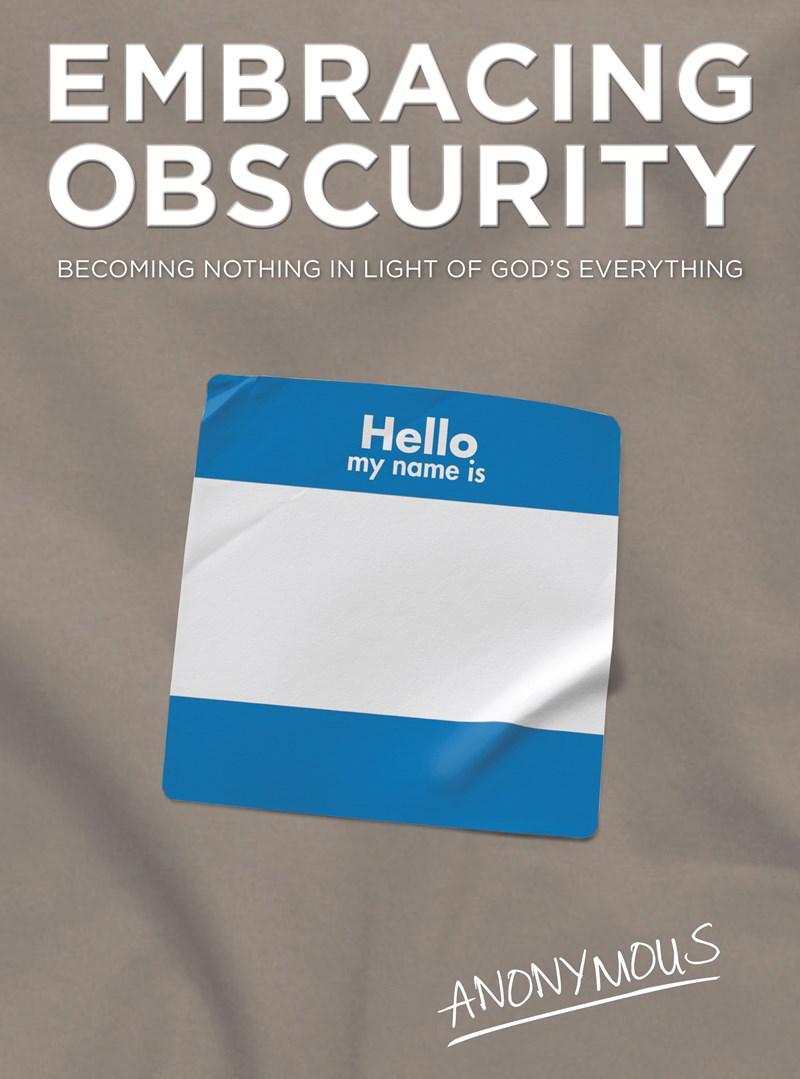
Embracing Obscurity: Becoming Nothing In Light of God’s Everything
Anonymous
Embracing Obscurity: Becoming Nothing In Light of God’s Everything
Anonymous
As pride creeps in, we are tempted to want more: more recognition, more admiration, more influence, more, more, more. Few have ever given thought to wanting less. That’s why we need Embracing Obscurity. Putting the premise into immediate action, an established Christian author electing to remain anonymous writes about living and dying in simplicity, contending that true success, as modeled by Jesus, starts with humility, service, sacrifice, and surrender. Such a life involves mystery and banks on the hope that today is just a dress rehearsal for eternity.
These words might seem offensive at first glance. Our pride doesn’t want to believe we are that proud. But isn’t that how we truly understand the gospel? In order to embrace the Savior for who he is we must first understand who we are—sinful, dead in our transgressions, and unholy before a holy God.
All about Him
If you don’t read anything else in the book, read chapter 4: “Embracing Significance;” put the book down, and then reread it. Here is where we begin to see that the Christian is somebody—in Christ! Our significance and worth are not derived from ourselves; rather, our worth is related to the worthiness of Christ, because of the value of knowing Christ, of being known by Christ and of being in-Christ. It’s all about him!
He writes:
It was not a great compliment when God called you to follow Jesus Christ.
“Foolish,” “powerless,” “despised,” and “nothing at all” are hardly complimentary . . . but, as I think you’ll come to see, that’s exactly when our true significance takes stage. After Paul gets done insulting the Corinthian believers in verses 26-29, his next words are revolutionary: God has united you with Christ Jesus (v. 30 NLT). In other words, you might be dumb, weak, shunned, and obscure; but if you love and follow Jesus, Paul says, then you’ve been joined to true significance.
Understanding our significance in Christ is the backdrop for the rest of the book as we explore topics such as success, servanthood, suffering, mystery, the spotlight, and hope. By the end of the book there’s no question that our hope for all circumstances is founded and rooted in the gospel. This is the ultimate strength of the book. Embracing Obscurity makes much of Jesus on every page.
As I’ve already mentioned, I think the anonymity was both a strength and a weakness of this book. If we could have known the author, we could relate to and engage the book personally. It would have been helpful to know the author at the beginning of the book as he was establishing our worthlessness. I wanted to know if this exhortation came from a pastor’s heart, or a “Christian celebrity” who could easily relate, or a counselor. Perhaps none of that matters. But I found myself reading through all of the endorsements to see if the author is “legit.” Then again, perhaps my need for qualifications isn’t the weakness but reveals the need for the book.