



“The drama is in the dogma,” Dorothy Sayers once said. It seems no evangelical theologian has more enthusiastically taken to heart her statement than Kevin Vanhoozer, research professor of theology at Trinity Evangelical Divinity School outside Chicago.
Building on the foundation laid by H. U. Von Balthasar in his multi-volume series Theodrama, over the past 12 years Vanhoozer has put forward and developed his own “theatrical” approach to doctrine and theology.
Project Continues
Beginning with The Drama of Doctrine (Christianity Today’s 2006 book of the year in theology), Vanhoozer argued that the category of “drama” is well suited to conceptualizing a theology that takes its cues from the gospel. Doctrine, on this model, is the stage direction that enables disciples to participate rightly in the drama of the gospel. Doctrine does this by rightly identifying the dramatis personae (God, Christ, Israel, and so on), the shape of God’s (theos) actions (drao = to act, drama) that come before (creation, election, Jesus, church, consummation), and in that light, our role in local community performances as the company of the church on the stage of the world.
Vanhoozer followed that up a few years later in his groundbreaking Remythologizing Theology (2010), putting his theory into practice by engaging in some 500 pages of theology proper. Essentially it was a call for theology to reorient itself to speaking of God’s being on the basis of his dramatic doings revealed in Scripture.
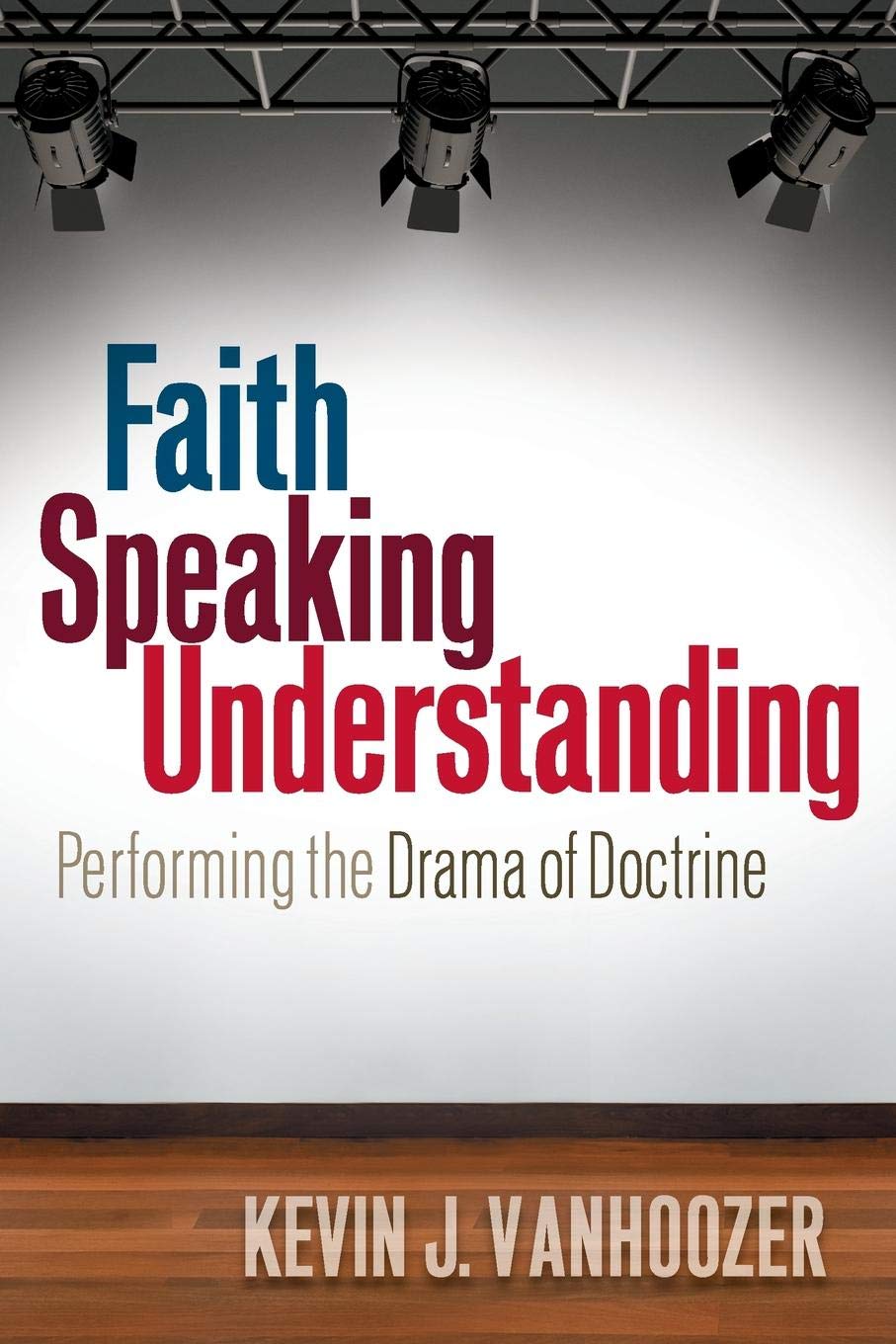
Faith Speaking Understanding: Performing the Drama of Doctrine
Kevin J. Vanhoozer
Faith Speaking Understanding: Performing the Drama of Doctrine
Kevin J. Vanhoozer
Despite their wide acclaim, however, the size, complexity, and price tag of these works has prevented many pastors outside the academy from been exposed to Vanhoozer’s work. This is a shame because—and I know this is a bold statement—these are two of the most important works of evangelical theology written over the past 15 years. The Drama of Doctrine saved my theology of revelation and Scripture in the emergent years, and Remythologizing Theology did the same for my doctrine of God. If I could force every seminary student to closely read and digest those two books, the church would be saved a lot of theological grief.
Enter Vanhoozer’s newest work, Faith Speaking Understanding: Performing the Drama of Doctrine. Let me put it this way: if Drama of Doctrine and Remythologizing Theology had a child, it would be Faith Speaking Understanding. Though intended as a briefer, less intimidating introduction to and practical application of his theodramatic theology for pastors and serious students, it isn’t a mere rehash of the last two works. As Vanhoozer explains, Faith Speaking Understanding is “an upstart sibling with a swagger of its own, namely a full-fledged proposal for the role of theology in the church’s task of making disciples” (xv).
Swagger it may have, but it’s swagger mediated through Vanhoozer’s inimitable style, irenic tone, and jovial spirit. Vanhoozer’s prose is a joy to read—a seamless movement between biblical and theological reflection (as evidenced by the extensive and helpful indexes of Scripture and theology) that is robustly catholic and winsomely evangelical.
Doctrine Is for Doing
The argument of the book falls into two parts. First, in “Before the Curtain Rises,” Vanhoozer reintroduces and retools his dramatic model of doctrine as direction for fitting participation. This will be of interest not only to those who’ve never encountered the model but also to those who have, since he takes time to deal with objections raised to his earlier proposal. For instance, does conceiving of doctrine as direction encourage discipleship as passive audience observation? May it never be! In fact, a theatrical conception of doctrine is aimed at a response that breaks down the walls between leaders and congregations and demands audience participation, much as the New Testament’s indicatives lead to its imperatives (36–37).
Part two, “Faith Showing Understanding,” gets to the meat of the book. Here Vanhoozer comes to his distinctive proposal for the role of doctrine in discipleship. Contrary to prevailing winds in popular evangelicalism that would sideline doctrine as ancillary, Vanhoozer thinks doctrine is central to the Great Commission of the church: to make disciples. But what does it mean to make disciples? “To make disciples is to teach people how to keep the faith”—not only in thought but in deed as well (xii). We are to be doers of the Word, not hearers only (James 1:22).
The church that fulfills the Great Commission teaches would-be disciples to obey the Great Commandment to the love the Lord with our whole selves (Mark 12:30). Hence the need for doctrine:
Desire for God without doctrine is blind; doctrine without desire is empty . . . we cannot love God without knowing God, and we cannot know God rightly without understanding what he has done in Jesus Christ. Discipleship depends on Christology, and Christology involves being able to show and tell who Jesus Christ is for us today. (xii)
The church, then, needs to be a community that tells the “theodrama” well, for only then will we be able to show it in our obedient, Christ-formed lives. Faith not only thinks but also speaks understanding when it performs and displays what it knows to be reality in Christ on the stage of the world (9, 230):
The church is a performance aimed not at earning but at exhibiting the righteousness of God, the life eternal, and the hope of the world. To perform the drama of doctrine is to do and become a constant display of faith and faithfulness, grace and gratitude, mercy and love. This glorious show must go on. (237)
Drama of Discipleship
To show how this works, Vanhoozer sets himself to getting some “real” theology done, with smashing sections on the Trinity, Jesus Christ, the Pactum Salutis, Satan and his minions, atonement, preaching, baptism, eucharist, ascension, and eschatology. These aren’t simply doctrinal forays for the fun of it, though. In each section of doctrinal development he aims to set forth what is in Christ and how it enables disciples to “embody the mind of Christ always, everywhere, and to everyone” (188). Vanhoozer not only tells us how to tell and show, he shows us how as well.
Vanhoozer demonstrates on page after page that the drama of everyday life is the stuff of doctrine. As I come to know that in Christ the eternal Son humbled himself to die for my sins, I receive direction to embody that reality by dying to self and loving neighbor in my day-to-day life. As we in the community come to know that in Christ God has made space for us at his table, we are drawn to practice generosity and hospitality too. As I understand that in Christ the heavenly curtain has been torn open, and that I’ve been seated with Christ at the right hand of the Father, I am given the strength to play my part as a public witness (martyria) to his lordship—as Stephen did upon the stage watching world. Basically, it is only because of the great doctrines of the faith such as Trinity and atonement that I can truly live to God in the midst of my “real life.”
Book for Everyone
For that reason I would encourage you to run to buy this book. Pastors, you are the public theologians of your church, tasked with wisely applying doctrinal direction to your local company of the gospel. For the vast majority of our hearers, they will only know what is in Christ if we preach it to them. This book is invaluable and invigorating to the call God has placed on you. Seminarians, same for you.
Finally, for those in the pews, this work will encourage you to understand yourself as a member of the company of faith with an equally important part to play in the drama alongside the so-called professionals.