




There is no shortage of angst over young people leaving the church today. Though the research is debatable, it’s widely accepted that most young people will walk away from the faith of their parents. Every day, it seems, there’s a new bestselling book or gut-wrenching memoir depicting the sins of the evangelical church and how we must change—or die. Some solutions are constructive; others, not so much. What’s missing in the discussion, though, is an honest look at the struggles and doubts of those who grow up in the faith.
That’s why I was excited to learn that Ryan and Josh Shook had written Firsthand: Ditching Secondhand Religion for a Faith of Your Own. Ryan and Josh, sons of prominent evangelical author and pastor Kerry Shook, offer an inside look at growing up Christian in a mainstream evangelical church culture.
With the exception of a few tired clichés, the Shooks seem to aim their argument squarely at the struggling young evangelical. It’s less a memoir of pained evangelical experience and more a challenge to the younger generation to pursue and develop their own relationship with God. They write:
It doesn’t matter how real your parent’s faith is, or anyone else’s for that matter, if you don’t develop a faith of your own. A handed-down faith that you’ve never owned for yourself doesn’t give meaning to your life. You might sort of wear it, but it doesn’t say much about who you are. . . . Hand-me-down faith may work when things are going well, but when pressures and problems hit, what you thought you believed will crumble. (5)
With a few exceptions, I found most of this book to be a welcome challenge to “second generation” Christians.
Permission to Wrestle
It’s refreshing, in a day of angst-written evangelical memoir, to hear the sons of a prominent evangelical family speak kindly—not only of their parents’ faith, but also of their own evangelical experience.
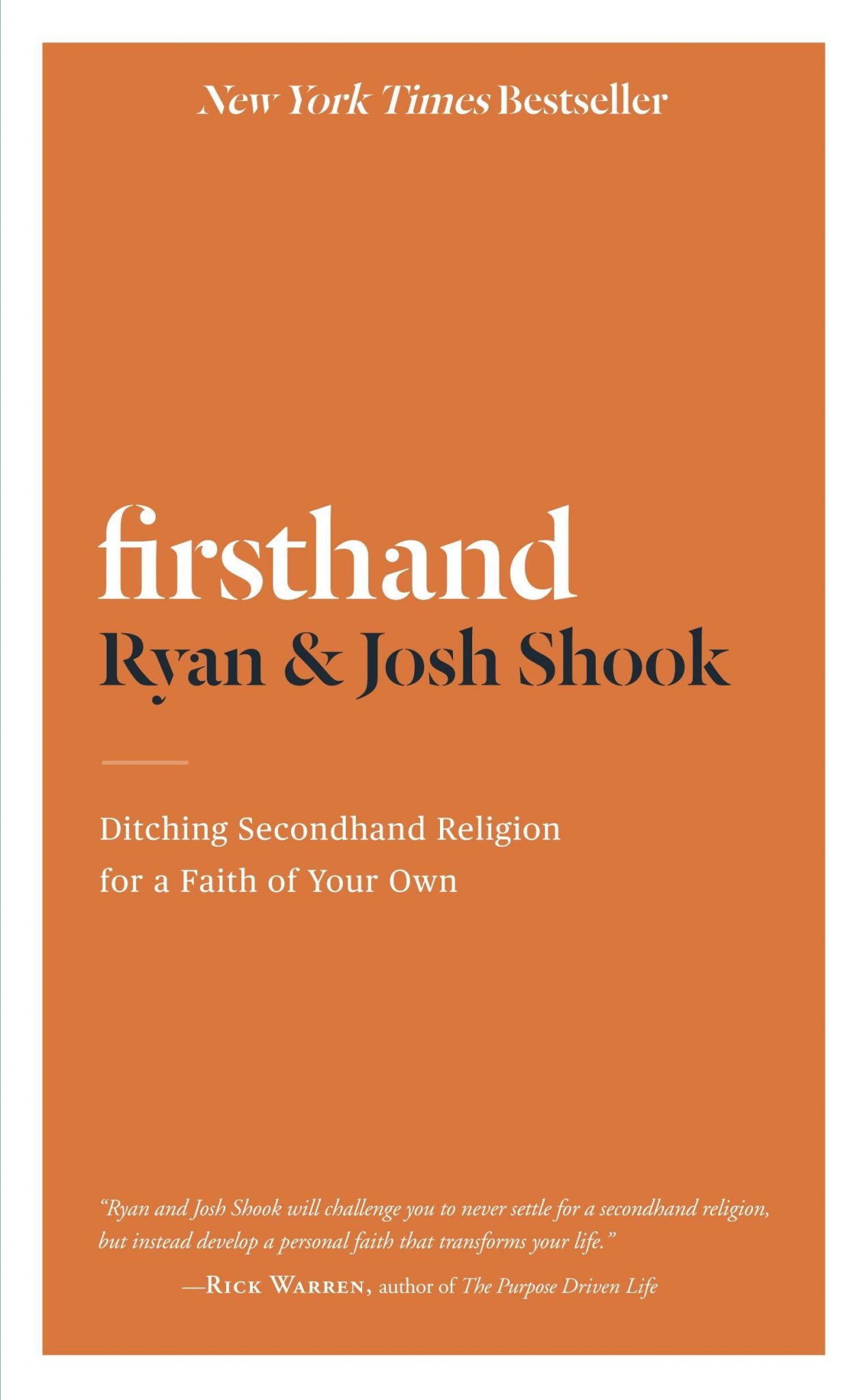
Firsthand: Ditching Secondhand Religion for a Faith of Your Own
Ryan and Josh Shook
Firsthand: Ditching Secondhand Religion for a Faith of Your Own
Ryan and Josh Shook
Of their parents the brothers write: “We saw them live out a genuine faith in front of us—two imperfect parents seeking to trust a perfect God. We feel truly blessed to have parents who have real and authentic faith.” As a parent of young children myself, I can only hope my children grow up to say this about Angela and me.
And yet, while raised in a healthy environment, Josh and Ryan speak openly of their struggles with doubt. In chapter 6, they talk about a season of life in which they doubted the very basics of the Christian faith and engaged their own pursuit of what was true. I think this chapter contains the best content in the entire book, as it gives permission for those who have grown up in the church to wrestle—personally—with the big questions of life. I imagine some young people will read this book and think to themselves: “If Josh and Ryan had doubts, growing up in an ideal Christian environment, it’s okay for me to have doubts, too.
Moreover, I thought the brothers’ advice to doubters was sound. They spoke of the way they “deconstructed” their faith (11) by going back to the basics, studying everything they could find on apologetics, theology, and faith. This study led them to develop deep convictions about the truth of Jesus’s claims. They encourage seekers and strugglers to embark on a similar journey, not accepting what they know or don’t know about Jesus based solely on what they’ve been taught, but taking the time to pursue the questions.
What’s refreshing about Josh and Ryan’s approach is that they don’t herald doubt as an art form; instead, they encourage doubters to pursue the truth. “Bring more than your questions to God,” they urge. “Bring him your heart. And your will.” In addition, they skillfully employ Paul’s warning in 2 Timothy 3:7 against “insincere seekers” (133).
I also found chapter three (“Sick of Secrets”) enormously helpful. Here the brothers open up about their own real struggles with sin and the pressure, in a Christian community, to hide behind a mask of perfection. While I found the “we are all messes” theme a bit redundant and overdone, I think it’s important to let Christian kids know the struggle they face with sin is normal for redeemed sinners. The last chapter (“Firsthand Community”) is a welcome affirmation of local church life. While many young evangelicals seem content to trash the church, I love that Josh and Ryan agree on the importance of Christian community in living out the gospel.
A Few Hang-ups
Though my assessment of Firsthand is overwhelmingly positive, I did have a few small hang-ups. First, I would’ve liked a more robust discussion of the sovereignty of God. Christians who wrestle with their faith and have negative experiences in church must be confronted with the hope that God doesn’t make mistakes in parenting or in the childhood environments over which we have no control.
Second, I would’ve preferred less reliance on the tired dichotomy between rules and relationship, theology and practice. Hence I felt chapter 5, “Trashing the Checklist,” was perhaps the weakest chapter. The authors appeal, for example, to a straw man of church life featuring the person holding the “checklist” and other just desiring to live “in relationship” with God. Second-generation Christians have to fight legalism, but the best weapon is the gospel itself, which reminds us that our hope isn’t in measuring up but in God’s free favor in Christ.
For instance, the Shooks write, “Christ came to remove the burden of secondhand religion with all of its detailed to-do lists and to bring us into a simple, real relationship.” Well, sort of. Christ came not to abolish the law and all of its detailed to-do lists, but to fulfill it (Matt. 5:17). By pitting Christ against the law, then, we tend to render the Old Testament irrelevant, forgetting that God gave the moral law as a gift of grace. The gospel calls children of the King to live out the law as citizens of a new kingdom. In fact, far from writing off the law, Jesus ramped it up in the Sermon on the Mount (Matt. 5–7).
Of course, sometimes “checklists” aren’t scriptural mandates but manmade traditions and preferences. So a hearty yes to the idea that we ought to abandon those. But despair over our inability to measure up to God’s good law should drive us, not to considering it unimportant, but to the forgiveness we’ve found in Christ and to the power of the Spirit in freeing our hearts to obey.
Last, I’m inclined to think the book might be more effective had it not been organized in quite so circular a manner. As I mentioned before, there was significant redundancy throughout the chapters. Moreover, I could have used less of the phrase “be real” and more explanation of what “real” actually looks like—though I recognize it was written in an intentionally conversational style. Perhaps a good follow-up book to Firsthand would be Joshua Harris’s Dug Down Deep: Building Your Life on Truths that Last.
These relatively minor objections aside, I believe Firsthand will do much good for the kingdom as many children of the church are challenged to own their faith, to tend honestly to their doubts, and to stand for the ancient gospel of truth.