



As I was sitting alone in the cafeteria one afternoon, far from home, overwhelmed and lonely on a campus of 20,000 people, an older student walked up, smiled, and asked if he could join me. He took a seat and I prepared to engage him in a heady discussion of politics, philosophy, science, and other topics I’d picked up during my first few weeks as a college freshman. Thrilled to have the company, I was mentally preparing for anything he threw at me.
Glancing up from his plate of spaghetti, he asked, “Have you accepted Jesus Christ as your personal Lord and Savior?”
Stunned, I was completely at a loss for a response. “Um, yeah, actually I have.” I finally managed in reply.
“Oh,” he said. “Okay, that’s good.” He wore a look of minor defeat. He had chosen the wrong table; no soul would be won for Christ over this lunch. We chatted politely while I finished my burger. He ate quickly and excused himself. I never saw him again.
That was almost 30 years ago, and yet that type of evangelism is still quite common. We use the same wooden methods—hand out a gospel tract, recite the canned here’s-how-you-get-saved speech, get them to say the sinner’s prayer—as if we’re closing the deal on a generic customer. But Christianity isn’t a form of multi-level marketing, and the gospel of Christ isn’t a product that can be sold using pre-packaged techniques.
What’s Missing
What is frequently missing in our evangelism and pre-evangelistic apologetics, Christian apologist and social critic Os Guinness says in his new book, Fool’s Talk: Recovering the Art of Christian Persuasion, is a recovery of Christian persuasion.
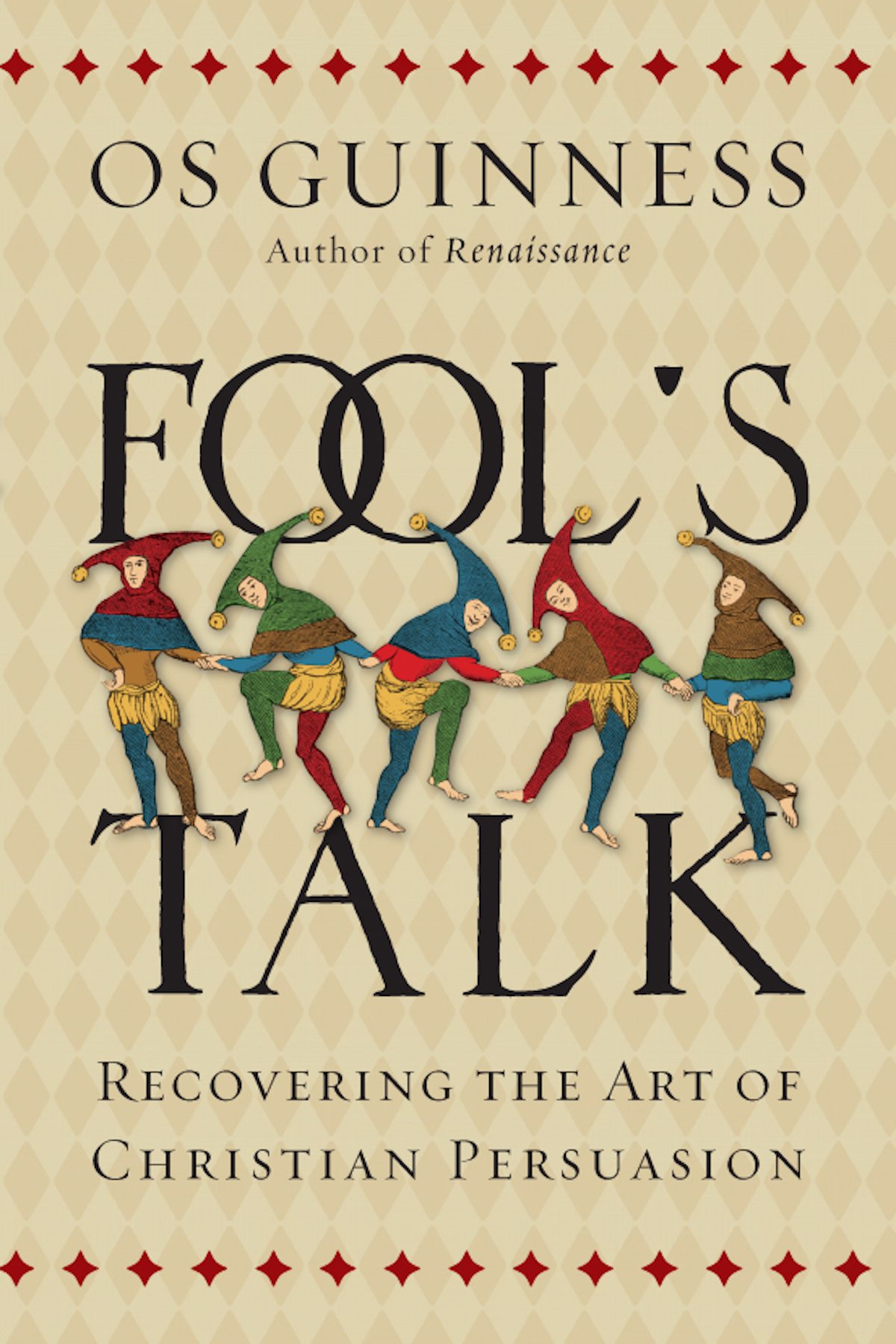
Fool's Talk: Recovering the Art of Christian Persuasion
Os Guinness
Guinness admits it “might seem bizarre, almost unimaginable” that Christian communication has lost something so essential to its mission. After all, there are more books on apologetics and evangelism than ever before, and the internet has expanded our ability to reach almost anyone at any time.
The problem, Guinness contends, is that we ignore or underestimate the fact that most unbelievers are not only uninterested in our message, but also openly hostile to it. The challenge, then, is to use Christian persuasion—the art of speaking to those indifferent or resistant to what we have to say—in a way that helps them hear the gospel in spite of themselves.
Ways of the ‘Fool Maker’
We’ve too often gone wrong in assuming gospel proclamation can be effective without creative persuasion. We tend to use generic techniques, sterile arguments, and jargon incomprehensible to outsiders and then assume—whether we’re understood or not—that the Holy Spirit will take care of the rest. Yet, as Guinness observes, “Proclamation and persuasion must not be separated.” And to proclaim and persuade we must adopt the ways of the “fool maker”:
The fool maker is the person who (once again) is not a fool at all, but is prepared to be seen and treated as a fool, so that from a position of derided folly, he or she may be able to bounce back and play the jester, addressing truth to power, pricking the balloons of the high and mighty, and telling the emperor that he has no clothes.
From this brief excerpt you can probably tell Guinness isn’t the type to advocate for a postmodern apologetic in which Christianity is merely a more attractive metanarrative. He’s an ardent defender of what Francis Schaeffer called “true truth.” Persuasion, he holds, must therefore be rooted in countering the false worldviews held by unbelievers, since that is the heart of unbelief. “In the biblical view,” Guinness notes, “the central core of the anatomy of unbelief stems from its willful abuse of truth.”
Schaeffer was Guinness’s friend and mentor, and his influence is found throughout the book. In many ways, Guinness is expanding and elucidating several of the approaches Schaeffer only hinted at in his own works. Students and fans of Schaeffer, then, will find much to appreciate in Fool’s Talk.
Confusing Approach
My main criticism is with the at-times confusing approach Guinness takes concerning technique, or what he calls “the devil’s bait.” He provides a useful and necessary warning against applying one-size-fits-all techniques to our efforts at apologetics and evangelism. An example he gives is the “Four Spiritual Laws”; he admits they’ve been “remarkably fruitful as a way of evangelism” but notes they aren’t good for everyone. With this type of warning I heartily agree.
But in hammering away at technique in general (he devotes an entire chapter to it), Guinness confuses the reader when he then offers his own “strategies.” Are these “strategies” not “techniques”? Guinness says they’re not, but he never quite makes the distinction clear. Even more confusing is that he concedes it’s “legitimate to recognize the place of technique.” How then do we know which uses of technique are legitimate and which are to be avoided? Guinness doesn’t say.
What’s missing from Guinness’s analysis is a consideration of “tactics” and how they relate to his strategies. A strategy is the larger, overall plan to address a situation. This is the primary focus of Fool’s Talk, and Guinness offers numerous examples of strategies we can incorporate into our apologetic approach. But strategy is carried out through the use of tactics—short-term, often flexible approaches used to achieve a given strategy’s goals. A strategy is often broad, such as “Use questions to turn the tables on your conversation partner.” A tactic would be a certain type of question (e.g., “Do you think your objections would apply to your own view?”) to help effectively execute the strategy.
Though the distinction between techniques and tactics can be difficult to discern, I found that Guinness’s broader point becomes clearer if you assume his is a valid use of tactics that are flexible and applicable to the individual (e.g., ask open-ended questions)—as opposed to inflexible, general techniques applied to every situation (e.g., using the Four Spiritual Laws).
Persuasive Read
Readers unfamiliar with apologetics can certainly gain from reading Guinness’s insights. But I suspect the target audience will be those already steeped in the approaches of apologetics and looking for an approach with more real-world application than the usual building of arguments that are logically tight, brilliantly constructed, and completely unpersuasive to unbelievers.
As Guinness admits, this is not the only book on apologetics you’ll ever need to read. But Fool’s Talk will persuade you that what we need today is for holy fools to recover a gospel-centered and cross-shaped approach to communication.