


Wayne Grudem, well known for his Systematic Theology, has written widely in a number of fields with books such as Business for the Glory of God and his most recent, Politics According to the Bible. We asked Grudem for a reading list of books that would help us all understand economic development. He passed along these titles along with some helpful annotations to give you a sense for each book’s particular contribution, including its strengths and weaknesses. We hope these books will make us informed contributors to the contemporary discussions about how to help the poor.
1. David Landes, The Wealth and Poverty of Nations: Why Some Are So Rich and Some So Poor. Landes is professor emeritus of economics at Harvard and also taught at George Washington University. This is a masterful survey of the history of economic development in the entire world, by region, over the last 500 years.
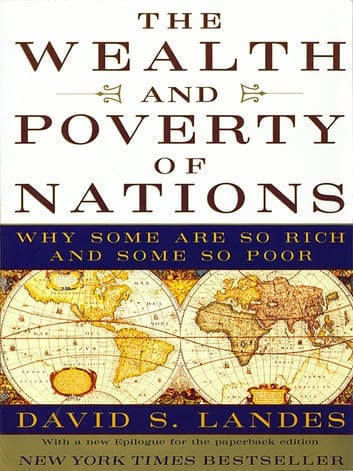
The Wealth and Poverty of Nations: Why Some Are So Rich and Some So Poor
David S. Landes
The Wealth and Poverty of Nations: Why Some Are So Rich and Some So Poor
David S. Landes
The Wealth and Poverty of Nations is David S. Landes’s acclaimed, best-selling exploration of one of the most contentious and hotly debated questions of our time: Why do some nations achieve economic success while others remain mired in poverty? The answer, as Landes definitively illustrates, is a complex interplay of cultural mores and historical circumstance. Rich with anecdotal evidence, piercing analysis, and a truly astonishing range of erudition, The Wealth and Poverty of Nations is a “picture of enormous sweep and brilliant insight” (Kenneth Arrow) as well as one of the most audaciously ambitious works of history in decades.
2. Hernando De Soto, The Mystery of Capital: Why Capitalism Triumphs in the West and Fails Everywhere Else. An excellent, insightful book about the need for people to have the right to own property and relatively easy access to obtain a publicly documented title to that property, in order for an economy to grow and people to overcome poverty.
3. William Easterly, The Elusive Quest for Growth. Easterly has also written The White Man’s Burden more recently, but I have not yet read it. He explains why aid to Africa has never really solved the problems of poverty in Africa.
4. P. T. Bauer, Equality, the Third World, and Economic Delusion. Bauer, who died in 2002, was emeritus professor of economics at London School of Economics and a specialist in development economics. He tells in detail why all the British aid to African countries over decades did more harm than good. It distorted local economies and entrenched corrupt governments in power, and had many other negative consequences.
5. Robert Guest, The Shackled Continent. Guest, Africa editor for The Economist, describes in vivid detail the barriers to economic development in Africa.
6. Brian Griffiths, The Creation of Wealth. Griffiths taught at London School of Economics and was adviser to Margaret Thatcher. Now in House of Lords, he gives principles for a Christian perspective on how economies grow.
7. Bjorn Lomborg, The Skeptical Environmentalist. Lomborg, a statistics professor from Denmark, shows that we are not running out of any natural resource, and we won’t run out in the future. But the world is short on knowledge of true facts about the state of natural resources.
8. Several writings of Julian Simon, especially The Resourceful Earth, The State of Humanity, and The Ultimate Resource II. Simon was a professor of business and economics in Maryland.
9. I plan to read Dambisa Moyo, Dead Aid: Why Aid Is Not Working and How There Is a Better Way for Africa. Moyo, a Zambia native, has an MA from Harvard and a Ph.D. in economics from Oxford. She was a consultant for the World Bank and then worked at Goldman Sachs. She argues that aid mostly entrenches corrupt African governments in power.
Here are some books on economic systems in general and the great flaws of socialism and government control:
10. Jay Richards, Money, Greed, and God: Why Capitalism Is the Solution and Not The Problem. This is now my top recommendation for people who want to understand economic systems from a Christian point of view.>
11. Arthur Brooks, The Battle: How the Fight Between Free Enterprise and Big Government Will Shape America’s Future. Brooks argues that what gives people genuine satisfaction in the economic realm is not to be given money but to achieve “earned success” the opportunity to have a responsibility (even if small) and to do well at it.
12. Friedrich Hayek, The Road to Serfdom. Hayek was Austrian who fled from Hitler. He became an economics professor at London School of Economics and watched with dismay as socialism grew in England. He explains how government control expands inch by inch until it takes over all of life. This all-time classic was written in 1944, with a 50th anniversary edition released in 2004.
13. Henry Hazlitt, Economics in One Lesson. Hazlitt was a long-time editor at The Wall Street Journal. First published in 1946, this book has become a classic. It is a wonderful book that explains how every action in the economy has more than one consequence. When we realize this we can understand better how an economy works.
Here are two books that I found unpersuasive (or wrong) in terms of explaining why nations become wealthy:
14. Jared Diamond, Guns, Germs, and Steel. I found Diamon’s argument unconvincing because it was completely materialistic and deterministic, from an entirely evolutionary perspective, allowing no role for human choice and decisions and initiative. He thinks physical geography determines everything!
15. Jeffrey Sachs, The End of Poverty. I was not convinced by Sachs, because I heard him saying that we have given X amount of money in the past but that has not solved the problem so the solution is that we need to give X + 1 or even 2X amount and that will solve the problem. Sachs is an economics professor but he also has another job advising the United Nations how to give such money away.