




The reading public loves war stories. This is no new development. Consider The History of the Pelopennesian War, written by the Athenian general Thucydides in 431 B.C. Wars change the course of entire civilizations. They are a matter of life and death, and not only for the soldiers who fight in them. No wonder they capture our interest and imagination.War stories also give us heroes and villains. We name schools, streets, and cities after the heroes. We dance in the streets upon the death of the villains. We curse them for decades, even centuries, after they wreaked destruction upon our friends, family, and other loved ones. War is personal.
John Woodbridge was only a child during World War II, growing up in the home of a Presbyterian pastor in Savannah, Georgia. He did no fighting, but the war was personal for him. He knew one of its heroes—Ira “Teen” Palm, an Army officer who helped lead the American push into Munich at the end of the war. And by the strange, sovereign work of God, his minister dad became the owner of a coveted artifact from the war’s greatest villain. Woodbridge, research professor of church history at Trinity Evangelical Divinity School, tells this fascinating story in Hitler in the Crosshairs: A GI’s Story of Courage and Faith, co-written with Pulitzer Prize-winning investigative journalist Maurice Possley.
Who? Why? Where? How?
Possley and Woodbridge write for several different, overlapping audiences. Palm’s story of redemption before the war will appeal to Christians as they learn about how the Lord saved him out of a self-centered lifestyle in North Carolina as an accomplished football player, saxophone player, and ballad singer. The strikingly handsome, variously gifted Palm is the star of the book. Woodbridge’s father, Charles, led Palm to the Lord, and the man who returned from Germany a war hero never stopped thanking him for it.
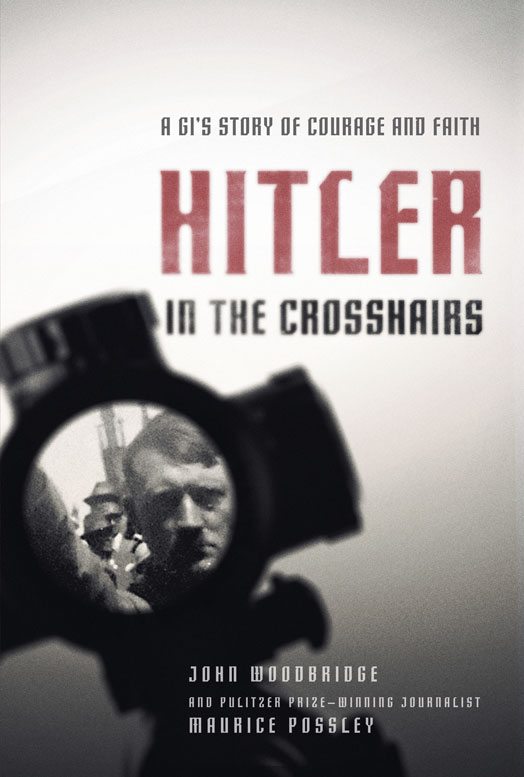
Hitler in the Crosshairs: A GI's Story of Courage and Faith
Maurice Possley and John Woodbridge
Hitler in the Crosshairs: A GI's Story of Courage and Faith
Maurice Possley and John Woodbridge
A Pulitzer Prize-winning journalist teams up with a university scholar in this compelling, untold historical tale of a young man’s courage at a critical time in United States history, and the saga of a dictator’s pistol that continues today. The time is World War II. Young soldier Ira “Teen” Palm and his men burst into a Munich apartment, hoping to capture Adolph Hitler. Instead, they find an empty apartment … and a golden gun. As the authors trace the story of the man and the gun, they examine a time and place that shaped men like Palm and transformed them into heroes. They also follow the strange journey of Hitler’s pistol.
Palm earned his way into military lore by participating in American efforts to find Adolf Hitler, whose exact whereabouts were unknown as the war neared its conclusion. While the Soviets closed in on Berlin, their American allies worried that Hitler might have fled south to lead a Nazi remnant and fight to the bitter end. We know Hitler did no such thing, opting instead to kill himself in a Berlin bunker. But Palm did not know this when he burst down the door to Hitler’s apartment in Munich. Palm did not find Hitler, of course, but he emerged with perhaps the most famous relic of the war: Hitler’s gold-plated pistol, a gift for his 50th birthday, marked by the dictator’s initials.
The pistol itself emerges as another star, broadening the book’s appeal to collectors, history buffs, and even fans of a good mystery. Palm thanked his friend and spiritual mentor Charles Woodbridge by sending him the pistol. The proud pastor showed off this historic find for his congregation while citing Palm’s example as a courageous man transformed by the gospel of Jesus Christ. That’s where the mystery kicks in. No Woodbridge owns the pistol today, because in 1947, someone burst into the family’s home in Savannah, ransacked it, and stole the infamous weapon. So who took it? Why? Where is it today? How much is it worth? Possley puts his journalistic skills to work seeking to answer these questions and many others.
Always Inspired
So this is a book about Teen Palm’s Christian faith, which sustained him through the travails of war as friends fell before him. This is a book about Hitler’s pistol, its discovery, theft, and present-day whereabouts. But the authors seek to do much more. They juxtapose Palm’s life, recounted primarily through letters sent to and received from his affectionate wife, with Hitler’s chilling rise to power in Germany. The contrast illustrates how hundreds of thousands of citizen soldiers helped bring down one of history’s most notorious mass murderers.
Possley and Woodbridge also set Palm’s Munich mission in the context of German uprisings against Hitler. As the Americans approached Munich, concerned citizens and soldiers conspired to compel surrender from the Nazis and spare the city from the destructive Allied onslaught. One German officer, Rupprecht Gerngross, had Hitler in the crosshairs—literally—in January 1944 as he visited friends in Munich. But the sudden appearance of a young girl led him to abort the assassination attempt. This officer later led an uprising in Munich that briefly wrested control of the city from the Nazis.
As you can surmise from this summary, there’s a lot going on in Hitler in the Crosshairs. The context gives readers a feel for this almost incomprehensibly complex time in world history. Palm is a bit player on the global stage, but without courageous, confident, and convicted men like him, the Allied cause could not have succeeded. Yet Possley and Woodbrige also remind us with stories from Germany that not all of Hitler’s countrymen supported him. War brought out the worst in this evil madman, causing untold death and destruction. But it also brought out the best in Palm, Gerngross, and countless others.This book helps readers remember that heroes and villains don’t neatly fit within our respective national borders. The authors make this point implicitly as they describe Palm’s preparations for a possible war with the Soviet Union following Hitler’s death. Indeed, Colonel Palm later distinguished himself further in 1961 by defying Soviet threats and leading a convoy of replacement troops into West Berlin. Yesterday’s allies had become today’s enemies.
Should the Lord tarry another 50 years, I suspect we’ll still be reading stories from World War II. The villains will bring us to tears as we plead for God’s mercy to spare us from such wrath. And we’ll discover new heroes like Teen Palm, previously forgotten to history by all but their families. Their example of trusting God for the strength to persevere against long odds will always inspire us.