




It used to be that men and women were expected to follow a particular pattern towards maturity and adulthood. Boy gets a job and makes a living. Boy meets girl. Boy falls in love with her and marries her. Boy and girl make babies and raise a family, with boy being the primary provider of this family. And then there came the “pre-adult.” Now the rules have changed. Actually, there are no rules at all anymore. Everything is acceptable. Anything goes. But with this new demographic of “already, but not yet” adults comes a whole new set of challenges. This new phenomenon of emerging adults is what Kay Hymowitz seeks to unpack in her book Manning Up: How the Rise of Women Has Turned Men Into Boys.
The main thrust of her book is that the advance of a female-friendly economy has caused a significant change in how men and women behave towards each other-more specifically, how men don’t behave at all. The second wave of feminism caused a seismic shift in the way women relate to the home and work. In the last 30 years droves of women have gone back into the workforce, and in the last 20 years have made significant strides in establishing their place in the marketplace.
The shifts in the home and workplace have shaped 20-somethings attempting to make their mark in today’s society. This is where the “pre-adult” comes in. The pre-adult is a step above the adolescent. Pre-adults are usually in their 20s, building a career, and most notably, not married. Hymowitz says “think of pre-adulthood as a profound expression of American individualism, acutely infected by the knowledge economy. It formalizes a stage of life dedicated entirely to autonomous self-expression” (181).
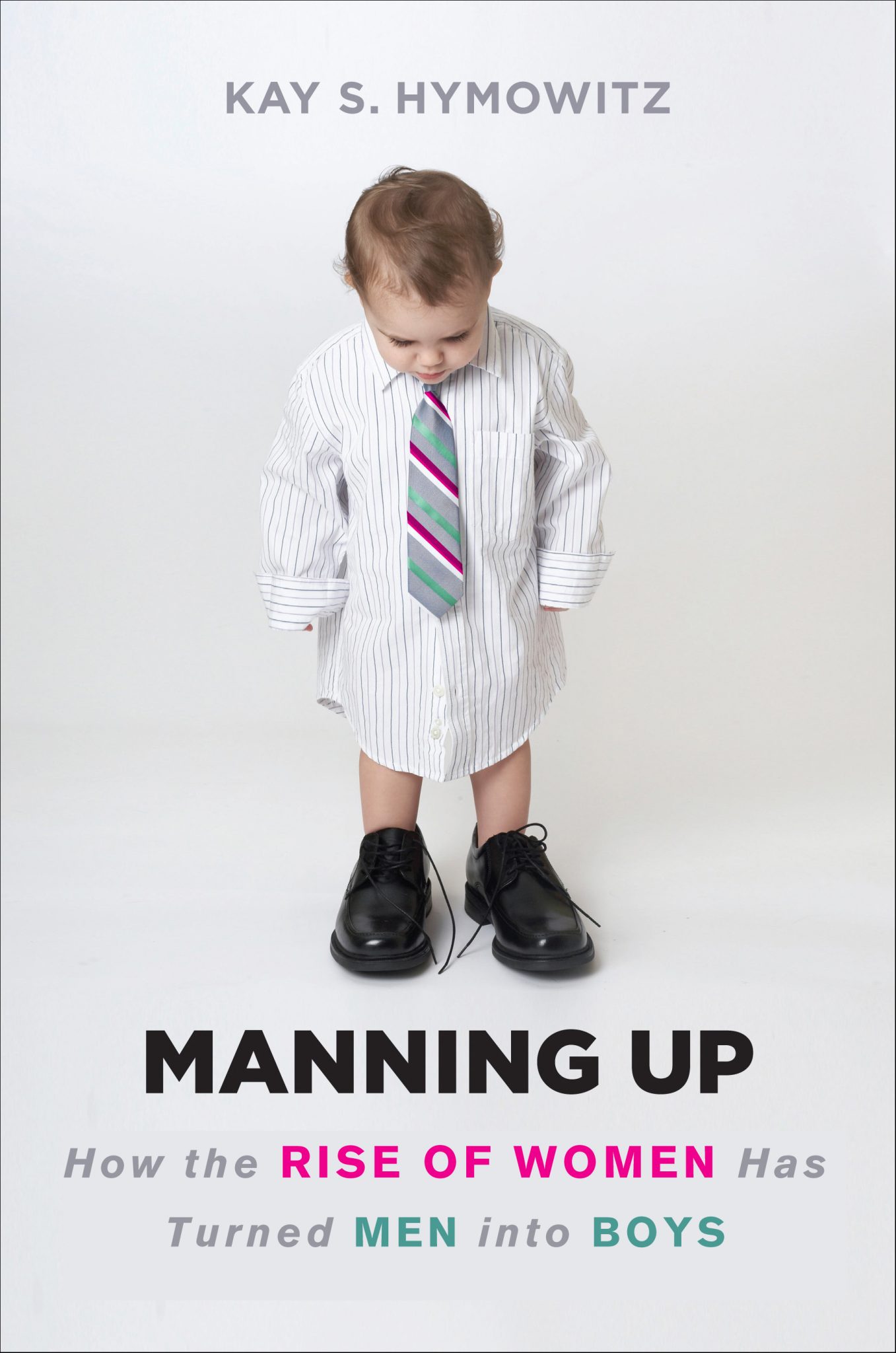
Manning Up: How the Rise of Women Has Turned Men Into Boys
Kay S. Hymowitz
In Manning Up, Manhattan Institute fellow and City Journal contributing editor Kay Hymowitz argues that the gains of the feminist revolution have had a dramatic, unanticipated effect on the current generation of young men. Traditional roles of family man and provider have been turned upside down as “pre-adult” men, stuck between adolescence and “real” adulthood, find themselves lost in a world where women make more money, are more educated, and are less likely to want to settle down and build a family. Their old scripts are gone, and young men find themselves adrift. Unlike women, they have no biological clock telling them it’s time to grow up. Hymowitz argues that it’s time for these young men to “man up.”
According to Hymowitz, making it in today’s world means more education. The vast majority of the job market requires a knowledge base resulting in increased educational needs (26). In addition, the gender most likely to be educated tends to be women, only furthering the assertion that this knowledge economy is a detriment to the growth and maturity of the male population (27). Gone are the days where marriage and family were the pinnacle of the college graduate’s life. Those are hindrances to the ever-present need to make it in the world (45).
Hymowitz offers an indicting assessment on the culture that the Millenials are living in. She asserts that while pre-adult women are making great gains in their careers, their fertility isn’t put on hold while they work to get the corner office. Feminism promised women that they could have it all, but their biological clocks are telling them otherwise. Hymowitz sees two problems with finding a solution. One is that many men have spent their entire pre-adulthood goofing off and using women, thus making them unprepared candidates for husbands and fathers. The men who are left are slim pickings. The other is that women have spent their pre-adulthood with the same level of sexual promiscuity as men. Basically, there is no incentive to work for them anymore.
After describing this portrait of pre-adults, she explains their dating practices. This is where she hits her stride. While the pre-adult might like to think that his decisions are strictly autonomous, Hymowitz argues that this new order of male and female behavior affects our society for the worse. Women are now reaching their 30s and 40s realizing that there are few men left to marry, so they embark on motherhood alone (182). She says that “choice motherhood” has tremendous implications for the men in our society, stating:
too many young men resist responsible, considered adulthood. Women give up on them and go it alone. As the single mother becomes a new (almost) normal, the cultural environment becomes increasingly indifferent to a guy in the house. The result? With nobody expecting anything of them, men get worse (186).
This assessment is the greatest strength of the book, the thread that ties it all together. Hymowitz looks out at Millenials and exposes a worrisome trend. But that is where she leaves it. Apart from her plea for young men to grow up and man up she fails to provide any lasting solutions for the troubling predicament of child-men and the women who coddle them. This is where the church must step in.
While this book is secular in its approach, she does offer a glimpse into the sea that our church members our swimming in. We cannot pretend that these realities don’t apply to us, or our church bodies. The Bible teaches that God has designed men and women uniquely different yet equal. The role of provider and protector is a good thing for a man to aspire to, not because it is a cultural construct of a generation gone by, but because by fulfilling his God-created role he is reflecting the image of his creator. The same goes for women. Pastors and women’s ministry leaders should read this book to gain a better perspective on the culture and the rising generation of adults. But only Christ-following Christians can fully know the solution to this problem.
As a word of caution, Hymowitz occasionally references colorful language spoken by the subjects she has studied. This is minimal, but you should be aware of it. Overall, the book is worth the time to understand the growing problem of female domination and male aloofness.
Hymowitz presents a chaotic world, one where men and women live without any rules. But she also presents a deep longing that cannot be ignored. Men and women were not created to be autonomous, self-seeking creatures. She gets that men and women are deeply social in nature and cannot live an individualistic life for long (187). And while she presents a Darwinian and self-help approach to remedying this situation, Christians know there is a greater story here. Yes, God created us for relationships here on this earth, but they are not ultimate. They point to something greater, namely the blood-bought relationship of Christ and his church. Without this truth being heralded from godly Christians across our cities the problem will remain. The people reflected in this book need an answer that is far greater than getting a second master’s degree or even settling down and having a baby. They need Jesus. Only then will the child-men around us man up.