




Let me begin with some self-disclosure. I don’t like books on evangelism. I find most of them to be profoundly unhelpful. Some of them are simply bad books. Some are little more than a series of anecdotes strung together. Worse, some of them, while heavy on methodology, (astonishingly!) get the Gospel wrong. Still others heap an enormous amount of guilt upon the unsuspecting reader.
There are some notable exceptions of course. The outstanding Evangelism and the Sovereignty of God by J. I. Packer opened my eyes to the relationship between the providence of God and the witness of his people. Bruce Metzger’s Tell the Truth drove a stake through the heart of my previously man-centered notions of evangelism. Both of these books ought to be on every Christian’s shelf.
I am pleased to say that there is another volume to add to that short list. Marks of the Messenger: Knowing, Living, and Speaking The Gospel by J. Mack Stiles just may become my new “go-to” book for evangelism. It may be that this book is helpful precisely because its author has for years integrated his profession with a strong sense of responsibility to advance the Gospel. Currently, Stiles lives in the United Arab Emirates where he serves as CEO of Gulf Digital Solutions and is general secretary for the Fellowship of Christian UAE students (FOCUS).
The goal of Marks of the Messenger is to make the reader a better evangelist. I suppose that is the target toward which all books on evangelism aim. But through biblical fidelity and shear simplicity I think Stiles’s book may actually accomplish this for many. Nowhere does one get the idea that Stiles is some sort of superhuman witnessing machine. This is helpful for those of us who are quite sure we do not possess a “gift” for evangelism but nevertheless desire to be better witnesses.
Stiles instructs through clear exposition of Scripture and his own experiences as a man seeking to advance the Gospel. He begins by asking “Who does Jesus want us to be?” By beginning with this question Stiles does not allow us to make an end run around some important matters. “It’s too easy to jump from wanting to be more like Jesus to ‘What Would Jesus Do.’ Before we jump, we should make sure we understand who Jesus would have us be . . . [To] act without a biblical understanding of who Jesus wants us to be in evangelism produces unhealthy evangelists” (17).
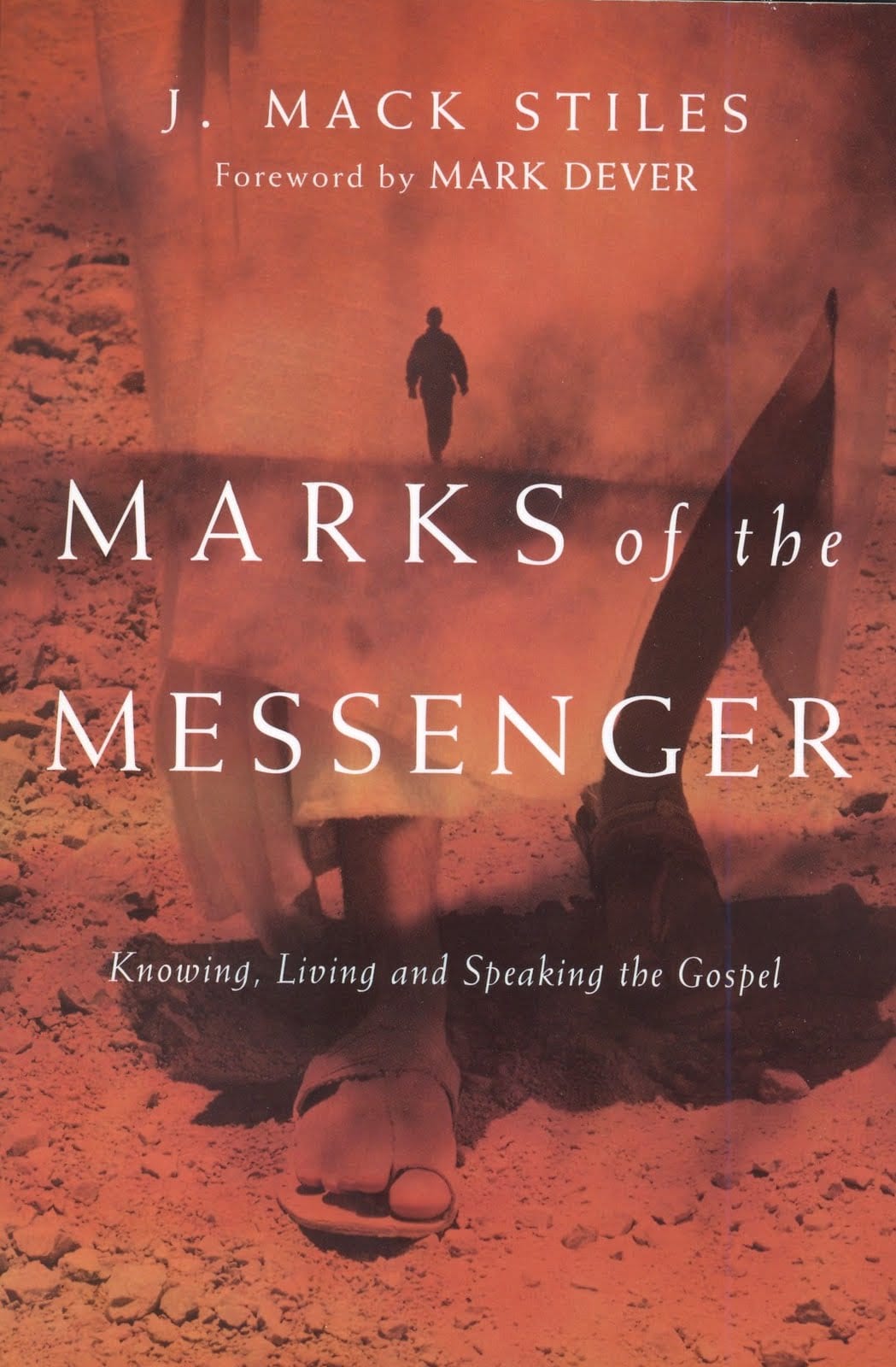
Marks of the Messenger: Knowing, Living, and Speaking The Gospel
J. Mack Stiles
Marks of the Messenger: Knowing, Living, and Speaking The Gospel
J. Mack Stiles
Many think evangelism is rooted in a method. It is rooted in something much deeper. It is found in what makes us whole and healthy messengers of God’s truth about Jesus. Mack Stiles has lived the life of the healthy evangelist in homes and coffee shops, at universities and farms. He has lived out and spoken about the gospel to Kenyans, Koreans, Arabs and North Americans. What he has learned around the world and at home is summarized here in a few basic truths that can shape any of us into faithful people who bring good news to needy and hurting friends.
Stiles’s goal, thankfully, is not to give us yet another “fresh approach” to evangelism. In fact, for one looking for that new method which will finally make him a good witness, this is not your book. And I write that as a way of commending Marks of the Messenger. The title alone should be an indication that what Stiles is targeting is not our methods but us.
The book begins in precisely the right place—the Gospel itself. In chapter one Stiles warns against pragmatism which he calls the greatest obstacle to effective evangelism. He calls pragmatic approaches to evangelism “the business of evangelism.” “When evangelism is untethered to who we are meant to be as people of faith, evangelistic practice eventually becomes twisted and deformed” (20). Chapters two and three focus on the content of the evangel. Stiles warns against the all too common danger of “assuming the gospel.”
In chapters four and five the implications of the Gospel are addressed. This is helpful because of the tendency among Christians to collapse what the Gospel produces into what the Gospel is. Only after clearly establishing what the Gospel is does Stiles turn his attention to what the Gospel produces. He addresses the fruit of the Gospel in our own lives as well as those implications for broader societal impact. Imagine! A book on evangelism which actually makes the evangel the center-piece.
Chapter six deals with the biblical understanding of conversion. Growing up in a large evangelical church I cannot ever recall being taught anything about conversion other than “pray the prayer and you shall be saved.” Certainly, I am oversimplifying but you get the picture. Any good training in evangelism must pay careful attention to what God does in conversion, for He is the most important Actor in the process.
Chapters seven through ten focus on taking action. What do we do about the inevitable fear that most Christians face when witnessing (7)? How do we confront and correct worldly notions of God’s love (8)? How does love among God’s people (the church) produce healthy evangelists (9)? Finally, Stiles offers “a Manifesto for Healthy Evangelism” (10).
Marks of the Messenger will be helpful for any Christian who desires to be a more faithful witness for Christ. I would recommend it for small groups even though there are no discussion questions. A good leader will have no problem designing a fruitful discussion from the pages of this excellent book.