



With the release of John Piper’s Bloodlines, the evangelical world is once again grappling with the issues of race, our past, and the gospel. But how does the conversation change when the inequities don’t match the paradigm we have come to know? What happens when the injustice and violence shifts a continent away and racial roles are reversed?
Ben Freeth explores these very issues in the recently released Mugabe and the White African, which chronicles his own family’s struggle against the race-inspired violence that has been the reality of the white farming community in rural Zimbabwe for the past decade. Their story was first explored in the 2009 award-winning documentary also titled Mugabe and the White African, which can be currently viewed on POV. Freeth’s companion book delves more deeply into the unseen realities and the spiritual dilemmas that confront Christians living under oppression; in this way it is reminiscent of F. Kefa Sempangi’s A Distant Grief.
Under Robert Mugabe, Zimbabwe has become a land spiraling out of control with violence, greed, and widespread deprivation. This is partly due to a series of “land reforms” that violently strip whites of their land and hand it to blacks with connections to the ruling ZANU-PF party. One of the farmers affected was Freeth’s father in law, Mike Campbell, who had legally owned Mt. Carmel farm in rural Chegutu for nearly 30 years and developed it into a corporation that sustained nearly 500 workers. But in 2000, militants began invading rural districts, beating, terrorizing, even killing those who resisted; farms were left in ruins, machinery stripped, irrigation systems destroyed, and crops and livestock plundered. All while local police did nothing.
Faith That Stands
In this context, many wanted to compromise, to negotiate bribes, to appease the brutality, or to simply leave altogether. But Campbell and Freeth’s Christianity compelled them to stand against the illegal seizures and to do so in a way consistent with the gospel. In a letter to fellow farmers, Freeth said this:
Jesus Christ did not come, as many believe, to bring tolerance and a wishy-washy creed. He preached love but he also preached judgment. He preached forgiveness; but he also preached repentance… Christ’s mission was one of truth, and the truth very often brings persecution and even death. . . . But Christ didn’t take up the sword—the sword was used against him, because he spoke the truth with authority. He did not retaliate with the sword, but with more truth, in love (102).
In an effort to seek truth, they eventually took their case to international court in Namibia (the Southern African Development Community Tribunal). As the trial dragged on, tensions escalated back in Chegutu. Their fundamental values were severely tested in 2008 when Freeth, his father in law, and mother in law themselves were abducted, tortured, and left for dead. Freeth recounts:
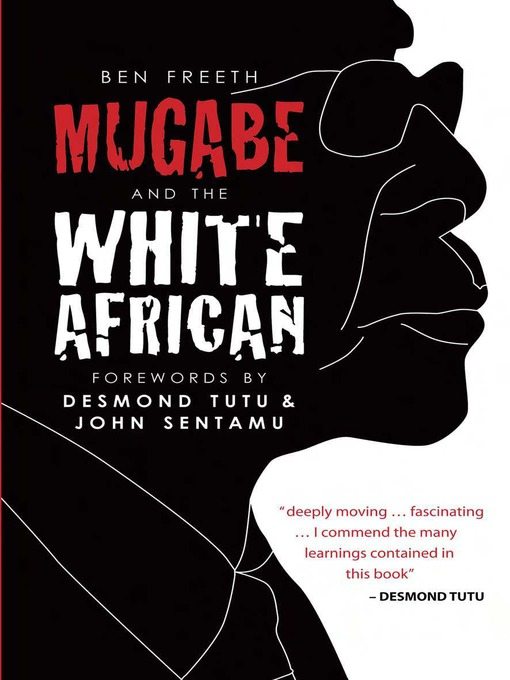
Mugabe and the White African
Ben Freeth
An intimate account of one family’s astonishing bravery in the face of brutality, as well as perhaps the outside world’s only real glimpse of what it is like to live inside the terror of Mugabe’s Zimbabwe, Ben Freeth has an extraordinary story to tell. Like that of many white farmers, his family’s land was “reclaimed” by Mugabe’s government for redistribution—but Ben’s family fought back.
The hardest words Jesus ever said were, “Love your enemies.” I knew it was right, but I’d found it impossible to love the people who were doing these things to us. . . . When they left off their beating, and as I was lying in the dust again, it was almost as though those words of Jesus from the Sermon on the Mount hit me physically, “Love your enemies,” and “Bless those who curse you.” Suddenly I felt a love for the people who were doing these things. . . . This wasn’t natural—it had to be supernatural. In my physical capacity I felt totally free. . . . I knew that they were lost souls needing love and the forgiveness that only Jesus can bring when people repent (197–198).
For Freeth these were more than just words; the book is full of mindboggling accounts of evangelizing their oppressors. In one incident, when he happened to be on the same flight as Mugabe, Freeth convinced an attendant to deliver a handwritten note and gospel literature to the leader’s private cabin. He also knew enough to make a hasty exit when the plane landed.
Larger Commentary
Freeth’s style is an unusual mix of fact telling and prophetic sensibility. Just when the narrative seems bogged down by legal and historical detail, it is unexpectedly, almost surreally, interrupted by tales of abject brutality and miraculous rescue. While it may not make for the smoothest read, this approach recreates the bizarre reality that the Campbells and Freeths endured. For years, they struggled through a drawn-out legal process at the same time that the very rule of law around them had disintegrated, leaving their home and young children in danger. In this sense, the reader can no more escape the cycle of absurdity than they could.
The frustrating irony about Mugabe and the White African is that those most likely to pick it up—secular intellectuals familiar with the film or Zimbabwe’s troubles—are also the most likely to dismiss it outright because of Freeth’s unapologetic Christian worldview. Already in the UK, despite wide approval for his work on behalf of human rights, Freeth has been challenged for being a “missionary” of sorts. The Christian community, on the other hand, is in very real danger of overlooking the book altogether because the subject matter is too foreign, too unfamiliar, and too political for our liking.
But in reality, Mugabe and the White African is not simply about Zimbabwe or even the white African plight. It is the story of good and evil, of fear and faith, played out in living color. And Freeth is at his strongest when he is drawing conclusions about that tension. In this sense, it is a commentary on the nature of oppressors, human frailty, and God’s divine order.
The Rest of the Story
Still, Freeth did write the book to publicize the very real atrocities occurring in Zimbabwe. And despite the SADC tribunal ultimately ruling in their favor, Mt. Carmel farm was confiscated. The Freeth and Campbell homes burned to the ground in 2009. In April of this year, Mike Campbell passed away from injuries sustained during his abduction.
Today Freeth and his wife, Laura, live in the capital city of Harare and continue to work among displaced farm workers who Freeth says “haven’t got a voice or any real power to help themselves.” They’ve established the Mike Campbell Foundation, and recently Freeth was awarded an MBE for his work on behalf of the farming community in Zimbabwe.
Ultimately while it may not be the kind of book we enjoy reading, Mugabe and the White African is precisely the kind of book we must read. It is the kind that pushes us past our native provincialism to unite us with our distant brothers; and it is the kind that reminds us that the call of the gospel is more robust, more multi-layered, and more dangerous than we ever could have imagined.