

In the last decade, there has been a major revolution in the way we think about poverty. The shallow, materialistic assumption that the best way to help people is to throw money at them indiscriminately is giving way to serious thought about what really makes a difference. One important insight has been the importance of economic systems. The Poverty of Nations: A Sustainable Solution by Wayne Grudem and Barry Asmus performs an important service by distilling key insights about how dysfunctional economic systems force people to live in poverty, while good ones provide the tools people need to make a better life for themselves.
Christians should sit up and take notice of these issues. Poverty has always been a central concern of God’s people. In the Old Testament, the Mosaic laws and the prophets deal extensively with justice and flourishing in the economic sphere of life—for everyone, but with particular attention to the poor and marginalized. In the New Testament, Jesus and the apostles tell us over and over again to identify with those in need and take action to help them flourish. The church is not being the church if it is not highly mobilized in favor of the poor.
And in fact, Christians are sitting up and taking notice of these issues. More and more voices—from a variety of cultures, theological traditions, and even political persuasions—are coming together around a conviction that the way we serve the poor is often more harmful than helpful. The Holy Spirit is once again moving the church to be the church by leading Christians to stand against degrading systems of paternalism, dependency, and cronyism in our churches and public programs.
Humans are made to be stewards and co-creators with God through productive work. This is all over the Bible from literally the beginning to the end: Humanity was created to cultivate this world through work (Gen. 1:28, 2:15); in the next world, all the peoples of the earth will bring the fruits of their work into the New Jerusalem for blessing (Rev. 21:24). Every human being is made to be a steward. That’s why economic systems that don’t give people stewardship over their own work, households, and property are so fiercely condemned by the prophets and apostles alike. They rob us of our human dignity and encourage greed, sloth, consumerism, self-indulgence, sexual immorality, and almost every other kind of sin.
Important Insight
Although written by a theologian and an economist, The Poverty of Nations contributes mostly on the policy side. The authors express a desire to keep their argument open to non-Christian as well as Christian audiences, and biblical engagement occurs regularly but is not the primary focus. There’s nothing wrong with this approach, but readers seeking a focus on Scripture should be aware of it. They could consult books like Grudem’s Business for the Glory of God, David Baker’s Tight Fists or Open Hands?, John Schneider’s The Good of Affluence, or the Stewardship Study Bible.
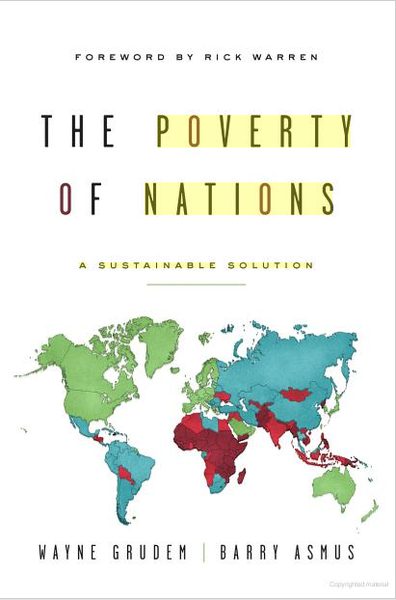
The Poverty of Nations: A Sustainable Solution.
Wayne Grudem and Barry Asmus
The Poverty of Nations: A Sustainable Solution.
Wayne Grudem and Barry Asmus
Readers who want to know about contemporary economic policy, however, will find a wealth of important insight in The Poverty of Nations. Grudem and Asmus have gathered a wide variety of critical lessons about what is beneficial and what is harmful when it comes to the economy. And their presentation is systematic and thorough but also highly accessible and engaging. For example, here is how they describe God’s plans to bless his people with wealth in the holy land:
The Israelites would have to harvest the wheat and the barley; they would have to tend and pick the vines and the fig trees; they would have to bake the bread; and they would have to dig copper out of the ground to make tools and implements. God’s blessing came through productive work that created new goods and services. It did not come by dependence on donations. . . . Even the poor people in Israel were not to become dependent on donations from others, for they had to work to gather their food from the “gleanings” that were left in the fields after the first harvesting (see Deut. 24:19-22). (72-73)
Step by step, Grudem and Asmus walk the reader through a litany of approaches that have not worked, ranging from long-term dependence on foreign aid and domestic welfare-state programs to socialist economic management to the romantic primitivism that idolizes traditional agriculture. Then they explain how the modern economy functions and what policies, conditions, and cultural values contribute to flourishing within that system. When markets are free from injustice, cronyism, and other forms of arbitrary interference, people can use them to create economic value for one another through productive work and efficient exchange. The authors get all the major policy issues right; if you just got elected to public office and you’re looking for an economic agenda, this is the one to use.
Freedom to Serve
One important feature of The Poverty of Nations is the authors’ acknowledgment that government systems alone are not enough. People absolutely need to be given the freedom to serve one another with their work and to create value through exchange, but that doesn’t mean they actually will do so. Economies can’t succeed unless they are grounded in a culture that prioritizes service to others and wise, long-term stewardship of resources over short-term indulgence and the gratification of selfish desires.
This issue actually points to the most important limitation of the book. While the authors acknowledge that virtue and culture are indispensable, they devote relatively little space to them. There is nothing wrong with writing a book about policy, of course; I’ve done the same myself. And economic policy is part of the culture, not separate from it. But precisely for that reason, getting the culture at large right is more important than getting policy right. A nation of irresponsible people will always reject the economic freedom that Grudem and Asmus are calling them to.
Because policy is cultural, more attention to the primacy of culture would also have strengthened the book’s approach to policy. The authors are clear that moral concerns trump economic factors, but they tend to define the economic factors in materialistic terms. For example, they often speak as if growth in monetary value constitutes economic success; it would be better to define success in terms of people being in right relationship with themselves, their neighbors, their property, and their world. Grudem and Asmus themselves cite examples of nations that destroyed their economies by defining success in terms of maximizing monetary gain, such as late medieval Spain and the British mercantilists; contemporary America is well on its way to becoming yet another such example.
The authors also presuppose an overly individualistic anthropology in which all economic action can be reduced to the choices of individuals. But before you can choose to create a business you must have an idea of what a “business” is, and that idea will be culturally contingent rather than something you’re free to make up for yourself. And if the world is ordered by God, what constitutes a business will be metaphysically contingent as well as culturally contingent—some approaches will cut against the grain of the unseen structure of reality and fall apart. The same goes for governments, families, churches, and other institutions; we must have an account of them in their own right before they can be objects of individual choice. The tendency to define economic action only in terms of individuals, like the tendency to define success only in terms of money, is a major cause of the moral decay that undermines public support for the very policies Grudem and Asmus prefer.
The Poverty of Nations devotes an entire chapter to arguing that government must serve the people rather than the interests of the politicians. That’s a critically important point, but government will not serve us rather than us serving it unless we have a strong sense that our culture has a coherent set of shared values and practices to which the government is subordinate. A relentless focus on policy, money, and individual choices makes it difficult to sustain this sense that our culture has integrity and coherence apart from political power; it increases the plausibility of the assertion that it is really the government that holds us all together.
None of this critique detracts from the success of The Poverty of Nations as a systematic summary of the economic policies that are necessary to give the poor freedom to flourish. When people are in dire short-term distress we can rescue them, but long-term economic functioning is something that cannot be handed to people. It comes from individuals, households, businesses, and communities taking initiative and working together to serve one another through productive work and free exchange, in a context of property rights and other basic protections against injustice. Everyone is made in God’s image, so everyone is a steward with something to contribute; that is why there is hope for the poor in all nations.