




If you knew what the President of the United States looked to for spiritual sustenance and guidance, would it influence your own reading list? If it were possible to read the same devotional literature President Obama reads each day, would you make it a priority to get your hands on it, too?
Judging from the popularity of Joshua DuBois’s new work, The President’s Devotional: The Daily Readings that Inspired President Obama, the answer to these questions for many readers is a resounding yes.
What Does the President Read?
What’s now a bound and published collection of 365 mediations began as a simple e-mail of spiritual encouragement from DuBois to his employer—then Senator Obama—while the 2008 presidential campaign was in full swing. Although DuBois only planned to send these e-mails on an occasional basis, his initial note and brief devotional were well received, and the senator expressed he’d like the messages to continue. “So every day, from that point on,” DuBois recounts, “I offered him a quote, prayer, or interpretation of Scripture to start his day.”
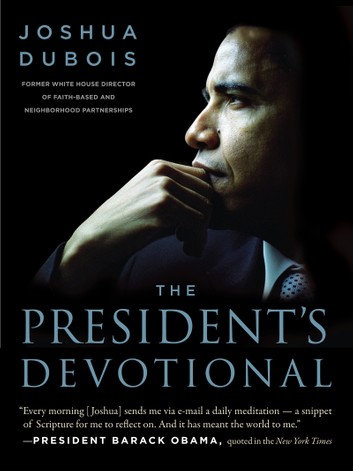
The President’s Devotional: The Daily Readings that Inspired President Obama
Joshua DuBois
The President’s Devotional: The Daily Readings that Inspired President Obama
Joshua DuBois
Even after four years, the President apparently continues to read these e-mails. Indeed, at this year’s National Prayer Breakfast in February, President Obama spoke specifically about DuBois’s practice of sending daily devotional thoughts to his inbox. “Every morning he sends he via e-mail a daily meditation—a snippet of Scripture for me to reflect on. And it has meant the world to me.” It’s no surprise, then, that a compilation of a year’s worth of readings fit for a President would reap considerable popularity among American readers.
Structure and Layout
The President’s Devotional mediations begin on January 1 and end on December 31. At the top of each day’s entry is a passage or single verse from the Bible and a related quote from a renowned author or historical figure. DuBois adds a few brief thoughts to underscore and illustrate the general truths contained in the quotes, then concludes the meditation with a short prayer. He occasionally departs from this format by offering only a brief prayer after the day’s quotes; in a few cases he just supplies the biblical passage and closes with a simple “Amen.” A few entries, moreover, are just DuBois’s prayers. While there’s some variation in length, only a few of the meditations go beyond a single page.
Unique to this devotional, however, are the two- to three-page introductions to each month in which DuBois relays stories of his time working with President Obama. Here we are given brief, interesting glimpses into the life of the President as he comforts victims after a national tragedy or visits an aging evangelist. We also learn a little of DuBois’s personal interactions with President Obama, even reading of a time when he disagreed with him on an important piece of legislation.
Reader Left Hungry
Unfortunately, these sections of personal narrative are the book’s primary strength. When it comes to the actual entries, the reader is left with little more than moral truisms and vague exhortations to pursue common virtues, despite DuBois’s claim that the meditations “have always been Christian at their core, and their ultimate subject is Christ.” This weakness shouldn’t be attributed to the book’s genre. To this day I’m still affected by specific principles gleaned from John Piper’s A Godward Life—a book of daily scriptural reflections read aloud to us each day by our team leader in New Zealand some 13 years ago. I also recognize the value in furnishing substantive yet easily accessible books to help busy Christians cultivate the regular practice of thoughtfully reading their Bibles and beginning each day with God. Young believers whose spiritual health can be stunted by gorging on technical theology are well served by biblically saturated yet manageable daily meditations. Devotional books have their place in Christian discipleship.
My concern, then, doesn’t lie with DuBois’s desire to provide the President (and now a wider readership) with daily ruminations on Christian truth. He should be commended for his courage and desire to place God’s Word before the eyes of the President each and every day. But I fear DuBois’s overall use of Scripture in these meditations encourages an approach to the Bible that, in the long run, could be more harmful than beneficial. By wresting passages out of their context, DuBois inadvertedly teaches his readers to handle Scripture uncarefully. Meanwhile, the reader’s pursuit of the virtues extolled in The President’s Devotional is subtly detached from the gospel and life-sustaining doctrine, as the Bible is treated as little more than a moral guidebook.
Poorly Handled and Lightly Applied
Even so there is some profit in the book. Some entries will surely pierce through apathy and spiritual indifference (e.g., April 1; June 1; June 15; July 28; Aug. 21; Oct. 11). For example, while reflecting on the life of Saul, DuBois observes, “Sometimes we vacillate between indulgence and grand sacrifice when all God really wants is obedience.” This is a keen and valuable insight. Regrettably, though, these occasional flickers are more the exception than the rule.
Most entries either take biblical passages out of context or fail to reckon with the real implications of a given text (e.g., Feb. 24; March 24; April 6, 8, 14, 20, 25, 30; May 17; July 18; Nov. 9). Several lift moral exhortations from the day’s passage without taking into account the significance of the Bible’s redemptive storyline (e.g., March 30; April 6, 30; May 11, 12, 19; June 26; July 19, 31; Aug. 9; Sept. 13; Sept. 16; Nov. 11). Often, Scripture is treated superficially (e.g., April 4; May 9, 10; June 11; July 16; July 26; Aug 20; Oct. 3, 6, 7, 12, 28; Nov. 8, 29) or not at all (July 12, 13; Oct. 15, 21), and the application usually comes in the form of ethical platitudes (e.g., March 12; June 12, 16, 25; June 28; Oct. 27).
Many other entries are founded on hermeneutical mistakes. In one instance, DeBois portrays Balaam as a “man totally immersed in the Spirit of God,” and one whom Christians should seek to emulate. “Let our prayer today,” DeBois exhorts, “be to be like Balaam. To constantly seek and receive the things of God, but to be attuned to the life around us as well” (Dec. 27). This is an astonishing statement, for if there’s anyone in the Old Testament who should not serve as our example, it’s Balaam. The story of this pagan prophet shows us that God can use even those who oppose him to accomplish his purposes. Even more frightening is the implication that a man can speak accurately the word of God yet still be at odds with his Creator. Calling Christians to imitate Balaam misreads the immediate story and fails to inquire of the broader whole-Bible context (see Deut. 23:4–5; 2 Pet. 2:15–16; Rev. 2:14).
Looking for Something More
Despite its many glowing endorsements and generally positive reception, I’m afraid this book ends up trivializing the Bible and the labor required to understand it. The President’s Devotional gives readers the impression there’s no essential need to understand passages in their appropriate contexts, to draw out principles faithful to the larger structure of biblical revelation, or to grasp how faith in divine promises motivates and empowers obedience to divine commands. Generally speaking, the Bible is treated as a compendium of moral truisms, religious clichés, and inspiring stories of courage and virtue.
If you’re in the market for spiritually nourishing, biblically faithful, theologically grounded devotional literature, I’d recommend resources that may come with less fanfare but that will feed your soul with rich and profound insight from God’s Word. For daily readings, consider Piper’s A Godward Life (or A Godward Life, Book 2), Don Carson’s For the Love of God (vols. 1-2), or Nancy Guthrie’s Discovering Jesus in the Old Testament. For help in prayer, pick up The Valley of Vision. If we’re going to walk with God with right conviction and deep feeling, we need the truths of Scripture carefully explained and applied. We cannot settle for anything less, no matter what the President is reading.