


I sat in my living room watching a rerun of Law and Order when a commercial for the Reverend Peter Popoff’s miracle spring water flashed across the screen.
A used-car-salesman announcer gushed, “God’s will has always been for us to be in health and to prosper, and he’s using the miracle spring water to do just that.” Another shot showed a woman jumping toward the air as hundreds of dollars rained down on her.
“God is a god of more!” the announcer shouted.
The Reverend Peter Popoff’s water pilfered people’s pockets. My friend—a self-proclaimed atheist—watched the commercial with me and noticed my disgust. He leaned forward and grinned. “What’s the matter? Don’t you believe in miracles?”
Trials That Tempt Us to Doubt
I wasn’t prepared to discuss prosperity-gospel semantics with an atheist, so I opted for what I thought would be common ground with my friend: “Miracles like that just don’t happen, miracle water or no miracle water.”
Scammers aside, I had to wonder. Do I really believe in miracles? Even more “legit” ones?
When my husband lay critically ill after open-heart surgery, more than one friend grabbed my hand and said, “We’re praying for a miracle.” I’d thank them, but I secretly never entertained the notion Jim would survive. And he didn’t.
Did I believe in miracles? Watching your husband die in front of you, or enduring any suffering, can quell even the most earnest childlike faith.
Recently I picked up a copy of Mike Cosper’s Recapturing the Wonder: Transcendent Faith in a Disenchanted World [interview] and read the back cover: “There is still magic in the world.”
We’ll see about that, Mike.
Ancient Topic, Fresh Approach
I often skip book introductions, but Cosper—executive director of Harbor Media and host of the Cultivated podcast—rewards those who read his. Within the first few paragraphs, Cosper’s theology and master-storytelling kept me turning pages:
I set out to write a book about spiritual disciplines—practices like Scripture reading and prayer and fasting—and found myself in the midst of a fight I was unprepared for. . . . I didn’t know how much I’d have to reckon with a world that conditions us for doubt. (1–2)
A book with wonder in its title turns out to be about spiritual disciplines. And the struggle to maintain spiritual disciplines is somehow linked to our doubts and disillusionment? Cosper officially hooked my interest.
Cosper unpacks the challenge of translating what we’ve been taught—including the most instructive and applicable theology into our daily routine of living, the doing. We can speak well of both theology and actions in great detail with many specific applications, yes, but what does living it out daily and seamlessly look like?
What do we really mean when we speak of “doing life together”?
Source and Solution of Our Disenchantment
Cosper invites discouraged, doubtful, and even jaded readers to see their mundane lives through a different lens. He mines ideas from well-known authors, theologians, and spiritual writers like Hannah Arendt, Charles Taylor, James K. A. Smith, Helen MacDonald, David Foster Wallace, and others. But this is no dry dissertation on theology or culture; Cosper shares his own relatable experiences with spiritual disciplines.
As each chapter discusses the sources of our disenchantment in this world, Cosper takes us on an insightful journey into our culture. We rely on science and technology to fully inform us about the world. Sometimes we approach Scripture as an “object for analysis,” as opposed to the “voice of the Beloved” (17). We have a ferocious aversion to solitude, reflected in our smartphone addictions. Materialism also infects us with disenchantment:
While gratitude and abundance are the heart of generosity, dissatisfaction is the fuel of our consumer culture, provoking our longings and directing them at products. (99)
The revelation of the sources of our doubt, especially the less obvious ones, would have made a great book on its own. But after each chapter Cosper provides specific, practical application—doable methods of practicing spiritual disciplines. I found the combination of profound insights and practical application deeply motivating. As Cosper writes,
To experience the richness of life in God’s kingdom, we must reorder our lives. We need to see through the shallow promises of our culture, and we need rhythms, signposts, and practices that orient us to another world. (139)
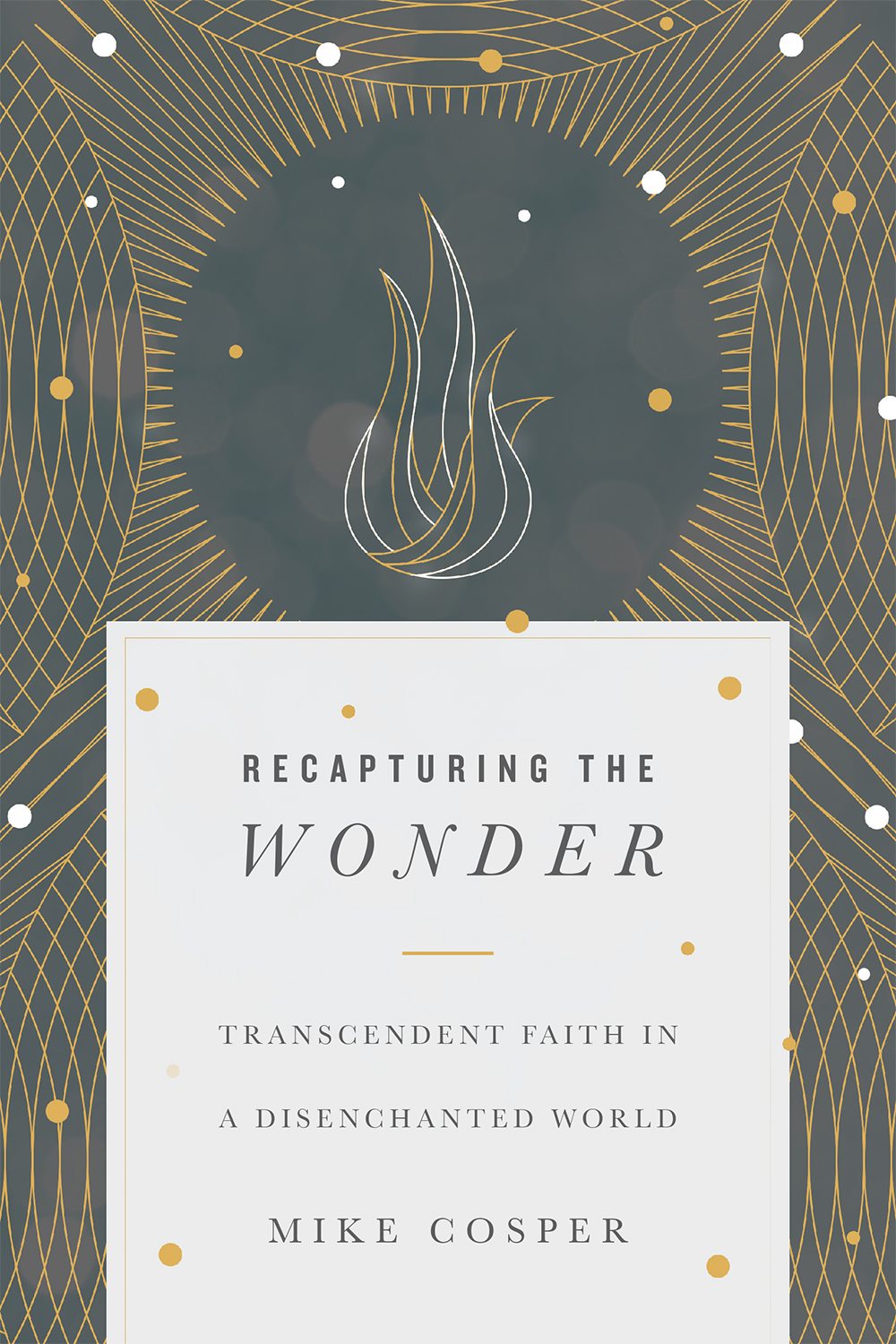
Recapturing the Wonder: Transcendent Faith in a Disenchanted World
Mike Cosper
Recapturing the Wonder: Transcendent Faith in a Disenchanted World
Mike Cosper
When we’re young, it’s easy to believe in the supernatural, the mysterious, the enchanted. But as we grow older, we learn to be more “rational” and more confident that reality is merely what we can see. Even as Christians who believe in the resurrection, we live as if miracles and magic have been drained from the world.
As Mike Cosper wrestled with his own disillusionment, he found writers, thinkers, and artists like Hannah Arendt, Charles Taylor, James K. A. Smith, and David Foster Wallace whose words and ideas reassured him that he was not alone. And he discovered ancient and modern disciplines that shape a Christian way of life and awaken the possibility of living again in an enchanted world.
Exquisitely written with thoughtful practices woven throughout, this book will feed your soul and help you recapture the wonder of your Christian walk.
I couldn’t have written a more concise defense of spiritual disciplines. Amid the insights, exhortations, and specifics, Cosper also kindly takes aim at the legalist who practices spiritual disciplines for favor with God:
Life oriented around the spiritual disciplines is not a pathway to become pleasing to God but a pathway to experiencing the joy of God that is already ours in Jesus. (149)
I read many parts of this book in tears, grateful for the reminder that we weren’t made for this world but another. I’d almost forgotten.
I Still Believe
I answered my atheist friend’s question by sharing the gospel.
He took a deep breath. “Let me get this straight. You believe a man who is really God was born of a virgin, lived and brought someone back from the dead while he lived, died a hideous death, rose from the grave, and busted out of a tomb three full days later?”
I could only nod and say, “Yeah, pretty much. That’s the gist.”
He laughed. “You, my friend, are living in another world.”
On that note, we both agree. Recapturing the Wonder helped me remember the beauty and magic of that other world. I’m glad I live there.