




Renaissance: The Power of the Gospel However Dark the Times is a good book with important flaws that will limit its appeal. Compared to the more substantial contributions of Os Guinness’s other recent works, A Free People’s Suicide (2012) and The Global Public Square (2013), this book is remarkably short and intellectually modest. It is an extremely condensed summary—almost a crib sheet or set of bullet points—on the current state of the Western church’s “culture conversation.”
The core chapters summarize the most important points people need to know from recent books on the church and culture. Chapter 3 provides some brief bullet points defending the importance of the cultural agenda, and cites a few successful examples from the history of Christian cultural engagement. Guinness dismantles the illusion that we can have “Jesus plus nothing”; without the context of culture to provide concepts and definition, the “Jesus” in “Jesus plus nothing” loses all meaning. Many of the major features of our culture today—altruism, reform movements, education, science, and human rights—were centrally shaped by Christianity. Chapter 4 summarizes the key reason the church can influence culture. A distinct and shared Christian way of life incarnates the truth within a culture. Some outsiders are attracted by this truth and move toward it. Meanwhile, worldly powers find, much to their surprise, that their darkness is exposed and challenged by it.
Chapter 5 lists key sociological insights relevant to how we incarnate the truth in culture. The human community is not totally and unambiguously dominated by either the world or the church; we live in a state of ambiguous tension. The structures of culture fall apart when they move away from God, and this distintegration creates opportunities as well as challenges. Some individuals and organizations have more power to shape culture than others; we must become aware of how this power is used and abused.
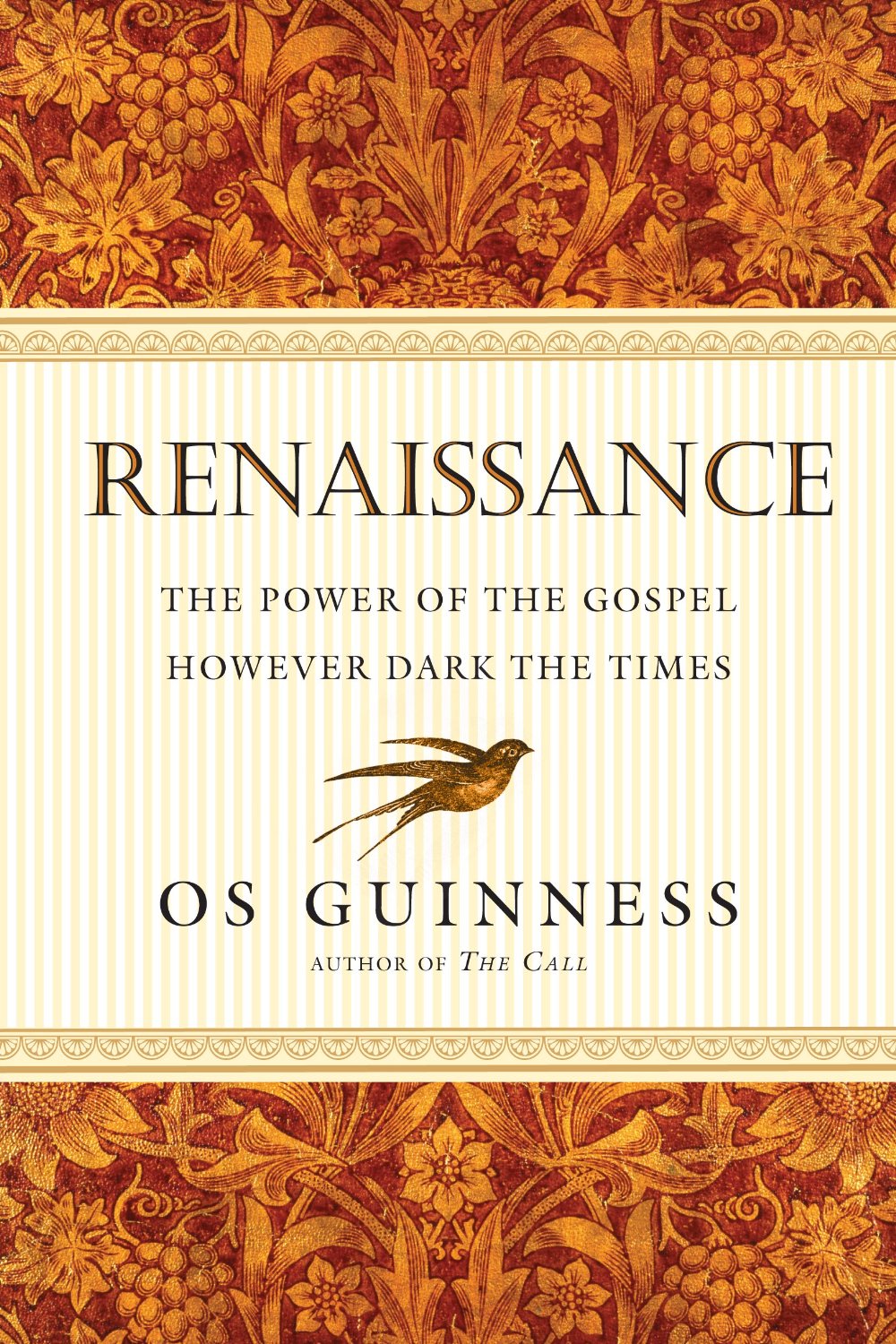
Renaissance: The Power of the Gospel However Dark the Times
Os Guinness
Before and after these core chapters, Guinness issues dire warnings about the dreadful state of the culture, and the even worse state (in his opinion) of the Western church. Guinness depicts not only a world falling apart into darkness and evil, but a church doing the same. He has ideas about how these declines might be reversed, but these abstractions do not leave nearly as strong an impression on the reader as his litany of examples portending doom and despair.
Short, But Not Sweet
As an introduction to help newcomers get into the culture conversation, this book could be helpful. But I see two important obstacles that will limit its success.
In this slender book, Guinness has no space to provide the kind of supporting explanations and arguments that might make these ideas persuasive to beginners. All the points he makes in Renaissance are in fact capable of being supported, as Guinness’s previous books and many others attest. But while veterans of the culture conversation know this, beginners do not. Bare assertion lacks both credibility and substantial definition.
This problem is exacerbated by Guinness’s tendency to state claims in their strongest possible form. He says we will soon be living in a culture where pedophila and incest are not only legal but normalized (20). The global problems of the 21st century will be worse than the horrors of the two world wars and the Cold War (48). Civilization has no better than a 50–50 chance of surviving (49). All these claims are pointing to real and serious problems, but to portray all our problems so starkly when there is no space to substantiate these claims will undermine his credibility with beginning audiences.
This brings me to the second reason Renaissance will have difficulty reaching its audience. This book has an attitude problem. Guinness comes across as demanding and impatient with anyone who doesn’t share his view of things or who hasn’t reached his level of insight.
Guinness writes like a man who passionately hates the world, and bitterly resents the Western church because it doesn’t hate the world as much as he does. He (very) occasionally affirms that Christians should love the world, but these abstract statements are never fleshed out with particulars, and thus fail to rise above the level of barren platitudes. His operational attitude toward the world, and even more toward the Western church, is always and everywhere law, law, law, and no gospel.
For God So What the World?
Guinness’s seeming hatred of the world and resentment of the church reach their high point in a shocking passage where he compares religious movements he dislikes to cooperating with genocidal totalitarianism:
The worldly church is not only corrupt but cowardly, for much contemporary worldliness is a voluntary capitulation to the spirit and system of the age. There are times when the powers of the age openly seek to seduce the church or brutally subjugate her to their own purposes. That can be bad enough, as witnessed by the widespread compromise of Russian Orthodoxy under Stalinism or Lutheranism under Hitler. But the contemporary worldliness of parts of the Western church, as exemplified differently by the extremes of either the Episcopal Church in America or the emergent Evangelicals, is in one sense worse. . . . Such worldliness is inexcusable because it is self-chosen, naively and breathlessly self-chosen, and in many cases foolish beyond all comparison. (119–120)
There you have it—Episcopalians are “in one sense” worse than Hitler’s quislings. Like Guinness, I have published some harsh words about the apostasy of the Episcopal Church. But even to think of comparing this, in however limited or qualified a way, to those who collaborated with Hitler and Stalin suggests hateful passions. I wish I could say that this passage isn’t representative of the book’s general spirit, but I can’t.
This hatred and resentment appear to be disguised from their author because he thinks he is directing them only against abstractions like “modernity.” He does not seem to have asked whether his view of modernity as unambiguously demonic, to be hated and destroyed wherever we find it, is compatible with loving and bringing hope to modern countries like America. More puzzling, we know from his other books that Guinness is aware of the spiritual blessings unique to the modern world—religious freedom, constitutional democracy, equal dignity for women, an entrepreneurial economy, and so on. His last book was a soaring paean to the glories of religious freedom, which is both a product and a cause of modern culture.
Most of Renaissance is written in the style of doomsday prophet, when what we need right now is Peter at Pentecost. Peter confronts his audience about their sins, personal and social, but he emphasizes the inbreaking of gospel hope. We are no longer waiting for the kingdom to come! We have been commissioned to go out to the nations (i.e., cultures) with the hope and power of the Holy Spirit.
The kind of cultural renaissance Guinness hopes for can only be carried out by people whose words and actions overflow with tangible and costly love for the church and for the world—with grace as well as truth. We know from his earlier books that Guinness knows this. It’s disappointing Renaissance doesn’t reflect it.