




“Whatever resides at the edges of evangelical identity, the Bible is certainly at the center.” So comments Beeson associate professor of divinity Mark Gignilliat in a blurb for a recent book that is a not-too-distant cousin of the one presently under review.
Gignilliat is right, but we can go farther. The Bible is at the center not only of “evangelical identity,” but also of every genuinely evangelical church, and of every genuinely evangelical life.
This practical centrality of Scripture is grounded in doctrinal conviction: we believe that Scripture is the Word of God, such that what Scripture says, God says.
This is one of the most basic Christian confessions. It’s a conviction that everything else we believe is built on. For that reason alone, every church leader, and indeed every Christian, should pay careful attention to what Scripture teaches about itself, as well as to how we should read Scripture in light of its unique God-breathed nature.
Theological Introduction to the Nature and Interpretation of Scripture
These two matters—the nature and interpretation of Scripture—are the subject of Scott Swain’s new book, Trinity, Revelation, and Reading: A Theological Introduction to the Bible and its Interpretation. Swain, associate professor of systematic theology at Reformed Theological Seminary in Orlando, says that the central question the book seeks to answer is, “What roles do Holy Scripture and the reading of Holy Scripture play within the unfolding drama of the commerce and communion between God and humanity?” (1) The book’s goal is to “articulate a brief but coherent vision of how these themes fit together within the larger evangelical reality of God’s relation to his people.” Swain’s hope is that this theological vision would function as a framework within which students can become “faithful and competent readers of Holy Scripture” (2).
Swain begins his argument proper with two chapters that unpack the role of God’s multifaceted revelatory word (ch. 1), and then specifically God’s written word (ch. 2), within the outworking of God’s redemptive plan, which Swain examines through the rubric of “kingdom through covenant.” Like the rest of the book, these two chapters are densely biblical, packed with concise textual discussions as well as many more contextually sensitive proof-texts. Citing B. B. Warfield, Swain states at the outset of chapter two that “the Bible is itself a servant of the triune king and a means of his covenantal self-communication. Holy Scripture is itself one of God’s ‘redemptive acts, having its own part to play in the great work of establishing and building up the kingdom of God’” (35).
Thus, similar to Timothy Ward’s recent and commendable book Words of Life though with perhaps even greater biblical and analytical rigor, Swain’s book illumines the nature of Scripture as a means by which God accomplishes his saving purposes. In sum, Swain says in his characteristically brief, almost aphoristic manner, “Through Holy Scripture, the Holy Trinity makes friends with us” (60).
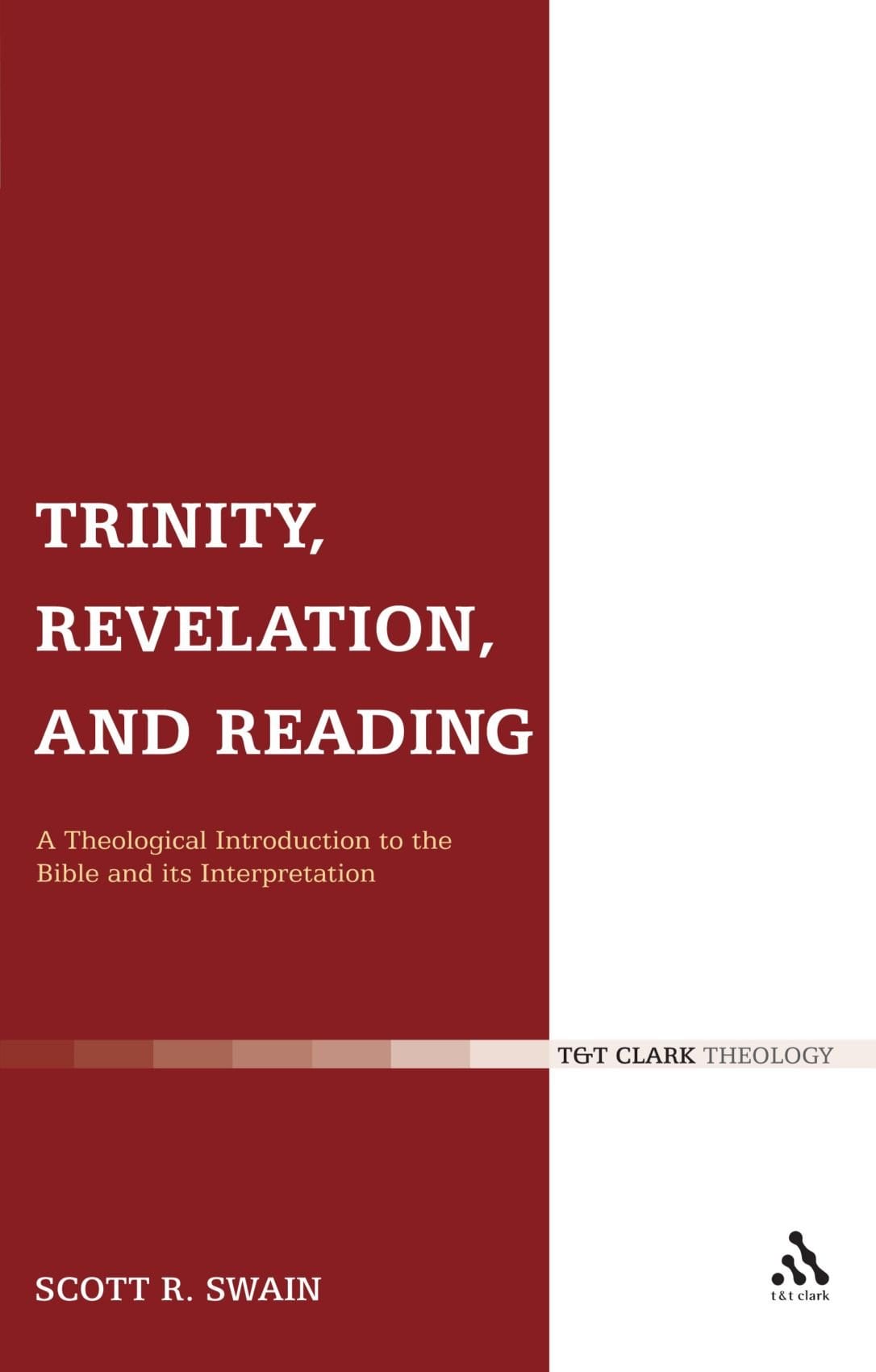
Trinity, Revelation, and Reading: A Theological Introduction to the Bible and Its Interpretation
Scott R. Swain
Trinity, Revelation, and Reading: A Theological Introduction to the Bible and Its Interpretation
Scott R. Swain
A theology of biblical interpretation, treating both topics in light of their relationship to the triune God and the economy of redemption.
Chapter three is taken up with “The Inspiration and Perfection of Scripture.” It gives a focused account of Scripture’s uniquely God-breathed nature (61–71) followed by a carefully nuanced discussion of the “perfection” that follows upon Scripture’s inspiration (72–93). With lucid brevity, Swain expounds the authority of Scripture, the truthfulness and trustworthiness of Scripture (I was glad to see Swain’s unembarrassed affirmation of inerrancy), and the clarity of Scripture. In each section he also draws out a number of practical entailments for interpreting the Bible that flow from each of these characteristics of Scripture.
Chapter three thus anticipates the fuller theological account of biblical hermeneutics that chapters four and five provide. These two chapters explore reading Scripture as an act of “covenant mutuality,” that is, as one of our actions within the friendship that God has graciously initiated with us. The two main topics of chapter four are the Spirit’s work in illumining our reason and the ways in which the church, the reading community created by the work of the Spirit, aids our interpretation. Chapter five examines public and private reading of Scripture and discusses four phases of biblical interpretation: prayer, explication, meditation, and application.
Couple Quibbles
At one or two points in chapter four, I wish Swain would have indulged the reader by providing a few more qualifications. For example, on page 111 he says that “dogmas” are “the church’s public and binding summaries of scriptural truth.” (Whose church? Which dogmas? Binding in what sense, and on what basis?) I can agree with Swain’s statement, but only by engaging in some theological unpacking that the text doesn’t directly aid.
I’ll also register what may amount to only an editorial quibble, though I bring it up because it relates to how the book locates itself within recent discussion. In the introduction Swain writes that “although the present study is in many ways quite traditional in stance, it will be clear to many readers that its arguments are unimaginable apart from the recent development in academic theology known as ‘Theological Interpretation of Scripture’” (11). “Unimaginable” seems a bit overstated. Has a concern to read Scripture “in the economy of grace” (96, n. 3) really been so absent from recent academic study—even among evangelicals—as to render this book’s arguments unimaginable?
Further, many of Swain’s dialogue partners, including Bavinck, Warfield, and J. I. Packer, are not exactly mainstays in TIS conversations. Yet evangelicals who have taken their cues from such thinkers have long been able to imagine the main thrust of Swain’s arguments, well before the TIS movement came into being. And some of Swain’s own arguments will be, though not quite unimaginable, at least unpalatable to some who identify with TIS.
Since we’re on the subject of TIS, I was glad to see that this work of Swain’s seems to embody the movement’s strengths and steer clear of its weaknesses. (On both of which see D. A. Carson’s recent essay, “Theological Interpretation of Scripture: Yes, But . . . .” in Theological Commentary, edited by R. Michael Allen.)
That’s all I have say that’s even in the general neighborhood of criticism.
Long List of Praises
On the other hand, were it not for the unblinking stare of The Gospel Coalition’s editors, I would go on for an inordinately long time praising this work. So, in tribute to this book’s useful and endearing concision—it’s only 139 pages of text, and every sentence counts—I will briefly state some of the leading reasons why I think Trinity, Revelation, and Reading is one of the best recent evangelical works on Scripture and hermeneutics.
First, the book gives a thoroughly biblical account of what the Bible is and how we should read it. In other words, it makes good on the promise of the subtitle.
Second, this book gives a compelling biblical-theological account of the role of God’s written Word in the outworking of God’s saving purposes. This is crucial theological grounding for the centrality of the reading, teaching, and preaching of Scripture in the church and the Christian life.
Third, by setting both the nature and interpretation of Scripture within a theological vision, Swain directs his readers not only to proper interpretive techniques, but also, what’s more foundational, to a proper posture. For instance, Swain writes, “In dealing with the Bible interpretively, we are not rational subjects dealing with an inert object; we are instead rational subjects addressed by the divine Subject and called to loving attention and fellowship” (7).
Fourth, this book simultaneously provides firsthand exegetical and biblical-theological work and demonstrates the validity, and one could even say necessity, of traditional systematic categories such as the authority, inerrancy, and clarity of Scripture. It brings fresh scriptural light to bear in a way that enhances, rather than derogates, traditionally Reformed and evangelical convictions about Scripture. And along the way Swain also briefly and capably assesses some recent proposals that fall short of mirroring Scripture’s self-testimony (see, e.g., 72 n. 21; 78 n. 34).
Fifth, this book dialogues with some of the best representatives of historic Reformed and evangelical thought on the doctrine of Scripture, which is something too few contemporary proposals—especially revisionist ones—seem to do.
Sixth, this book conveys a great deal of theological and interpretive wisdom in very few words. The book’s technical vocabulary will unfortunately put it out of the reach of many, yet ambitious readers will find it an excellent introduction to the nature and interpretation of Scripture.
Finally, the entire book aims not merely at information transfer, but at edification—and in my estimation it succeeds. This is perhaps most plain its discussion of hermeneutics, but is no less present throughout the entire theological exposition.
Personal Appreciation
To close on a personal note, this book has already aided not only my personal approach to Scripture, but also my efforts to equip others in their study of Scripture. I’m currently enjoying the privilege of co-teaching a Sunday school class about how to study the Bible, and this book has informed and improved not only the content of individual classes but also the shape of the whole course.
I am grateful for the fruit Swain’s work has already borne in my life, and, I trust, in the lives of my fellow church members. I look forward to benefiting from more of Swain’s work. And I strongly commend this one to you.