It is boringly obvious and impossible to deny: the church of Jesus Christ is one of the most racially and ethnically segregated institutions in America. Echoes of Martin Luther King’s indictment of 11 a.m. on Sunday morning ring in the ears. Consider the following: (1) nearly nine in ten churches are 80 percent or more one race; (2) the average public school is six-times more diverse than the average church, the average neighborhood ten-times more; (3) the small number of ethnically diverse churches is largely unstable and located in transitioning communities where white congregants are moving out while ethnic minorities are moving in. In addition to other factors, these statistics suggest a grim racial reality about the institutional body of Christ: on the whole in America, church is where Christians go to make their stand against the God who delights in diversity.
For the believer filled with the hope of the gospel, the view should be much different. And it is that view—that vision—which Trillia Newbell sets forth in United: Captured by God’s Vision for Diversity. While she doesn’t shy away from the painful difficulty of pursuing a gospel-driven vision of diversity, especially for a black woman in a Reformed church, she remains committed to God’s power to make out of many peoples one new and diverse humanity in the church. “God himself created the world by the power of his voice,” she writes. “Surely he can do a small thing like build a church that is rich in diversity” (19).
Much writing on race and the church is content to traffic in the observable data of sociology alone, seldom if ever inviting a view from above the stark facts. But United never loses sight of a guiding theology. Again and again we’re reminded that our ecclesial problems around skin and race are always first and foremost problems of sin and grace. As one adopted into the family of God, the Christian’s identity is never just black female, white man, or whatever society asserts. We are named as “in Christ,” united to him in his death and resurrection. And far from diminishing racial identity or making it invisible, we are able to love our created ethnic humanity in light of God’s recreation of us in Christ. In this connection, notions like justification, sanctification, and propitiation have real-world payoff for how we understand race.
United soars when discussing the identity-shaping benefits of salvation, and it contributes much to the sociologically driven and theologically thin treatments that abound. If you want to see how rich, Reformed theology intersects with racial identity in a personal narrative, read United. More specifically, though, read it to acquaint yourself with the unique perspective of a black Presbyterian woman. Most evangelicals don’t know a black Reformed woman. So this treatment will open up new vistas of insight that gather at the intersection of theology and racial experience.
Difficult Dynamic
The book unfolds from Newbell’s pre-conversion identity crisis as a “proper” Southern black girl who was often asked, “Why do you act white?” The story progresses through her conversion, cross-racial friendships, and subsequent interracial marriage. It ends with her expressing hope that her two children will participate in a church that embodies King’s biblically informed dream of racial harmony and unity.
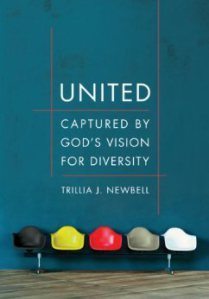
United: Captured by God's Vision for Diversity
Trillia Newbell
Along the way, deep friendships with Amy (white) and Lillian (Asian) began answering her fervent prayer for diversity in the church. Newbell’s vision for diversity in the church didn’t remain in the abstract realm; it came to be experienced in the concrete reality of relationships. The friendship between these three women highlighted their individual differences of culture and life experience. But it also demonstrated just how similar they were as members of the same family of God. As Christians, they were “different but the same” (87), united in their diversity. It is this true and delicate dynamic—unity in diversity—that so often proves difficult to negotiate in the church but undergirds the book from beginning to end.
Scholarly studies on religion and race have argued that majority-culture churches tend to emphasize unity—what is common and transcendent among believers—while downplaying explicit racial discussion in an effort to create harmony. However, ethnic minority-led churches reaffirm and highlight difference, or the diversity of ethnic experiences, in an effort to address racial matters. As a way forward, white majority-culture Christians want to minimize race in the interest of unity while minority Christians want to maximize it for the exact same reasons. One group thinks in terms of unity and the other in terms of diversity. Navigating those clashing cultural perspectives requires consummate wisdom, not formula. Wise negotiation will carefully insist on both dimensions of our redeemed humanity without allowing either our common “third race” status in Christ or ethnic particularity subsume the other. Every believer interested in pursuing God’s vision for diversity must reflect on this dynamic in his or her cross-racial relationships. Newbell’s joyful and hopeful account of navigating that dynamic is a helpful guide to that end.
Difficult Diversity
United contends that nothing less than the glory of God is on display in the diversity of congregations. God charged the world with diversity, delights in diversity, and will ultimately have the diverse church for which Jesus died (Rev. 5:9). As Annie Dillard, reflecting on the diversity of the whole creation, remarked, “the Creator loves pizzazz.” The manifold wisdom of God is seen in both the diversity of creation and also the redemption of people from every nation.
But United doesn’t mute the excruciating difficulty of pursuing racial unity within the church. Fear, apathy, race fatigue, and geographical separation by race are some factors that short-circuit the pursuit of diversity in our churches. Diversity is difficult because sanctification is difficult. Loving your neighbor as yourself is tough and made even more so when differences of culture, class, and ethnicity are added to the ecclesial mix.
United isn’t a how-to manual for achieving diversity in our churches as much as an invitation and exhortation to capture the vision and join the pursuit.
Denial of Power and Privilege
So where should that pursuit lead pastors and churches? Any meaningful pursuit of diversity will have to tackle matters of privilege and power.
When Dietrich Bonhoeffer spent time among black Christians in Harlem, his eyes were opened to the presence of the Duboisian “color line” in the American church and the need to address it in his own German church context. If cross-shaped racial unity was to be addressed, the “fatal privilege”1 of the dominant culture church leadership in America and Germany needed to be opposed. According to Bonhoeffer, pastors and those in power can’t stand by and “benefit from a privileged status in the church” but must “see their own true service, which they can still perform for their church, in resigning from this office of pastor as a privilege, which is what it now has become.”
If our churches are going to faithfully pursue diversity, particularly in our rapidly changing American context, the obstructing force of ecclesial power and privilege must be addressed continually in light of the call to cross-shaped, self-donating discipleship and neighbor love. Truly learning from and deeply listening to and submitting to leaders who don’t look like us, yet who possess far more cultural wisdom and knowledge than we do, is just one way that relinquishing privileged position invites kingdom diversity in our churches and communities. Inevitably, the vision of United will lead readers into such discussions and actions.
1 The quotes are from chapter 3, “Bonhoeffer, Christ, and Culture,” in Reggie Williams’s Dietrich Bonhoeffer, The Harlem Renaissance, and the Black Christ.