
Larry Woiwode’s newest work, Words Made Fresh: Essays on Literature and Culture, has a daunting subtitle, asking readers to refine its broad meaning with their own specific hopes of what might lie within its pages. Delectable words like literature and culture are made even more irresistible when paired with essays—that increasingly elusive genre.
It’s an alluring presentation but a tough premise to deliver on. Like short-story collections, an assembly of essays usually raises expectations because publishers presumably wouldn’t touch them unless there is something really really special about them. And when the verso copy mentions everything from Dylan and Updike to Barth and Kierkegaard, it’s hard not to salivate. Thus, this reader expected Words Made Fresh to be a collection on nothing less grandiose than, well, literature and culture. Instead, the collection of essays is a solid tribute to a writer who has had a long and successful career, good but not stunning as a singular work.
Larry Woiwode, the poet laureate of North Dakota, is the author of five novels and two collections of short stories. His articles have appeared in The New Yorker, Esquire, The Atlantic Monthly, Harpers, The Partisan Review and The Paris Review. He has been writing since the late 1960s; the earliest essay in this collection was first published in 1975. Smart, savvy, and prolific, Woiwode has been seamlessly shifting between Christian and secular audiences for decades, forging a long, respectable career. With incisiveness and level-headed convictions, he has contributed to American thought through a long portfolio of essays on a range of topics. It seems the best of these were chosen for this slim anthology, but when put together, the assembly feels somewhat wanting.
The opening essay, “Guns & Peace: On an American Icon,” starts the collection off on a personal note as Woiwode shares pieces of his life through his on-and-off relationship with firearms. The following nine essays however don’t contain quite the same poignancy.
“Homeplace, Heaven or Hell: On the Order of Existence,” an essay about the role of place in writing, offers sage advice while inspiring writers to a higher standard. It’s a gem of an essay with a challenging conclusion:
Writers may be reformers after they reform themselves and their outlook, but they aren’t reformers if they aren’t shaping contemporary experience and phenomena into forms that illustrate a dependence on, and captivity to, ultimate form and it’s up to writers, as it’s been for centuries, to help us find our way around this home on earth, whatever our place in it.
His essay “View of Wendell Berry: On Life against Agribusiness” follows in a similar vein: bemoaning the contemporary situation while taking care to offer an antidote, this time in the example of one particular artist. Honing in on Berry’s intimacy with the land and his respect of creation, Woiwode writes, “Our hope is here on earth.”
The other essays are a bit less striking. Woiwode admires John Gardner and John Updike in “Gardner’s Memorial in Real Time: On the Achievement of Mickelsson” and “Updike’s Shattered Self: On Americas’ Maestro.” And yet the excess of small details regarding their careers somewhat overshadows the larger observations. The essays leave the reader wanting to be lifted a little higher to better survey the more general landscape that the subtitle promises.
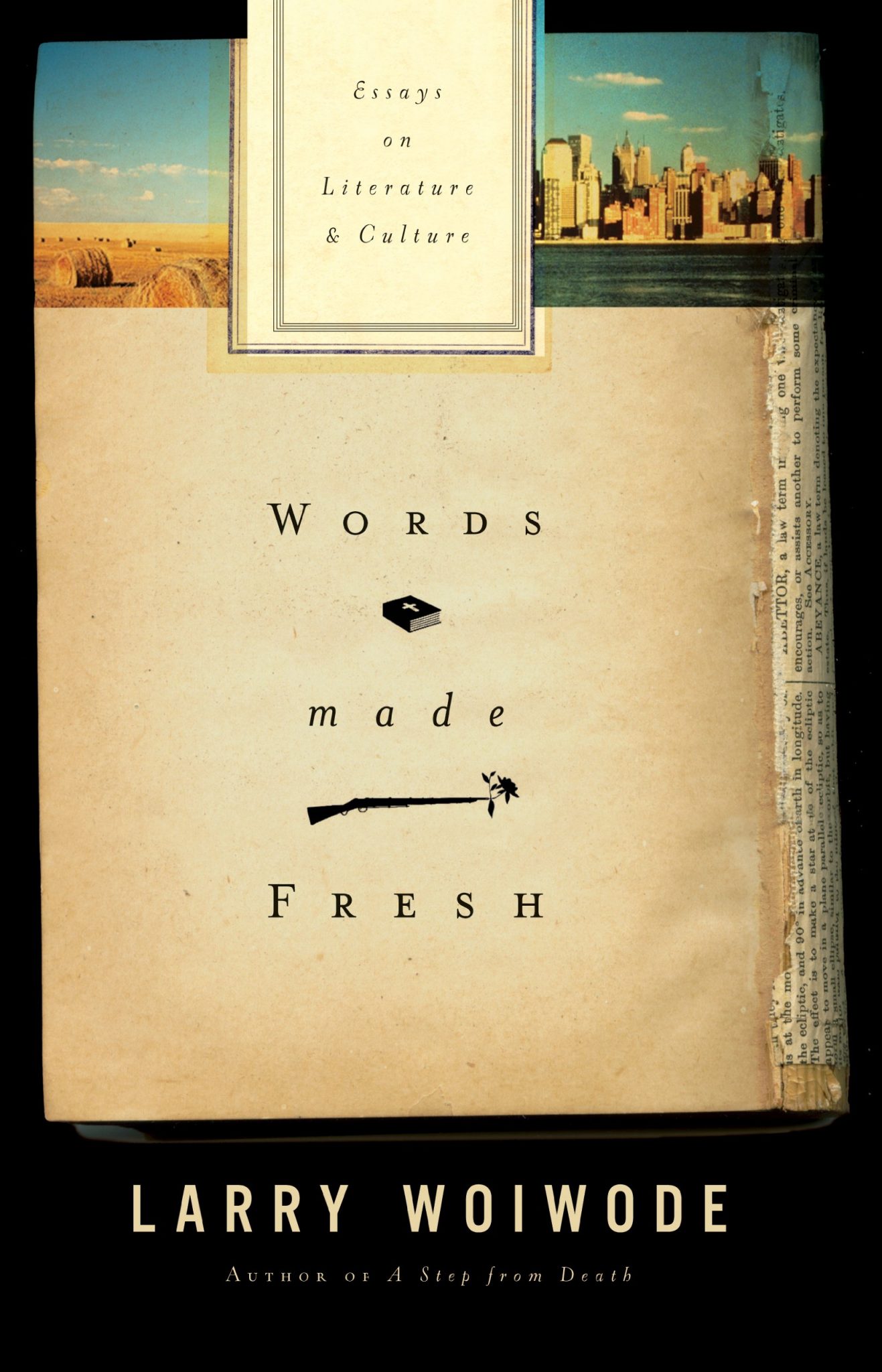
Words Made Fresh: Essays on Literature and Culture
Larry Woiwode
Larry Woiwode is a writer of writers―a real American hero―and his prose leads us to delight in the written word in a fresh way. Through the mediums of literary analysis, cultural reflection, and personal memory, these ten essays trace Woiwode’s work and thought on such topics as the redemptive fiction of John Gardner, the ownership of guns, the faith of William Shakespeare, and even the difference in news as reported by CNN versus Bob Dylan.
His essay “Dylan to CNN: On News and Not the News” perhaps promises the most but delivers the least. His observation that Dylan was “delivering to [Woiwode’s] generation not only political and cultural news but, with each album, was clearly charting an individual odyssey—his own” is an interesting statement, but not exactly a new one. Perhaps as a result, Woiwode’s conclusion feels like it could have been a bit more subtle: “People of faith, especially those who confess to take Jesus seriously, have to start looking away from TV for the news and stop imbibing as fact what they take in from Tom Brokaw or the latest anchor on CNN.”
Though it is hard to draw out a unifying theme among the selections in Words Made Fresh, one thing that buttresses this anthology is Woiwode’s trust-worthy voice. You may not want to read about some of the minutia surrounding the Who-is-William-Shakespeare controversy as recounted in “The Faith of Shakespeare: On My Favorite Actor” or the scattered details around John Updike’s legacy. But Woiwode’s intelligent engagement with such topics and the natural kneading in of his Christian worldview—which depending on the topic is either front and center or in the wings—is refreshing.
In all, Words Made Fresh is perhaps good evidence of why essay collections are both a challenging creative task and also a tough sell. Finding the single thread that runs through an array of topics is not necessarily the task at hand, and yet the reader can’t help but grasp for one. The problem here is not Woiwode—who is undoubtedly worth one’s time—but in the challenge of creating a cohesive experience out of a collection of essays that alone are fine pieces, but when compiled fail to accumulate to something more.