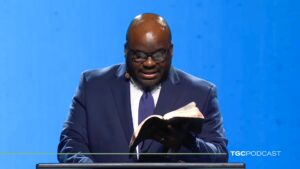
Listen or read the following transcript as D. A. Carson speaks on the topic of Hope in this address from The Gospel Coalition Sermon Library
Doubt has many causes. I began my life’s work not teaching in a seminary but as pastor of a church on the West Coast of Canada. That church had a hundred or so college and career young people. One of the young women in that group called Peggy.… If you put her at one end of the room and the 99 at the other end of the room, about 80 percent of the energy in the room was at her end. She was vivacious, attractive, energetic, full of ideas.
She was a student at the University of British Columbia, a devout Christian, as it happened. She came to me one day and said she had met a chap on campus, a football hunk, who wanted to talk to her more about Christianity and wanted to know if I would talk with him. I said, “Sure. Just be careful what you’re doing here.” “Oh, I’m fine. I just want him to know Jesus,” she said.
So that Saturday night I was in my study, and at 10:30 there was a knock. In bounced Peggy, followed by Fred. Fred walked in, and he was as dour and as straight and linear as she was tangential, vivacious, and energetic. He had no Christian background whatsoever. Peggy announced, “This is Fred. He wants to meet you.” I knew right away that wasn’t true. I was merely the obstacle on the way to Peggy. That was transparent.
We went out to IHOP, the International House of Pancakes, and we talked until about 2:00 in the morning. I was trying to put him at his ease and find out more of his background and see where he was and so forth. We chatted about this and that, nothing very serious. Next Saturday night there was a knock. Off we went to IHOP again.
This time he had a list of questions. He couldn’t believe any of this Christian stuff. All of his questions came out of a framework of systemic doubt borne of fairly massive ignorance. In other words, he had no background in this sort of material at all. Week after week he came for 13 weeks, and we talked until 2:00 in the morning. What this was doing for my Sunday sermons I have no idea, but that’s what happened every Saturday night for about 13 weeks.
Every week he had his questions, and I’d give him some books to read and suggest some articles he should look at and some discussions he ought to have. Every week, even in the midst of this university year, he’d go away and read whatever I assigned him. At the end of 13 weeks, he said in his own inimitable Fred-type way, “All right, I’ll become a Christian.”
Now I have to tell you that’s not normally the way it works, but in his case, his move from systemic suspicion of the whole lot to eventually the place where he is today, happily married to Peggy with children whom they have reared and now, in fact, a deacon of a church.… Who knows what could happen to you tonight? Be careful. In fact, all of this came about, in the first instance, because of information.
Some doubt is charged from major philosophical commitment. Here, for example, is Aldous Huxley, one of the more famous philosophical atheists of the twentieth century, in his book Ends and Means. “For myself, the philosophy of meaninglessness,” which is what he espoused, “was essentially an instrument of liberation.
The liberation we desired was simultaneously liberation from a certain political and economic system and liberation from a certain system of morality. We objected to the morality because it interfered with our sexual freedom; we objected to the political and economic system because it was unjust. The supporters of these systems claimed that in some way they embodied the meaning (the Christian meaning, they insisted) of the world.
There was an admirably simple method of confuting these people and at the same time justifying ourselves in our political and erotic revolt: we would deny that the world had any meaning whatsoever.” Well, at least he’s honest. I found a very similar passage two or three years ago in Michel Foucault, one of the French fathers of postmodern thought.
Sometimes doubt is fostered neither by ignorance nor by systemic philosophical commitment but by ten thousand atomistic, pragmatic choices. Sometimes you find somebody, for example, who’s reared in a conservative, maybe even Bible-Belt frame of reference, and they’re brought up with a certain heritage of Christianity. They maybe have not thought about it too deeply, but it’s part of the atmosphere in which they live and move and have their being. That’s the framework in which they live.
Then somewhere along the line, married, 2.5 kids, pressing on toward middle age with new responsibilities in upper middle management at work. Reading the Bible seems more of a chore. Mixing with Christians is a bore. The pressures at work are such that with 12-hour days there and often homework to do at night, it’s just all a bit much.
Things begin to slide toward a different direction. Then, of course, there’s the summer cottage that has to be maintained and the boat. Eventually, five years, seven years down the road, he wakes up in bed with somebody he really shouldn’t be in bed with. He gets up and goes to the loo, looks himself in the mirror, and says, “I don’t believe all that rubbish anyway.”
How did he get there? Some deep philosophical analytic reflection? I don’t think so. What there is instead is a series of ten thousand atomistic choices. I suppose what I’m really saying is that very often our belief structures or our unbelief structures are fed by a lot of things besides just straightforward reason. They’re fed by a lot of things.
Sometimes people come from very abusive families, and they’re carrying horrendous baggage. A young woman who has been abused by her father and now told about the fatherhood of God? I’m sure some of you are in that position here. In a crowd this size it’s almost inevitable. Sometimes people become cynical just from sheer fatigue. You see that at a certain level in anybody of any age. My wife and my kids will tell me that I become cranky and a bit more cynical if I’m just running on too few hours’ sleep.
So if you’re a university student committed to a 4.0, plus the sports, plus the frat, plus the parties, plus a part-time job, and you have to have time with your friends, and the sleep hours get pushed out so you are eventually dragging yourself around, eventually, the cynicism you may be displaying may be more a function of sheer exhaustion than rational thought, which is, again, another way of saying we’re complex beings and the things that feed into our beliefs and unbelief, to our priorities, to our cynicism, to our optimism, and so on …
All of these things are fed from many, many different directions. Now I could give you a lot more examples. What’s the point? The point is that doubt has many causes, and, therefore, the appropriate answer depends on the cause of the appropriate doubt. Some forms of doubt may be highly honorable, may be a function, in fact, of growing up.
Beginning to ask questions that were merely part of your heritage in the past, part of coming to a stable outlook, demands that you ask some fundamental questions and see what is merely inherited from your parents and what you have thought through. There’s nothing dishonorable about that in this fallen world. It’s part of maturation. But sometimes the most useful thing you can do in the entire world is get a good night’s sleep. If you come from an abusive background, you may need some help at some point putting that together.
Now what I thought I would do tonight is come at who Jesus is and his resurrection from the perspective of the first person about whom we have any details regarding his unbelief in the resurrection. His name is Thomas, and you find the account in John 20:24–31. The New Testament is about the last third of the Bible, and it begins with four books: Matthew, Mark, Luke, and John. They all tell something of the life, ministry, death, and resurrection of Jesus.
At this point, Jesus has come back from the dead, according to these texts. He was crucified, brutally killed. I’ll come to that in a moment. Quite frankly, his own disciples had not expected this to happen. After he was arrested and was finally executed and he was hanging on the cross, the disciples were not hiding in an upstairs room saying, “Yes! I can hardly wait till Easter Sunday.”
They had no category for a crucified Messiah. They thought that Messiahs win. To see him executed smashed their hopes. They certainly had no category for resurrection. It’s not as if they talked themselves into it because they were convinced it had to be. They were in deep despair and afraid of the authorities. Then on that first Easter Sunday, the first reports trickled in from Mary and other women.
There was a race to the tomb when two of the disciples named Peter and John went there, and then there were two who were walking home to Emmaus, a small town two miles outside. Jesus showed up with them. On that first Sunday, he also showed up to the small band of the original disciples. One was dead: Judas Iscariot, who had betrayed Jesus. He had committed suicide. Another was missing. His name was Thomas. So we pick up the account.
“Now Thomas, one of the Twelve, called the Twin, was not with them when Jesus came. So the other disciples told him, ‘We have seen the Lord.’ But he said to them, ‘Unless I see in his hands the mark of the nails, and place my finger into the mark of the nails, and place my hand into his side, I will never believe.’ Eight days later, his disciples were inside again, and Thomas was with them. Although the doors were locked, Jesus came and stood among them and said, ‘Peace be with you.’
Then he said to Thomas, ‘Put your finger here, and see my hands; and put out your hand, and place it in my side. Do not disbelieve, but believe.’ Thomas answered him, ‘My Lord and my God!’ Jesus said to him, ‘Have you believed because you have seen me? Blessed are those who have not seen and yet have believed.’ Now Jesus did many other signs in the presence of the disciples, which are not written in this book; but these are written so that you may believe that Jesus is the Christ, the Son of God, and that by believing you may have life in his name.”
For the sake of organizing our way with this text, let’s begin with the cry of a disappointed skeptic. Verses 24–25: “But he said to them, ‘Unless I see in his hands the mark of the nails, and place my finger into the mark of the nails, and place my hand into his side, I will never believe.’ ” What kind of doubt is this? It’s not the doubt of a philosophical materialist; that is, a person who is convinced that all there is is matter, energy, space, and time. Plus nothing, minus nothing.
This man, Thomas, whatever else he was, was a devout first-century Jew. He believed there was one God. He believed that God was sovereign and good, that he was in covenant with his people, that he was the Creator. He believed all of that. What kind of doubt is it then? Is it the doubt of a man who’s morally compromised and thus justifying himself? No, there’s no hint of that sort of compromise in this man’s life. In fact, earlier on in this book he assumes almost heroic proportions by some of the answers he gives.
What kind of doubt is this? This is the doubt of someone who has been burned by his faith and does not want to be snookered again. In other words, he really did believe that Jesus was the Promised One, the coming one from Old Testament times, the one whom we refer to today as the Messiah, the Anointed One. Messiah is simply the Old Testament Hebrew equivalent of what we mean by Christ. Christ wasn’t a proper name. Jesus was never called, “Mr. Christ.” It’s Jesus the Messiah, Jesus the Christ, the Promised One.
He really believed Jesus was that, and he believed Jesus would set things to right and stop evil and bring about the end of all things and bring justice to bear. In fact, he’s crucified under the authority of Pontius Pilate. Now his friends are saying, “He has come back to life,” and Thomas is saying, “I was snookered once. I’m not going to get snookered again.”
It’s just too possible to talk yourself into believing that somebody is alive just because you want it to be so. Some people, after all, believe that Elvis is alive. We don’t have to go to rising dying god stories of various fertility cult myths in the ancient world. Just look at Elvis. Thomas is shrewd enough to realize that it’s possible to talk yourself into believing something that isn’t true just because you find it comforting. It meets one of your own needs. That’s it. He’s not going to go down that route.
There’s something almost noble about his unbelief. He doesn’t say, “All right. If you say so, I’ll believe it too. Where do I sign up?” In fact, what he does is lay down the absolute condition for taking away this unbelief. Do you see what he says? “Unless I see in his hands the mark of the nails, and place my finger into the mark of the nails, and place my hand into his side, I will never believe.”
You need to understand something about crucifixion. When the Romans crucified you, after scourging you and beating you in various ways.… When they actually took you out to the place of crucifixion, they made you take the cross member on your shoulder. The upright was already in the ground. It was always in a public arena, at a crossroads or on a main thoroughfare, because there was supposed to be shame involved.
Indeed, the Romans had three methods of execution, but crucifixion was the one for scumbags, for slaves, for the detritus of society. No Roman citizen could ever be executed by crucifixion apart from explicit sanction of the emperor himself. So crucifixion had the aura in the ancient world of shame. It’s the sort of thing where ethicists in the ancient world say, “Don’t talk about crucifixion in front of your children.”
There were no jokes in the ancient world about crucifixion, just as it would be unthinkable for us today to joke about Auschwitz. Crucifixion had the same sort of shock value as Auschwitz does for us. It’s hard for us to understand that today when the cross has become so much a symbol of things Christian. We dangle them from our ears and our bishops wear them around their necks and they’re on our buildings. Nobody is scandalized.
Imagine having a fresco of Auschwitz on your building. That’s the way crucifixion was viewed in the ancient world. There were no comforting loincloths. You were crucified naked. As you hung there, sometimes nailed up through the wrist and sometimes just tied up, you pulled with your arms and pushed with your legs to open up your chest cavity so you could breathe. Then, of course, the muscle spasms started, so you collapsed. Then you couldn’t breathe, so you pulled with your arms and pushed with your legs so you could open up your chest cavity and breathe.
That’s why the physical pain of crucifixion was bound up with muscle spasm until you finally collapsed and died of suffocation. That was the normal way. If, for some reason, they wanted to finish you off a little faster, as happened in this instance because there was a Jewish holy day coming up, what they would normally do is come along and smash your shins. Then you couldn’t push anymore and you’d suffocate in a few minutes.
When they got to Jesus on that fateful day, they discovered he was already dead, so instead of smashing his shins, one of the soldiers guarding the crosses of Jesus and two others took out a short javelin and shoved it up under Jesus’ rib cage. It pierced the pericardium, and out came, we’re told, water and blood. That meant in addition to the standard wounds of crucifixion, Jesus had a unique mark on his body, the piercing in his side.
You can imagine now what is going on in Thomas’ head. “Is it even conceivable that Jesus has a twin, somebody who looks a lot like him? I want evidence that the pre-death Jesus is the same one who ostensibly comes out of the tomb, and the only way I can be sure of that,” Thomas says, is precisely what he stipulates here. “Unless I see in his hands the mark of the nails, and place my finger into the mark of the nails, and place my hand into his side, I will never believe.”
Here is the cry of a disappointed skeptic, yet at the same time, it is the cry of someone who wants his faith to be grounded in truth. He is not saying, “I want to believe this, and I choose to believe it. Whether it’s true or not, he will sort of rise in my heart.” He wants this to be demonstrably true or he will dismiss it as false and not for him an easy believe-ism. The fact of the matter is the Bible as a whole makes a pretty sharp distinction between faith and gullibility, and we’ll come back to that a little later in the chapter. It becomes a very important point farther on.
Second, the adoration of an astonished skeptic. “Eight days later …” That really means a week later. It’s the way they count. They count both ends. They do the same thing in French. Huit jours, eight days, means a week. Quinze jours, fifteen days, really means two weeks. So here, this is the next Sunday. It’s one week later … in the same upper room, probably. “… his disciples were inside again, and Thomas was with them. Although the doors were locked …”
Now Jesus in the days of his ministry never appeared in locked rooms before. There were no Houdini-type tricks, but now, for the second time, he appears somehow and comes and stands among them and says, “Peace be with you.” Probably simply, “Shalom” (modern Arabic, salaam), which does mean something like, “Hello,” but in its root it actually means peace, well-being, and in its common use in the Scriptures it means, finally, well-being with God himself.
Jesus was given to giving pregnant expressions, things that at one level could be seen as quite superficial and at another level were deeply pregnant with meaning. In fact, here in the context he’s certainly saying more than, “Hi, guys.” He’s saying something like, “In the wake of my death and resurrection, the peace of God be with you.” That will become a little clearer as time goes on. It’s a pregnant expression that has to be unpacked in the context of the larger book.
Apparently, he is fully aware of what Thomas has stipulated as his condition for faith. So he says to Thomas, “ ‘Put your finger here, and see my hands; and put out your hand, and place it in my side. Do not disbelieve, but believe.’ Thomas answered him, ‘My Lord and my God!’ ” We need to think about this confession, because it is strange. It seems to go considerably beyond what the evidence, as supplied by the text, actually demands.
Are there students of your acquaintance in this august university who are committed to the faith of Jehovah’s Witnesses? Jehovah’s Witnesses typically do not believe that Jesus is God. They believe that he may well have been a high god of some sort but not the ultimate God, so this text could be seen as a wee bit embarrassing. Over the years, they have developed two explanations for this text. I’ll only mention one of them. I don’t have time to mention both.
One of the explanations their apologists give is that what Thomas really said at this point was, “My Lord! My God!” That sounds more like a twenty-first-century university student remark than a first-century one, I would think. Every culture has its own ways of expressing itself in profanities of some sort, but it’s hard to imagine a devout first-century Jew saying that. It really is very difficult.
The hardest part of it all is the little word and. Even if by some stretch of the imagination Thomas saw this apparition and said, “My Lord! My God!” it’s hard to imagine that he said, “My Lord and my God!” It’s very difficult to imagine. Still, that doesn’t explain what Thomas is saying. Why doesn’t he say something like, “You are alive” or “Oops”? He seems to be saying too much just from a resuscitation, a resurrection, a coming back to life.
Why should that be thought to make Jesus God? Why this high confession at this point? Doesn’t it strike you as strange? You have to remember that Thomas has had a whole week to think about these things. You can imagine what has been going through his head. “The guys can’t be telling the truth. You don’t come back from the dead like that. It’s just not possible. But supposing they are telling the truth. No, no, it can’t be. But supposing they are. What would follow from this?”
Then he could think of all of the conversations Jesus had had with them, even on the night he was betrayed, just a few days earlier. By the time of this second Sunday, just 10 days earlier. Jesus has said all kinds of strange things. He said to his disciples, “Do you not know he who has seen me has seen the Father?” with reference to God. Who goes around saying stuff like that?
Jesus said so many enigmatic things. He offered so many pregnant expressions that I’m sure the first disciples before Jesus’ death often said to themselves, “Deep, deep.” He was constantly saying these things that they didn’t quite understand. In fact, John himself comments in some earlier expressions that Jesus gave that the disciples didn’t understand him at the time; they only understood it later.
I’m sure on the night Jesus was betrayed, when he said, “He who has seen me has seen the Father,” there were some looking around the room. “Here he goes again. Deep, deep.” Then he said other things. “Before Abraham was, I Am.” Elsewhere, he had insisted (it was recorded in this book, in fact) that God himself had determined that all should honor the Son (with reference to himself) even as they honor God. Text after text.
Of course, if you’re going to be a decent historian, you should look not only at this gospel but the parallel gospels and think of the various times and places Thomas showed up in hearing of the words of Jesus there. Let me just mention one. It’s very interesting. It’s the account of Jesus healing a paralytic. He might have been a quadriplegic. At the time, Jesus’ ministry was pretty popular, and he was speaking on this occasion in a crowded house. Not with chairs put out, but all of the bodies squashed in there.
This paralyzed man was carried to the site, because at this point, Jesus already had something of a reputation for doing miracles under certain circumstances. So they carried him there, four chaps carrying this fellow on a mat. They got to the crowd at the doorway of the house, and they couldn’t press in. “Wait your turn. Wait your turn. The Master is talking. He doesn’t have time for you now. Wait till the end.”
Well, these fellows weren’t going to put up with that, so they climbed up the outside stairs. A lot of the houses in those days were built with flat roofs, and then you would take the evening air by climbing up the outside stairs. There was no air conditioning and no air fresheners. It was just a nice way to spend the evening. So they climbed up the outside stairs and listened for where Jesus’ voice was coming from. When they got over that place, they started taking off the tiles.
Then they tied some rope to the end of the mat or small bed and dropped this chap down in front of Jesus. If the crowd wasn’t going to make way out of courtesy, they were going to make way because a bed was coming on their heads. The fellow was dropped down in front of him, and Jesus says, “My son, your sins are forgiven.” Some of the religious theologians present said, “This man is speaking blasphemy. Who can forgive sins except God alone?”
To understand what is going on in this expression, you need to think through this business of offense and forgiveness. Supposing, God forbid, you go home tonight, and on your way home you are mugged, horribly beaten up, maybe gang raped. I find you tomorrow in the hospital, and I come up to you and say, “Be of good cheer. I have found your attackers, and I have forgiven them.”
What would you say to me? “Who do you think you are? You weren’t the person who was gang raped. What sort of arrogance is this? This is disgusting that you should come in here in all my suffering and pain and pretend you have the right to forgive these jerks.” Of course, in various substantial measure, you’d be right. Only the offended party can forgive the offense.
It’s that simple philosophical point that has generated one of the most moving books to come out of the Holocaust. It was written by Simon Wiesenthal. It’s called The Sunflower. It’s a little essay of only about 85 pages. Read it. Wiesenthal’s entire family was wiped out in the Holocaust. In the last days of World War II, before the Russians cleared Auschwitz coming in from the east …
Just a few weeks before that event, Wiesenthal was pulled out of a work crew line and brought into a room where there was a young German soldier bleeding to death. This young Nazi had been told he wasn’t going to live. There simply weren’t the medical resources. He asked before he died to speak to a Jew, and in the peculiar arrangement of things, it was Wiesenthal who was pulled out of the line and shoved into this room.
The young dying Nazi soldier begged Wiesenthal for forgiveness before the Nazi died, not only for what the military forces had done in broad terms but for what he himself had participated in in barbarity against Jews. Wiesenthal listened to all of this, and he reasoned to himself, “The prime victims of the Nazis are dead. If only those who are offended can forgive the offense and those who are offended are dead, then there is no forgiveness for the Nazis.”
He tells of his emotions as he thought through this matter, standing before this German young man. Without saying a single word, Wiesenthal turned and walked out of the room. After the war, deeply troubled by what he himself had done, Wiesenthal wrote to a lot of ethicists around the world, Christian, secular, and Jewish. “Did I do right or did I do wrong?” It sparked off a huge debate. You can pick up that debate too.
By biblical standards, Wiesenthal almost had it right. There is a profound sense in which only the offended party can forgive. Surely that’s right. Otherwise, you come to the ridiculous situation where I forgive your rapist. Yet there’s another dimension in all of this in the Bible that is astonishingly profound and yet very simple when you stop to think about it.
Go back to an account of King David, who lived about a millennium before Jesus, about 1000 BC. He was a good king, the beginning of an entire dynasty, an excellent administrator, a fine warrior, concerned about public justice, but in his middle years, while his troops are away at the front guarding outposts and defending the line, he seduces a young woman next door whose husband is at the front fighting David’s war.
The woman gets pregnant. David knows he’s going to get caught out, so he arranges to have the young soldier sent back, thinking that he’d sleep with his wife, and then, you know, a month or two here or there, who’s to know? But the fellow didn’t sleep with his wife, and David knew he was caught. So he arranged with the military high command for a skirmish to take place in the frontier with everybody in the military unit being told that at a certain signal they could withdraw, but the young man wasn’t told. As a result, he was killed.
In due course, he married the woman next door, and David thought he had gotten away with it. There is a prophet in the country called Nathan, who eventually confronts him. David breaks down in terrible contrition, and so on. Then he writes a psalm. You find it in the Bible in the book of Psalms. It’s Psalm 51. He’s talking in his psalm to God. One of the things he says is, “Against you only have I sinned and done this evil in your sight.”
Isn’t that a shocker? At one level, it’s blisteringly untrue. He certainly sinned against Bathsheba, the woman. He certainly sinned against her husband. He sinned against the baby conceived in Bathsheba’s womb. He sinned against his own family. He sinned against the military high command. In one sense, he betrayed his office and sinned against the entire people. It’s hard to think of anybody he hadn’t sinned against, and now he has the cheek to say, very religiously, “Against you only have I sinned and done this evil in your sight.”
Yet from a biblical perspective, in a certain sense, that is exactly true. David is not saying that he bears no guilt to these other parties. Of course he does. He’s saying that the deepest dye, the ugliest offense, the person most offended, most wounded, is always God. What makes sin sin in the Bible is not just that we’ve hurt our neighbor (although that’s serious enough; the Bible has enough to say about social justice) but that we’ve defied our Maker, who is also our Judge.
If you cheat on your income tax, the person most offended is not Uncle Sam; it’s God. If you hate and nurture bitterness, the person most offended is not the person whom you are hating; it’s God. That’s the way the Bible looks at things. So now this paralyzed man is dropped down in front of Jesus, and Jesus, with all the authority, the aplomb, of God himself, says, “Your sins are forgiven you.” The theologians of the day understand what this means.
It’s not as if this man has offended Jesus. It’s not as if somehow he swiped his car or mugged him on a back street of Jerusalem somewhere or anything like that. They haven’t met before, as far as anybody knows. Jesus nevertheless pronounces this man’s forgiveness. So the crowds say, “Who can forgive sins but God alone? Jesus is blaspheming.”
Thomas was there. He could remember all of this. Now so many of these enigmatic utterances, these vast overclaims, these insistences on his oneness with God, his authority to forgive sins as if he stands in the place of God.… It all begins to make some sort of strange sense. Yet there is something even deeper here. Jesus is, in some sense, a God-man. What’s he doing on a cross? Gods win.
I was brought up in Canada at a time when students in high school were required to memorize endless reams of poetry, and I still have a deep love of poetry. At the end of World War I, that most stupid of all wars, a bloody mayhem, 10 million men mowing each other down with howitzers and machine guns to guard a 2,300-mile ditch across Europe, gaining a few hundred yards, losing a few hundred yards …
Bloody mayhem for four years for no good reason whatsoever. No principle, no releasing of people from concentration camps, just bloody-minded hatred and power lust in which a whole generation was wiped out. At the end of all of that, there arose a small group of poets, and these poets wrote some of the most moving poems of war I have ever read in the English language. Wilfred Owen and others. One of the least well known is Edward Shillito, but he wrote one very moving one that makes reference to this account. It’s called “Jesus of the Scars.”
If we have never sought, we seek thee now;
Thine eyes burn through the dark, our only stars;
We must have sight of thorn-pricks on thy brow;
We must have thee, O Jesus of the scars.
The heavens frighten us; they are too calm;
In all the universe we have no place.
Our wounds are hurting us; where is thy balm?
Lord Jesus, by thy scars, we claim thy grace.
Then, in reference to this event:
If, when the doors are shut, thou drawest near,
Only reveal those hands, that side of thine;
We know today what wounds are; never fear
Show us thy scars; we know the countersign.
The other gods were strong, but thou wast weak;
They rode, but thou didst stumble to thy throne;
And to our wounds only God’s wounds can speak;
And not a god has wounds but thou alone.
That’s why for the first three centuries of the Christian church, all over the empire, Christians spoke with immense irony of Jesus reigning from the cross. Now remember what crucifixion meant in the first century. Jesus reigning from the cross.
The other gods were strong, but thou wast weak;
They rode, but thou didst stumble to thy throne;
And to our wounds only God’s wounds can speak;
And not a god has wounds but thou alone.
Thomas got that far at least, demonstrably in the text. He might have gotten one step farther. It’s a step that Paul certainly makes and that the author of this book, John, certainly understands. How far Thomas got it is not disclosed here. He certainly got it later. Whether he got it at this stage I cannot say. Eventually, you have to ask the question.… Why did Jesus die? Did he die for his own sin? Did he die because he was under God’s curse? What was he doing there?
If he was, in some sense, both God and a human being, how could he die apparently under God’s curse, under his rejection? The Christians came to understand, based also on their understanding of Old Testament predictions, that he didn’t die to pay for his own sin. Nor did he die a miserable martyred chance, a puppet blowing in the wind. Just a few days earlier, Jesus has said, “No one takes my life from me; I lay it down of myself. I have this command from my Father. I have the authority to lay it down and to take it up again.”
So even though he seems to be a political pawn in the forces of the Middle East with the various segments of authority clamoring together and conspiring in, quite frankly, a perversion of justice to get rid of a rabble rouser who’s politically dangerous, yet, in fact, Jesus insists that he goes not as a martyr but as a volunteer. The Christians became convinced he died not for himself but for others. They loved to quote the words of the prophet Isaiah 700-plus years earlier: “He was wounded for our transgressions, and he was bruised for our iniquities.”
Here, then, is the adoration of an astonished skeptic. “My Lord and my God!” But we must take one more small step. “Jesus said to him, ‘Have you believed because you have seen me? Blessed are those who have not seen and yet have believed.’ ” I think this verse is probably one of the most misunderstood verses in the New Testament, precisely because inevitably we look at it through the filter of our cultural location.
We’re inclined to think of it like this: “Well, Jesus is patting Thomas on the back for at least coming to faith in the light of this insurmountably powerful evidence, but it’s better yet to have the kind of faith that is independent of evidence. It’s much better to belong to that great company of people who have no evidence and yet believe anyway.” Isn’t that the way the verse seems to read?
This, I suspect, is because we come from a background in which, today, faith means something like personal, subjective, religious commitment or personal, subjective, religious choice. Isn’t that more or less what it means today? You have your faith; I have my faith. How can you talk about faith? You look at it from your perspective, and I look at it from my perspective, and we have our different faiths, don’t we?
In Dan Brown’s The Da Vinci Code, for example, at one point the hero argues at great length that all of the Christians distorted their early documents and made up a whole lot of things that simply weren’t true, and the young woman asks in the account, “Yes, but doesn’t that mean the Christians were destroying the basis of their own religion?” The answer comes back, “Well, no. That’s the way faiths are. They’re divorced from questions of fact or from truth.”
It’s personal religious commitment divorced from any matters of truth. Isn’t that the way faith is viewed today? It’s private. It’s personal. Despite the widespread view of faith along those lines, of the many, many instances where faith or the corresponding verb to believe are found in the New Testament, with various shadings of meaning, not once is that meaning ever found. Let me give you an example.
Paul, writing earlier than this, within 25 years of these events, is writing to Christians in the city of Corinth. Some of them are having a hard job believing that Jesus rose from the dead, so he said, “All right, let’s reason this out a wee bit. Supposing Jesus really didn’t rise from the dead. What follows?” Well, he says, the first thing that follows is that all of the witnesses who claimed they saw the resurrected Jesus, more than 500 of them, are either deluded or lying.
In other words, we’re claiming this is a historical event, the kind of event that takes place in space-time history with real witnesses. What you are forced to say, then, if Jesus really did not rise from the dead, is that all of these people are corrupt or deluded or lying or mistaken or something, but you have to write them all off … all of them, up to 500 of them, with many of them still alive … you can go and interview them … in different circumstances in different parts of the country in different times and places with different instructions; in fact, Jesus eating on occasion with them. You have to write it all off.
Second, he says, you’re still in your trespasses and sins. What he means by that is if you presuppose everything else in the Bible is true except for the resurrection, then you’re left with this terrible situation in which we really do stand under the judgment of God. We have done terrible things. We have to say sometime with David, “Against you only have I sinned,” and no one has paid for our sin.
If Christ has died, he might have just died like an animal or like some other sinner. The only reason why we know his death is acceptable before God is by his resurrection. That’s what shows that he’s vindicated, that his death was acceptable before God. Then he says (this is the interesting bit for our purposes) your faith is futile. In other words, if you believe that Jesus rose from the dead when, in fact, he did not rise from the dead …
Paul does not say, “Well, God bless you; as long as you’re sincere.” He says, “Your faith is futile.” This suggests that for Paul, one of the validations of faith is the truthfulness of faith’s object. Let me repeat that. It’s very important. One of the validations for faith is the truthfulness of faith’s object. The Bible never, ever, ever asks you to believe something it does not insist is the truth, which is why in the New Testament faith is strengthened by the articulation of truth.
Then Paul goes one stage farther and says, “In that case, if Christ really didn’t rise from the dead and you believe he did, not only is your faith futile but you are, of all people, most to be pitied.” In other words, far from having a certain kind of superior faith because it’s divorced from evidence and now divorced from fact, you’re a bit of a joke. “I just feel sorry for you,” the apostle says. You’re believing stuff that isn’t true if Christ did not rise from the dead. Where’s the sense of that? Where’s the honor of that? Where’s the truthfulness of that?
Now do not misunderstand me. Faith is more than believing the truth, but it’s never less. Faith involves a personal element of conviction. It involves a personal confession. It’s saying, “Yes, I see that Jesus rose from the dead, and if he really did rise from the dead, if he really did die to bear my sins in his own body on the tree, then I abandon myself to him. I bow before him.”
It involves an element of commitment, of trust in him because he really did rise from the dead, but never, ever does it invite you to commit yourself to some ethereal Jesus who did not rise from the dead or who claims he rose from the dead but really didn’t, so long as you can crank yourself up to believe with your stomach muscles what your head tells you cannot possibly be the truth. Not once.
I don’t want anyone to become a Christian on such grounds, because it’s not real Christianity. It might be stomach indigestion. It might be sheer hysteria. The Bible is so strong on distinguishing between gullibility and faith it never encourages you to believe something the Bible isn’t prepared to defend as the truth. That is why verse 29 is connected with the last two verses.
“Now Jesus did many other signs in the presence of the disciples …” Earlier ones were mentioned in the book, and now there’s the resurrection itself. “… which are not written in this book; but these are written so that you may believe that Jesus is the Christ, the Son of God, and that by believing you may have life in his name.”
In other words, Thomas now himself becomes part of that string of witnesses whose report is written down in books like our four canonical gospels that we can go and examine and read and weigh and think about. Do I think, therefore, that these gospels give you the kind of irrefutable proof that anybody with a modicum of intelligence has to believe the evidence is so overwhelming? No, no, no.
I’ve already said that doubt and skepticism can have many, many causes, yet I do claim that God has given us plentiful evidence from these first witnesses, some of it now written down that we can peruse and think about. Yet beyond all of that, sooner or later, you have to come to the same sort of place Thomas came to and not simply say, “Oh yes, you are alive,” but “My Lord and my God!” The personal pronoun becomes inevitable.
In this frame of reference, then, Christianity does not claim to be a possible cop-out from the difficult vicissitudes of life. You are coming to the God who has disclosed himself in a real person in space-time history, who died for our sins and rose again, was touched and handled and seen, and promises his followers finally on the last day a new heaven and a new earth, an absence of all sin and decay, a God-centeredness, a joyous holiness, and even resurrection life.
That’s the sweep of the Christian good news, the Christian gospel. If you have questions you’d like to raise, you may do so now.
Female: I was just wondering a little bit about what you spoke about last night. You said a little bit about literal interpretation, and you also spoke about looking at the Bible from our cultural context and that sort of thing.
It seems like people dismiss things in the Bible that they don’t want to have read or they legitimately read things in the Bible through the lens of cultural context and biblical context, such as different prohibitions on women speaking in church, for example, or sort of explain through, “Oh, that was the cultural context at the time but it’s now no longer relevant.” I was wondering if you could shed a little bit of light on that.
Don Carson: I think there are probably two or three questions tied together there. The heart of the big one, I think … correct me if I’m misinterpreting you … is since we are all so culturally located as we try to interpret the text, who can guarantee that we have any sort of faithful interpretation of the Bible at all? Aren’t we all domesticating all of our interpretations by our own cultural located-ness, whatever the examples that we use? Is that the heart of your question?
Female: [Inaudible]
Don: Let me repeat that for posterity since you weren’t at the mic and we don’t want to lose anything you said. Apart from the sort of general form in which I put the question, how about the specific prohibitions, for example, or mandates that some people think are culturally stipulated, but once the culture changes, then you don’t have to bother with them anymore; it doesn’t have the same effect of relativizing the Bible. Is that a fair summary?
Female: Yes.
Don: I think the first thing that should be said is that all human knowing, because it’s the knowing of finite people like you and me, is, in one sense, only ever approaching the truth. That needs to be explained. I don’t know how many of you here are computer people or math people or physics people or chemistry over against the English majors and all of that, but the scientists amongst you will catch this one right away.
You’re familiar from calculus with asymptotic approaches. This is where you have an X-Y axis, and a curve comes down and gets closer and closer and closer to the line, but it never actually touches it. That’s the whole basis of calculus. It’s approximations, but the approximations are so good you can land people on the moon.
There is a sense in which human beings never, ever get to the perfect knowledge that is attainable only by God himself. Only an omniscient God can ever have that kind of perfect knowledge, but human beings can get closer and closer to the truth. When you start with any discipline.… I don’t care what your discipline is here.
When you start out, you have all kinds of misconceptions, and basic terms aren’t understood. Whether you’re learning Greek or nuclear physics or microbiology or whatever it is you’re learning, you get closer and closer to understanding more and more and more. The same is also true, with all kinds of complications, when you’re studying biblical texts or when you’re studying Shakespeare, for that matter, or Chaucer.
So sometimes you have people reading the texts and bringing so much baggage with them they don’t understand very much. They’re distorting the Scriptures all the time. It’s a free country. People can say what they like and publish their views, and sometimes they’re not very convincing.
Those who really do want to listen sympathetically to the Word of God and keep rereading it and rereading it and listening to what others have done and how others have interpreted it and reread again and read how it has been understood in church history and learn from other Christians, and so on, they do get closer and closer and closer, so that on many, many texts they’re as good as saying they know exactly what the text says while still disclaiming any pretense of omniscience.
So I want to say, on the one hand, that we do come out of various cultural locations and we do bring baggage with us but that such cultural located-ness does not prevent us from coming to a better and better grasp of Scripture. For 10 years, I worked part time with an organization called the World Evangelical Fellowship. One of my jobs was to bring people together from around the world, all six of the continents except Antarctica, from different cultures and races and backgrounds.
They all had a high view of Scripture. We set them the task of writing certain essays in advance on a certain topic. The papers were circulated. Then we all flew into a center in England, and then we went through each other’s papers and critiqued each other’s papers for days on end, paragraph by paragraph by paragraph. It was fascinating.
For example, one of the chaps used to come from Africa saw passage after passage in Paul in communitarian terms. The corresponding bloke from North America tended to see things in individualistic terms. Who was right? Who was wrong? How do you know? With time, what we discovered, because we had both of those guys in the same room and some very good minds with good training around …
As they pushed back and forth and back and forth, they came to see that some of them were really communitarian-type texts and some were individualistic-type texts. Both sides were sometimes right and sometimes wrong, but they inevitably brought their own biases with them. It took time and patience and thought and mutual critique to come to a little more faithful understanding of what text after text was saying.
So in broad terms, I still want to say that although we are culturally located, I don’t want to take the next step of the strong postmodernists and say, “Therefore, we cannot know any true thing.” I don’t want to say that. I’m saying that we can never have the knowledge of God but that, nevertheless, we can come to know some true things, even if we can never know them perfectly.
Now when we come to the second part of your question.… That is, what do you do with those sorts of prohibitions and so on that do seem to be culturally located? All of us recognize that there are at least some like that in the Bible. For example, the apostle Paul writes to believers at a certain church on one occasion and says, “Greet one another with a holy kiss.” Uh-huh.
Well, in this same group, just watching these people come into a room was an education. I shall never forget when Pablo Perez from Mexico was descending on an Englishman in the proverbial Harris Tweed suit, who was standing there looking somewhat bemused. He descended on him saying, “Brother!” All 300 pounds of him, about to pounce on one insignificant little Englishman looking bemused.
The Englishman stood up and said, “Have we been introduced?” Then in comes the American and says, “Hi, everybody! Sorry I’m late.” That’s before you even get the flippin’ meeting going. That’s culture. Which is why, “Greet one another with a holy kiss” has sometimes been translated in a paraphrastic way as, “Give a hearty handshake all around.” Whoa! That one is not going to fly in Japan.
Now when is that sort of thing justified and when is it not? The rule of thumb is if the thing itself is not integrally related with large biblical theological structures but is merely a manifestation of them, then there are usually other social manifestations that are acceptable. So in cultures that don’t have a lot of kissing but do have a lot of handshaking, like Germany, that’s a pretty good way to go.
If, instead, you have something that is so integrally tied to the very theological substratum … that is, the form itself is part of the structure of the whole argumentation such that you can’t remove it without doing damage to the whole structure … then you have another problem. So I do think there are some guideposts that help us discern when things are merely cultural forms of something more fundamental.
In the case of, “Greet one another with a holy kiss,” the issue is not that there is a theology of kissing in the Bible. Rather, there’s a theology of Christian acceptance of one another, greeting one another, loving one another, cherishing one another, building one another up, and the form in which it took place was that kind of greeting.
The undergirding theology, it seems to me, is the social care that Christians were to have for one another out of love because of Christ. The kissing is merely a cultural form. So Christians may not always agree on the derivative implications of those sorts of things, but they have been thinking about those things for two millennia, and there are large books that deal with those sorts of issues, trying to be fair and accurate to the text while recognizing social difference.
Female: [Inaudible]
Don: It is hypocrisy. I guess I would want to say two or three things. First of all, I wouldn’t want to deny it. Where it existed it should be condemned. I would also say some other things as well. For example, I would want to say that there are a lot of people who think of themselves as Christians who are not Christians in any biblical sense of the expression, just because they’ve been brought up in some sort of superficially Christian culture.
They’re Christians in the same sense that there are a lot of Hindus and a lot of Muslims who are part of their culture and have not thought through, even though there are a lot of others who have thought through. So if you’re dealing with cultural Christians, then you are likely to have more and more and more non-Christian behavior too. That also has to be said.
It is nevertheless insisted in the New Testament pretty strongly that Christians are concerned not only with orthodoxy (straight belief) but orthopraxy (straight conduct), and that does need to be said. I’m going to stick my neck out here. It’s almost a dangerous thing to say. At the same time, when I read, for example, in a very recent book, Letters to America, that virtually all hatred and all war and so forth comes out of religious proclivities, the ignorance of history is profound.
While there were about 3,500 people who died in North America in the troubles of the last 30 years, Protestants versus Catholics, none of which I want to recommend, I would point out that.… I mean, I’ve spent a lot of time in Northern Ireland. My father was born there. Let me tell you, neither on the Protestant side nor on the Catholic side did they die because they were arguing over the precise meaning of transubstantiation with respect to the Catholic mass.
Insofar as the thing was religious, it was a travesty for both sides. I would want to go further and say that while this was going on, this is the same century where the bloodiest wars.… World War I, World War II, the Vietnam War, and so on … had very little to do with religion at all but came out of major, major systems of either secularism or flat-out atheism. So to argue that all that religion has contributed is a bloody mayhem is historically really perverse.
One of the most moving depictions of slavery is in three books by Thomas Sowell, who points out that every major culture had slavery of one sort or another until the eighteenth century, and the thing that eventually abolished slavery was, first and foremost, before it happened here in the Civil War …
It was first and foremost the evangelical awakening in Britain that eventually abolished it in the empire when Britain ruled the seas, stopped the trade in the Persian Gulf, stopped the trade in the Atlantic, and so forth. So one wishes sometimes there were a little more evenhandedness in the historical analogies of these things in the past.
Wherever these things have been done either by those who are genuine Christians or those who have taken on the Christian name, God help us. There’s no defense for it. On the other hand, there is a whole history of public repentance of these things too that is hard to find mirrored anywhere else. The introduction of trade unions, the abolition of children in the mines of Britain, the introduction of prison reform, and so on.… All of it came out of converts of Whitefield and Wesley in the eighteenth century.