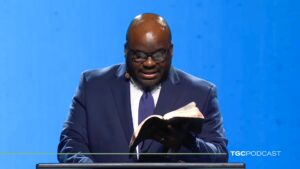
Listen or read the following transcript as D. A. Carson speaks on the topic of Truth in this address from The Gospel Coalition Sermon Library
The term postmodernism is excessively ugly. It’s not particularly transparent. One has to sort out what modernism is before one can figure out what postmodernism is. The term itself was first coined in the last century. Then it died and reappeared in this century in the first third in connection with architecture.
There was a style of architecture designated modern and then the style changed. Where do you go from there? Postmodern was affixed to it just because at that point modern was no longer referring to that which is contemporaneous but that which happened to be contemporaneous at a particular point which no longer was. As a result, postmodern came to become a popular expression in this century.
By the 70s it was applied to several domains including economics. By the end of the 70s it was being applied to almost everything. Its semantic range was enormous. Above all, however, it has to do with the domain of epistemology. That is, the study of how we know or think we know. Increasingly, that is the way it is used by those who analyze culture.
At the risk of a rather stylized history of Western intellectual thought, let me run through three distinct periods of epistemology that have brought us to this period. The period before modernism in Europe had an epistemology that operated something like this. The overwhelming majority of people who thought about such matters believed that there was a personal, transcendent God who knew everything.
All human knowing is some subset of his exhaustive and perfect knowing. Anything I know truly is some very small part of what God knows truly and perfectly. That means all of my coming to know anything is necessarily bound up with some form of revelation. It has to do with the domain of how this God who knows everything imparts some small bit of what he knows to me.
In that connection, Thomas Aquinas, a medieval Catholic scholar, and John Calvin, at the height of the Reformation, were in perfect agreement. They disagreed on how much knowledge came through the various domains, but they all agreed that human knowing was, at the end of the day, a subset of God’s perfect and exhaustive knowing.
What we call science today is coming to terms with what God knows about the natural order. It came eventually to be called natural philosophy. We may learn things from Scripture or in the context of the church, but in any case, it’s some form of revelation, of God’s self-disclosure by which we come to know some small part of what God knows.
History is messy. One does not get a turn in the realm of epistemology that takes a year or two or a decade or two or even a half-century. There are huge sweeping movements and countercurrents and so forth. Most people who talk about these things nowadays fasten on the figure of RenÈ Descartes and the origins of what is now called Cartesian thought.
In first year philosophy books, Descartes is sometimes presented as a skeptic, a first systematic skeptic. He wasn’t. He was a devout Roman Catholic who was discovering that many of his friends to whom he wanted to share his understanding of the Catholic faith had moved into a realm of epistemology in which they no longer accepted the existence of an omniscient God as a kind of foundation for all further discussion.
He wanted to find some foundation, some basis by which he could proceed to convert them to Catholicism. In due course, he came up with his famous cogito ergo sum. “I think, therefore I am.” He was so chuffed with himself (there’s pretty good evidence for this) that he went off to the monastery of Saint Anne’s and offered prayers of gratitude for having thought this one up.
In fact, he wasn’t the first one to say that or to say something like that. In the fourth century, Saint Augustine had said, si fallor sum. “If I err, I am.” But Augustine said this just in passing. He didn’t make it the foundation of a whole epistemology, a way of thinking about knowing. So Augustine never became famous for that particular utterance.
Probably, in fact, Descartes had read it, since Descartes was extraordinarily well-read, and it may have stuck back there in the craw somewhere and come out in this revitalized form. In any case, in the 1630s his magnum opus appeared and that work, extraordinarily subtle and insightful in many ways, came to be the fountainhead, or at least the figurehead of what came to be called modern epistemology. I think, therefore I am.
Notice some of the elements built into this already. Whether you agree that this is a sound statement (I think, therefore I am), from Descartes’ point of view this was a kind of baseline that no rational person could deny. It was a kind of foundation. From this foundation, he felt he could build up by a series of observations and inferences an entire structure that would convince reasonable people of the truth of Catholicism. That’s what he thought he could do.
In some ways, Descartes’ significance goes way beyond that rather failed evangelistic enterprise. His significance really is in developing a form of epistemology that leaves God out of the equation. You do not begin now with a God who knows everything, a kind of reservoir of absolute knowledge. You begin with me.… I think, therefore I am. Most people outline the elements of modern epistemology along the following lines.
1. It begins with a finite human knower.
You’ve lost the reservoir of an absolute mind.
2. It believes that certainty is both desirable and attainable.
It holds that by the proper creation of a scientific epistemology it is possible to be certain about things.
3. It is profoundly foundational.
(Although the expression foundational was invented later.) What Descartes was after was a foundation that no one could doubt, an axiom, something that was self-evident, and on this foundation then, by appropriate methods and logic, a whole structure of epistemology could be built up. It was profoundly foundational. Eventually foundationalism broke into different camps, evidentialist and the like, but in any case it was profoundly foundational.
4. It developed, in due course, rigorous methods.
Basically, modernist epistemology came to be a proper foundation plus properly defined methods with the assumption that if you turn the crank, out comes absolute truth. You begin with foundation, you establish your methods, then you turn the crank and out comes absolute truth.
It was thought that this would work in just about every discipline. It has worked extraordinarily well in the so-called hard sciences. Until fairly recently it was presupposed that it would work well in all of the other sorts of disciplines as well if you give it enough time. Thus, Marxist historiography was really based on that kind of assumption.
The idea was that Marxist historiography was scientific. If people didn’t see it then perhaps their foundations weren’t right or their methods weren’t good, but if you had the appropriate foundations, a proper dialectical understanding of the tensions between economic units and social obligation and the individual, then by turning the crank, eventually you could come up with a scientific historiography.
If people disagree with that, then they’re nuts in exactly the same way that people are nuts if you explain to them how a water molecule is made up of two atoms of hydrogen and one of oxygen. If you explain it to them and they don’t see it, then there’s something wrong with their brains. You don’t allow them to go to university or you put them in insane asylums. They clearly don’t have it. They’re not up to snuff intellectually.
The same is true also in the domain of theology. People kept writing books on the assured results of modern criticism. Eventually it was noticed that the assured results kept changing, but the analysis of these assured results in their change was ascribed finally to faulty methods (we’re refining our methods) or faulty foundations (we’re improving our foundations). At the end of the day, the aim is still this epistemological certainty, and it was meant to be applied to every domain of discourse, not merely the hard sciences.
5. Increasingly, it came to be naturalistic.
It wasn’t that way for Descartes; he was a Catholic. In the first two centuries of Cartesian thought, most thinkers were deists. Some were Christians. Very few were atheists. In this century, however, naturalism has been on the rise, so modern epistemology has often been tied very strongly to naturalistic assumptions.
6. Modernist epistemology has been connected with what is now called ahistorical universality.
That is to say, if you find something to be true, it’s true everywhere for all people at all times. If you discover in Peru that the water molecule is made up of two atoms of hydrogen and one atom of oxygen, that’s also true in Boston or in DC or in Pago Pago. It doesn’t make any difference. It’s universally true.
In the same way, if you do history or if you do theology or if you do English literature, what you find to be true is universally true. These sorts of assumptions in the modernist epistemology bring with them a number of implications. In the domain of hermeneutics, for example, the art and science of interpretation. In this way of looking at things, hermeneutics is that art or science by which you learn how to interpret things in order to find out the truth.
I, the knower, study it, the text or the thing to be examined, in order to find out the truth of what that text says. That’s the way hermeneutics works. Likewise, in the Christian church (in the modernist period) you found all kinds of people who were interested in studying hermeneutics in order to find out how to read the Bible.
The assumption being that if you found out how to read the Bible and turn the crank, out came ahistorical universal truth. Then in this connection as well, evangelism, articulating the truth, proclaiming the truth, within that kind of heritage becomes a matter of convincing other people that what you’re saying really is the truth.
They share with you this vision (because they’re modernists the way you are) of what truth is but your task then (if you are a Christian, whether you’re sharing your faith as an individual in some group or the like) within this framework is to convince people that certain claims made by the Christian religion are in fact true.
Thus, I can remember 25 years ago involved with Christian outreach talks and so forth in universities speaking under titles like this, Has anyone ever come back from the dead to tell us? You have to be sort of vaguely cutesy when you’re university. Then you’re dealing with Jesus and the resurrection. What kind of evidences are there for the resurrection?
Historically, there are very good evidences. You would hold that if someone really came to see that the evidences are plausible, credible, in fact in some degree convincing, humanly speaking you’re 70, 80, 90 percent of the way toward making someone a Christian. You might not put it quite like that, but that’s what you thought deep down.
Nowadays, much of this has gone. That’s why we’re in a postmodern world. The change didn’t happen overnight. Immanuel Kant, who is certainly not a postmodernist, held that the data that we receive from the phenomenal world, from the world of experience and sense, are organized by our minds.
There is not some kind of structure in thought that emerges right from data into an entire ordered science. The noumenal world, the world of spirit thought, controls what data we receive. Then sooner or later somebody’s going to ask the question, “Yes, but supposing human beings control such data differently?”
Some people see the Romantic period as a decisive break away from Cartesian thought. In some ways I suppose that’s correct. Suddenly the daffodils that are dancing are a way of accessing some deeper truth about the world, maybe even about God because God himself may become increasingly identified with all of reality. You are edging toward a pantheistic view of God.
It doesn’t really decisively break from the Cartesian model. The decisive breaks have really been in this century. They have come about in several different ways focused in different countries. In some ways this will be somewhat of a caricature, but I don’t see any faster way of breaking it out conveniently.
In Germany, the argument has been over hermeneutics. In France, it’s been over linguistics. In America, it’s been over sociology. That’s a vast oversimplification because nowadays people talk with one another on the Internet and share papers at international conferences, but there’s enough truth to that sort of caricature that we’ll let it stand.
Let’s begin with hermeneutics. In the modernist model, the Enlightenment model, we saw hermeneutics, the art and discipline of interpretation finds me, the knower, trying to interpret it, the other thing, the thing to be interpreted. The idea is that I would approach (in this case) the text and ask the right sorts of questions, which themselves emerge from an appropriate foundation.
In approaching the text and asking my questions, the text answers back. So I approach the text with these questions, it answers back, and I thereby learn some true things from the text. Now the scholarly interests in Germany were saying it must be recognized that the I who’s asking the questions is not an omniscient I.
If he or she were omniscient, he wouldn’t have to ask. If he’s not omniscient, then inevitably he or she is biased by the position he or she occupies. The questions I ask are a function of who I am, inevitably! I’m a white middle-class married Western male. Moreover, I have this amount of education and that amount of experience. I’ve lived in these countries, not those countries.
I got up this morning and I was reasonably happy. I had a good night’s sleep, but some other morning I might’ve gotten up really crotchety and grumpy because I’d stayed up until 4 trying to finish some paper or other. Maybe I’m having a fight with my wife and things seem very dour. Maybe I’ve just had a divorce.
Maybe I’m feeling guilty because I’ve got an affair going on the side. Maybe I’m about to get sacked at work. Maybe the doctor just told me I have leukemia. All of those things shape how I look at things, what questions I ask, what things I think are important. What was the last book I read? Inevitably, the contents of that book are a little closer to the fore in my thinking than some book I read 10 years ago. That effects what I ask too, doesn’t it?
Inevitably, not only the questions I ask but even what I can hear back are shaped by who I am. How can I possibly speak of objective methods in which I approach the text with a straight line and it comes back to me? Rather, it’s more as if I’d come up to the text and swipe it and then the information that it elicits, the data that it elicits, the response it provides … can’t be truth exactly, but it hits me a certain way.
I hit it and it comes back and hits me, as it were. There is a sense in which by hitting me it then changes me. I am no longer exactly the same person tomorrow when I approach that same text because now I have been swiped by the text once myself. If that’s the case, then the kinds of questions that I might raise and the kinds of answers that I’m open to hearing are themselves all somewhat tweaked.
In any case, my next-door neighbor or you, any of you will ask questions differently and hear things a bit differently. To speak in that kind of framework of objective truth is simply chimera. The straight lines back and forth just don’t happen. Rather, it’s more like a hermeneutical circle. It comes round and round and round. You’re in that circle.
It’s not a question of how you get in or how you get out. You’re in it whether you like it or not. That’s the nature of finitude. We’ve lost this omniscient base that was characteristic of premodern epistemology, so the very nature of finitude demands that we acknowledge our relative location and all of the finiteness of all of the things that we hear and experience and claim to understand.
The aim of the exercise, therefore, is not the acquisition of absolute truth. The aim of the exercise, depending on whether you’re talking to Fuchs or Ebeling (or one or two others) is Sprachereignis, a language-event, or Wortgeschehen, which means something like a word-event, a moment of serendipitous discovery, an “Aha!” experience in which you are enlightened or illumined, in which you see things you didn’t see before.
A fair bit of more radical German hermeneutics has worked out of some form of that model since the late 1930s. People have tweaked it in various ways to find ways of cycling in closer or the like, but that is the discussion that was generated in the 1930s and 1940s in Germany.
In France, the heritage has come out of the work of Ferdinand de Saussure. De Saussure is the father of modern linguistics. He died without having published very much, but he lectured prodigiously and his students took copious notes. Eventually they published, posthumously, a four-volume Cours de linguistique gÈnÈrale, which has now been translated into English. It is four volumes of Course in General Linguistics, which is really the foundation document of contemporary linguistics.
Again, de Saussure was not interested in these sorts of questions. There was no way he could be labeled a postmodernist. He was interested in language. Most of his discoveries in language have stood the test of time and most people have bought into them. Let me give you a very simple example.
He was very interested in the connection between what he called the signifier and the signified. Take the word tree. Why does the word tree mean tree? How do you get tree-ness out of tree? His argument is that it is, at one level, entirely arbitrary. Tree means tree only because as compared with all other words in English it doesn’t mean anything else. It’s a matter of difference.
It doesn’t mean tea. It doesn’t mean thee. It doesn’t mean three. It doesn’t mean hippopotamus. It comes to mean tree. It’s associated in our mind with the thing that’s outside your window and that’s growing, that you can climb out of or pick an apple from. It’s got no essential meaning of tree-ness. All you have to do is move from language to language to see.
In German, it’s Baum. In French, it’s arbre. How can you assign some value of tree-ness to tree? Thus he argues that the signified words, in particular, that interested him are intrinsically arbitrary and achieve their semantic force by differences from all other words. Well, this has been developed by Jacques Derrida, now an old man but still flourishing, into what has now been called deconstruction.
Derrida’s thought is extraordinarily complex. I have read it and reread it and reread it. There are parts of it that I think I understand reasonably well and there are parts that I’m still not sure I understand. Amongst the important things that he goes after, he says that this intrinsic arbitrariness to language is correct, but de Saussure made a mistake by locating it at the level of word.
It’s also at the level of syntax and the level of sentence and at the level of discourse. In every area there is an arbitrariness to meaning. It is bound up finally with differences that we make in conventional usage and even idiosyntactical usages. In due course, Jacques Derrida would argue that whenever you receive a text, even a text that on some superficial reading seems reasonably consistent and coherent, the reality of language is such that you can always find loose ends in it.
You can always find pieces that don’t fit. So that what is meant by interpretation, if you understand how language really works, its intrinsic limitations, what you are supposed to do is to deconstruct it. Hence, deconstruction. You are supposed to pull at the loose ends and adopt into you the pieces that fit where you are in your grasp and perception of the world now.
You may even use that new synthesis that is emerging in you then to attack what’s left in the text. In France, Foucault, who did not call himself a postmodernist, but whom just about everybody else does, was more interested in what he called the totalization of language. He says language, because it is spoken by people who are projecting their own power, their own influence, or the like, is inevitably manipulative.
Language, including his own, he would freely admit, is quite frankly distorting, a way of projecting power. Thus proper responsibility is to defang it, to analyze it in such a way as to strip it of the kind of manipulation that it inevitably discharges. Whether it is, “I love you” or whether it is “This is an act of war” or whether it is a whole discourse, in every case there’s a projection of power to it which domesticates some corner of society and debases people.
In this country, by contrast, much more work has been done at the level of the impact of social units, Stanley Fish, Richard Rorty, and others. There’s a wonderful example in Stanley Fish. He was lecturing on a course in seventeenth-century religious poetry, and just before that he was lecturing on a course in literary theory.
In the earlier course on literary theory, at the end of the class he put up on the board the name of the two editors of a book that he wanted his students to peruse. The two editors were Jacobs and Rosenbaum. Then the particular essays he wanted read were by Levin and Thorne and Ohman. He could remember whether it was spelled O-H-M-A-N or O-H-M-A-N-N, so he put a question mark next to it. They trotted off to do their homework.
Then in a moment of inspiration, in come the students for the religious poetry class. He puts a box around these names that he’s put on the board, and he puts “Page 43” at the top of the box. He says to this class of incoming students of seventeenth-century religious poetry, “I would like you to interpret that.”
They scramble and they talk amongst themselves. Jacobs and Rosenbaum? Rosenbaum is German for rose tree. Jacobs, bound up with one of the patriarchs. Clearly it’s something to do with the patriarchal Jewish heritage of the Old Testament that leads in a Christian worldview to the cross, the tree par excellence.
Under that, there’s Thorne. Well, you’ve got the “E” on, but then that’s Old English spelling. What do you expect? The thorns that Jesus wore on the cross. Levin? Again a bit of a funny spelling, but leaven is so often in the Bible a symbol for evil which the cross and the thorns of Christ address by Jesus’ own sacrifice on the cross.
They were having a little bit of trouble with Ohman, but one bright student suggested that this was finally breaking up into an expression of worship, “Oh man” (Which is a fairly glorious bit of anachronism.), but some doubted; hence, the question mark at the end. Fish, from all of this, derives the conclusion that every act of interpretation finally is a function not only of an individual but of some sort of social unit.
So that nowadays if you go off to university and you try articulating your Christian faith in an English class or a class on sociology or the like, chances are very good that some bright university lecturer will say to you something like this. “So you really believe that Jesus is the Lord or he’s God or he’s your Savior in some way?” “Yes.” Poor Ms. Christian has been daunted by this august lecturer.
“Did you come from a Christian family?” In many cases she would say, “Well, yes.” Or maybe she became a Christian in high school. “Do you go to a Christian young people’s group or a Christian church?”
“Well, yes.”
“You’ve read some Christian books?”
“Well, yes.”
“Don’t you think that you think like this, in part, because you have been with Christians?”
“Well, yes.”
“The Muslim sitting next to you.… Don’t you think that he thinks the way he thinks because he was brought up by devout Muslim family? Or the secularist two rows back.… Don’t you think that she thinks the way she does because of the way she was brought up? What right do you have to claim that your way of looking at things transcends the mere functionality of the particular social group to which you belong?”
In that kind of framework, nobody’s asking truth questions in the sense of objective truth. That’s modernist. In a postmodern framework, it is assumed that truth is a function of the particular social group that you’re springing from or that controls the discourse that you fall into.
Likewise, 25 years ago some sort of Christian outreach at university would go to quite a lot of pains to demonstrate that the evidence for Jesus’ resurrection really is very good (and it is!), yet today if you gave the same sort of address, in the first three or four questions would come, “Yes, but what about all the Hindus?” or “Don’t you think that because you’re a seminary professor? What do you expect? You read that kind of stuff, don’t you?” so that, increasingly, within this kind of framework a whole array of things undergo a subtle shift. Some of these are the results of this rising postmodern epistemology and some of them are mere correlatives. Let me list a few of them.
Tolerance changes its face. It used to be under the diktat of modernism that tolerance allowed you to claim that your view was right, was the truth, but you insisted that other people had the right to disagree with you. That was tolerance.
But in a survey done of university students at about 15 universities three or four years ago, students were asked, “Which person is more tolerant, A or B, where person A holds very strongly that certain things are true but insists you have the right to disagree and utter what you think is the truth and person B says not only that he doesn’t know but that he doesn’t think that anybody can know? Who is the most tolerant person?” Eighty-five percent chose B. Suddenly you see there is a very subtle difference in the very nature of tolerance.
Nowadays, the only heresy that’s left on most campuses is the view that there is such a thing as heresy. That’s heresy. It generates a whole new PC outlook, which itself is so profoundly socially determined, but that is the given that you cannot usefully break. The most insightful postmodernists, David Tracy, for example, at University of Chicago, they acknowledge this.
They acknowledge it quite frankly. They cannot anchor their PC perspectives in some transcendental claim and don’t want to. They say, “This is where we are. This is what it means to be a modern postmodern, humanist thinker.” Within that framework then proselytizing takes on a new light.
If you’re witnessing to your faith, then if you proceed along the line that says, “Well, I would like to share with you my religious experience and you share with me your religious experience. We’ll all have a shared discussion together,” nobody’s offended. If you say, “I would like to share with you what I hold about Jesus Christ, and I really do hold that he is the only way to God,” then you’re a narrow-minded, right-wing, modern bigot by definition.
The rules of discourse have changed in this kind of framework. It’s not that there are competing truth claims out there and now you’ve got to arbitrate. You’re already dismissed in the first place as a bigot. Then within that framework there are other elements: the pressures of secularization have pushed these developments along.
Secularization in technical literature does not refer to those processes in society by which we abolish religion; it refers to those processes in society by which we shove religion to the periphery of discussion. You can be ever so religious; it just doesn’t matter any more. It’s hard to believe, but at the end of the last century, until he died, the messages of C.H. Spurgeon, who preached until his death in 1894 in London, were transcribed and cabled across the Atlantic to be published weekly in the Thursday issue of the New York Times.
It’s very difficult to imagine anything like that today, isn’t it? The domain of religion just doesn’t operate the same way. It’s all right to be a Christian so long as you don’t say anything in public, especially anything in public that is connected with anything governmental because you’ve got to handle this wall of separation between church and state.
Perhaps it shouldn’t say anything moral because then it’s meddling. It shouldn’t say anything that says anybody else is wrong because then it is modernist. And so on and so on. It becomes terribly circumscribed. So you go off to university and you face all of these pressures, and if your faith survives as a Christian, unless you are being nurtured by some strong and thoughtful Christians, it is likely to survive in an extraordinarily privatized form, in which it may be of some help to you but it is no longer something out there in the marketplace of ideas.
Even when you have some group coming along like Heaven’s Gate. Did you listen to the discussion in the news and in the papers? I heard one Washington columnist alone say something responsible. The rest went out. The strongest adjectives you could find anywhere were bizarre or odd. No one would come out and say, “This group was wicked. This was evil. It manipulated people. It moved them toward mass suicide.” No, “They found it relevant in their own lives. It was a trifle bizarre from our perspective.”
You’re not allowed to say anybody’s wrong anymore. I have learned tomes at home that prove conclusively out of a postmodern perspective that child sacrifice is perfectly acceptable if you’re in the right kind of religious group, offering babies to Moloch, in Old Testament terms. Then to add to all of that is the rising biblical illiteracy of the age.
Again this is neither cause nor affect. It’s a correlative, but these things begin to link together. The people to whom I talk about Christianity in university campuses (which is where I tend to talk about these things; that’s where my examples come from, inevitably), the vast majority of them, if they are non-Christians, don’t know the Bible has two Testaments.
I’m serious. They’ve never heard of Abraham, never heard of David, never heard of Solomon. If they’ve heard of Moses, it’s because they confuse him with Charlton Heston. There’s no grasp of even the big events in the Bible, let alone the Bible’s storyline. It’s just gone. This has an effect not only in Christians trying to share their faith, but it has a huge effect, for example, on English teachers who are trying to teach English literature nowadays.
Because so much of English literature in the West has been profoundly influenced by the Bible. Not only the actual stories but the metaphors and the allusions and the figures of speech and so forth. It’s almost impossible to plumb that literature intelligently in my view without having some grasp of the Bible, whether or not you believe the Bible.
The Bible is a closed book to the vast majority nowadays. Clearly, if the Bible is a closed book then it becomes easier to write it off in some quick, dismissive tone as that which belongs in the past, the modernist period, or worse the premodern period of superstition than it is to engage it in all of its claims to an alternative worldview.
Let me tell you the titles of some books. The New Literary Criticism and the Hebrew Bible; Reading Sacred Texts through American Eyes; Deconstructing the New Testament; Mark and Luke in Poststructuralist Perspectives; Poststructuralism and the New Testament: Derrida and Foucault at the Foot of the Cross; Liberating Exegesis; The Open Text.
This is my discipline. You must understand, I have all these books, and I’ve read them. It’s another world from where we were 20 years ago. Before I press on with some sort of response, if you say, “That surely is the intellectual elite. That’s the university world. That’s what you’d expect from professors and people who can’t handle screwdrivers.” It just isn’t quite that simple.
This is permeated throughout the whole culture so that even people who have never, ever heard the term postmodern are often postmodern right down to their socks. Three or four years ago, Star Trek: Voyager came out. We don’t watch a lot of TV in our family. Our rule of thumb has been the kids don’t watch TV unless one of their parents do.
Since we don’t watch much, they don’t see much. This means that we never use it as a babysitter. I thought, “Well, after supper one night, Star Trek is going to be on. New series. Sit down with the kids and see what it’s like.” I could scarcely believe my eyeballs. Basically the same old plots. Upgraded graphics. Usually slightly inferior acting. But a massive change in worldview.
The initial Star Trek was modernist through and through and through. This new Star Trek is postmodernist through and through. Through the media and in other ways, these changes are everywhere now. It’s not the preserve of some elite university in New England or something like that. One understands in reading these things sometimes conservatives have sometimes responded with a kind of despondency. Many of them love to cite Yates, although Yates has been dead for decades.
Things fall apart; the center cannot hold;
Mere anarchy is loosed upon the world,
The blood-dimmed tide is loosed, and everywhere
The ceremony of innocence is drowned;
The best lack all conviction, while the worst
Are full of passionate intensity.
How shall we respond to this? In the few moments that are left in me, let me merely outline some ways to think about this. I’m speaking out of a Christian frame. I’ll outline some ways to think about this, and then we’ll open it up for discussion.
1. It is important to recognize certain strengths in postmodernism.
From a Christian point of view, I would argue that an informed Christian epistemology should be neither rigorously modernist nor rigorously postmodernist. There are some strengths in postmodernism. I’ll criticize it in a moment.
For a start, it has done yeoman’s work in questioning the claimed authority of a great deal of modernism, which can be useful. There is sometimes an arrogance bound up with modernist interpretations that is not only reductionistic but frankly idolatrous. Moreover, even from practical experience.… This is a global village. Everybody keeps reminding us.
You can get on the Internet and talk with people from East Africa or talk with people in Shanghai. You quickly discover that people do have different ways of looking at things. For 10 years I worked part-time with the World Evangelical Fellowship. I organized international conferences that brought people together from the five continents to talk about this, that, or the other.
It was extraordinarily interesting to find the different perspectives that people brought to the table. This was within a group that shared the common authority of Scripture. Moreover, we Christians, above all, should recognize even more than the postmodernists themselves that reason itself is never a final and sufficient arbiter of truth.
Because we not only acknowledge our finiteness, we acknowledge the fall. We’re not only limited in what we can understand, but quite frankly, we’re perverse. Because of that, we are prepared to suppress the truth, to twist the truth, to distort the truth. Especially if it comes home and starts calling our moral suasion into the clear light of day or if it puts claims on our allegiance or the like. It can be terribly threatening.
There is a sense in which we should not be too quick here to condemn all there is about postmodernism. Moreover, we recognize surely if we read the Bible at all that access to knowledge about God, though there is from a Christian perspective propositional knowledge about God that this omniscient God has in fact disclosed.
Yet the Bible is full of more things than just propositions. There is praise and lament. There is beauty. There is apocalyptic metaphor. There is lyric. There are ways of getting at perceptions of reality besides mere propositional logic. That, too, we should recognize. There are some things to be grateful for in postmodernism.
2. Practical experience, I think, shows that accurate communication is possible.
This is not a theoretical response. This is purely ad hominem. I’ll approach a more theoretical response in a moment or two. Even at the ad hominem level, we should recognize that, surely. In the course of writing my book, The Gagging of God, I read about 1,100 books and articles and read the reviews of countless numbers of those books.
In some cases, when a book was reviewed in a hostile fashion, the book’s author would reply with a later letter or the like to the learned journal. In no case where there was a hot and bothered author who was a self-confessed postmodernist, did he or she respond by saying, “Well of course if he wants to read me that way, what do you expect? It’s a postmodern world. People are going to read things in different ways.”
In every case they would say something like, “They really didn’t understand me at this point. I wonder if they really read the book properly. What I really meant was this. You can see that on page such-and-such this is what I really said.” In other words, when it came to their own books, these postmodern authors were without exception committed to authorial intent provided they were the authors, which surely tells you something.
It is not theoretical answer, but it does warn you that there’s something wrong with the theory that doesn’t accommodate that very easily. About 12 years ago at the seminary at which I teach, which is an evangelical seminary, we worked on an evening course together with other seminaries in the metro Chicago area.
There was a Catholic one and a Lutheran one. Various forms of skepticism were well-worked into the system. What we were supposed to do on each of these eight or ten nights, each of us having about three hours for one night, was to offer a kind of evangelical or Catholic or liberal Lutheran or whatever view of hermeneutics. That is, of how you go about interpreting the Bible.
I was supposed to do the three-hour bit from evangelicalism. I did my bit and then there was a question time with these students from the various schools. Some of these were Master’s students. Some of them were Doctoral students. There was a very sharp young woman from another seminary. I knew nothing about her at all except that she was a Doctoral student there.
When I finished, she said something like, “You know, I disagree with just about everything you say. What you’ve given us is a whole lot of modernist stuff. I think you’re out of date. I don’t think you’ve understood contemporary discussion very well.” I didn’t think I was as bad as all that, but maybe I was. I knew even less about the subject then than now.
I tried to defend my ground, and I couldn’t get by her and she couldn’t get by me. It was a bit of a frustrating discussion. Then in a moment of sheer perversity on my part, I said to her finally, “I think now I perceive what you’re saying. You’re using irony in order to affirm the objectivity of truth.”
“I’m not doing anything of the sort! You’re twisting everything I’m saying! I’m not saying that. I’m saying just the opposite of that!” I said, “This is terrific! To irony you’re adding emotion in order to affirm the objectivity of truth.” “I’m not doing anything of the sort!” She got angrier and angrier.
Finally, when she finally cooled down I said to her, “But that’s how I’m reading you.” I told you it was perverse. It wasn’t kind. Then I had to apologize for being rude. She didn’t ask a question for the rest of the course. Because she kept replying, “You’re twisting what I am saying. You’re willfully misrepresenting me.”
She wanted to attach authorial intent to her own words. That doesn’t prove anything. That’s not a theoretical response. At least you ought to recognize that a theory which doesn’t handle that sort of basic level of communication has got something wrong with it somewhere. It has to be a little more sophisticated than that. In the best cases, it is.
3. Postmoderns, as far as I can see, regularly offer us an absolute, but utterly indefensible antithesis.
Once you understand that antithesis, you understand a great deal. They offer us an absolute, but in my judgment indefensible, antithesis. Let me explain. They offer us an either/or, an antithesis. If you buy into that either/or, you lose.
You have to expose the antithesis as a false one. The antithesis is this: Either you can understand something absolutely and wholly and comprehensively and truly or you are lost in a sea of some form of profound relativism. You can always show that finite human beings cannot understand anything except that which is neatly defined by themselves. Universally, completely, comprehensively, wholly, and truly.
Because everything is connected with something else. You’re going to miss some of the connections somewhere. If the alternative to this is this, then the absolute relavist wins every time. I was beginning to think through some of these things some time back when I was reading Paul de Man, who again is another Frenchman who did a lot of his work in his later life in this country and has now died.
In one of his books, he’s trying to prove this antithesis without calling it that and gives an example of Archie Bunker. In this august assembly, may I be so presumptuous as to hold that everyone here knows about Archie Bunker? Archie Bunker is the quintessential redneck. He hates women. He hates blacks. He hates intellectuals.
The reason he is so funny is because all of these attitudes are beings poked at by the scriptwriters. They were taking the mickey out of this sort of right-wing attitude all the time. It really was quite a clever program. In one particular scene, which Paul de Man goes on to describe, he says Archie’s wife, Edith, brings in his bowling shoes.
She says, “Archie, do you want your bowling shoes laced up or down?” He says, “Ah, what’s the difference?” She says, “The difference, Archie, is if you lace them up, you start at the bottom of the holes and you come up. Then you go into the next holes and the next holes. If you want to lace them down, you start at the top and you go down.”
She’s explaining all the difference between lacing up and lacing down. The audience is killing itself laughing because (in the words of Paul de Man) what Archie Bunker meant when he said, “Ah, what’s the difference?” was, “I don’t give a damn!” That’s what he meant. From this, Paul de Man goes on to say even in the simplest area of communication there are “vertiginous possibilities of referential aberration.”
Reference refers to something. There’s meaning in the text, but then the text talks about something in itself. Referential aberration. You’re understanding it to refer to something else when it’s really referring to this. Vertiginous possibilities. Very steep, calamitous possibilities of misunderstanding what the text is actually referring to.
When I read that, I took off my glasses that are my official badge of middle age and I thought, “Give me a break! Who’s misunderstanding this? Edith! She is the characteristic twit. She’s supposed to misunderstand it. That’s why it’s funny. Everybody else is laughing because they understand that it is a pun and it could be taken either way. The only other person who didn’t understand it was Paul de Man!”
You quickly discover in this literature that people are driving constantly toward this absolute antithesis. Either you understand stuff absolutely, comprehensively, holistically, and truly or you’re lost in a sea of relativism.
4. There are some models that can be used for thinking through the knowledge of objective truth, however limited it might be.
Instead of having a circle that goes round and round and round, quite a number of writers have developed more of a model of a spiral that comes in and in and in, so that as you approach a text closer and closer and closer then you understand more about the text.
When you first read a text and you don’t understand any about that world, then you may be quite a long way out. What you hear it saying, it may not really be saying. If you’ve never read any of the Gnostic literature, for example, and suddenly start to read the Gospel of Thomas, it really is odd. You won’t understand it. What you do understand, you probably misunderstand.
As you go into that kind of literature and read in and read in and read in, it begins to make more sense. It’s a bit like the book of Revelation in the Bible. That’s apocalyptic literature. People wrote a lot of that between about 200 BC and AD 100 to 150. Nowadays nobody writes it, so it’s an odd book.
On the other hand, if I were teaching an ideal course on the book of Revelation, my first assignment would be 500 pages of reading of Second Temple Judaism apocalyptic, because then you discover how a lot of the symbols work. As you get closer and closer and closer in, then the last book of the New Testament sounds a little less odd too, because it was written at a particular time and place. It belongs to a certain literary genre.
Then there’s another model that’s used by some. This one was developed in Germany. It’s called the fusion of horizons model. In this model, your understanding is looked at as if it were a horizon, because as you understand things it’s akin to looking out. When you look out and you look on the horizon, that’s what you see. That’s your understanding.
The horizon of the apostle Paul as he writes the book of Romans is here and your horizon of understanding is here. The question is, then on this model, how you can somehow fuse your horizon of understanding with Paul’s? You can’t do it absolutely. You’re not Paul. You can’t think yourself into the first century absolutely. You can go through a process of distanciation.
You distance yourself from your own presuppositions to a large degree. You try to find out what those words meant for Paul, what his presuppositions were, what else he wrote, how he looked at things, what his vocabulary was. You may not be able to get right inside Paul’s head, but to a very substantial degree you can distance yourself from your own horizon of understanding and then line it up with Paul’s with a sufficient degree of fusion that you can get some transfer of data across.
It won’t be perfect. You will never understand Paul perfectly and exhaustively. You may understand some part of him truly. Another model that was developed in science by Karl Popper. This is the asymptotic model. If you have an X-Y axis, along the X-axis you’re dealing with time and on the Y-axis you’re dealing with a degree of understanding of something, so that you can imagine an asymptote, a line that starts up here and comes down and get closer and closer and closer to the X-axis, but never touches it. That’s an asymptote. That’s an asymptotic approach.
Picture Johnny, age 7, brought up in this church, catechized nicely, good Sunday school teachers, and good parents. You approach Johnny and you say, “Johnny, do you believe God loves you?”
“Yes.”
“Why do you believe God loves you?” He’s only 7, after all. He says, “Well, Jesus loves me, this I know. For the Bible tells me so.”
“Where did the Bible say that? The Bible doesn’t have any bits in it about Johnny. How do you know that God loves you?” He thinks and he thinks and he says, “Well, the Bible says ‘God so loved the world that he gave his Son.’ I’m part of the world. He must love me.” Has Johnny understood John 3:16?
I mean, has he understood the Greek verb agapao, to love, and its relationship to phileo and other words in the semantic domain? Has he understood what kosmos means? World in John’s gospel. World is not a big place in John’s gospel. Primarily, it’s a bad place. When you say, “God so loved the world,” in John’s gospel, you’re not to admire God’s love because it’s so big; you’re supposed to admire God’s love because the world is so bad.
Does Johnny understand that? Does he understand that a mere 20 verses on, in verse 36, “The wrath of God remains on those who disobey.” How does John’s gospel sort out God’s love and God’s wrath? Has Johnny given that any thought? He’s only 7. He probably still thinks in terms of cuddles. Does he understand?
Of course he understands, but on this graph he’s way up here still. He’s not far along in his years and he’s way up here, but he’s in the right quadrant. He’s not thinking it’s about the sex life of sea turtles down here or about nuclear power and the strong force or anything like that. He’s in the right domain.
As he goes on and studies more and thinks through and grows up and eventually does a PhD at Trinity in the theology of John’s gospel against Jewish background, has he touched the line yet? No, he’s still finite. If we may project forward 50 billion years into eternity, has he touched the line then? No, omniscience is an incommunicable attribute of God.
He’ll never know the way God knows. That doesn’t mean he can’t know truly. He may know truly without knowing exhaustively. He may know some things truly without knowing them in all of their possible domains and connections and interlacings and so forth. There are many models, in other words, that offer us alternative ways of thinking about these things than the absolute antithesis that is foisted upon us.
We’re just about out of time. Let me end with just a couple of brief comments. Interestingly enough, in this world that is increasingly secular in many ways, there’s a rising interest again in something vague called spirituality. Spirituality is coming to mean almost anything. It’s an exceedingly slippery world. You sort of feel improved by crystals.
That’s part of a pantheistic framework of spirituality for some. Whatever as Christians we might not like in such forms of spirituality, what is increasingly obvious is that those who are interested in “spirituality” are interested in the authentic. At heart, that’s what an awful lot of people seem to me to mean by spirituality.
Whether you think they have found something authentic in their crystals is another issue. At the end of the day, they want some connection beyond what they judge to be the mere aridness of propositions and scientific discovery, or at least technology. It’s just too narrow, too arid. They want some connection with something of transcendental importance.
Within that framework, I would want to argue, there is an immense biblical opportunity. Because however much Christians insist that the Christian gospel is objectively true and can be known, we also insist that it transforms people. The worse possible thing we can do as Christians is talk about the truth of the gospel while remaining harsh or bitter or unforgiving or nasty or mean-spirited or the like.
This world is looking for people who are genuinely authentic, who have a sense of the knowledge of God that is, no doubt from our perspective, based in truth that God has disclosed, but nevertheless has been so transforming that our witness needs to be self-consciously more and more holistic.
Now for the last thing, and it’s by far the most important thing. One of the most important things we must do in this framework is recognize that biblical Christianity entails a worldview. Let me explain the importance of this. If you were talking about Christ 30 years ago to an atheist, that atheist would likely be a Christian atheist or a Jewish atheist.
The kind of God he or she disbelieved in would not be a generic god. It would be a Jewish God or a Christian God, because that’s the cultural heritage we’ve received in the Western world. It wouldn’t be a Buddhist perspective to the divine. It wouldn’t be Krishna by and large in the West. It would be a Jewish God. It would be a Christian God.
It would be some form of Judeo-Christian biblical God whose existence was being denied. What that means is that the frame of discourse is still in our camp. You’re still talking about the same thing even if one party is believing it and another party is disbelieving it. You still share the same camp.
In that kind of framework when you start talking about Christ and Christian truth and the forgiveness of sins and all of these sorts of things, then you’re talking with people who by and large still know something of the Bible’s storyline. They know how it works. That’s decreasingly the case.
Nowadays, although many, many postmodernists are interested in stories, partly because stories are often open-ended, what they’re suspicious of is the big story, the metanarrative. Metaphysics is the kind of physics that underlies all the other physics. It’s the approach to all the realities that explain all the physics.
The metanarrative is the big story that explains all the other stories. Christians insist that to make sense of Christianity there is a metanarrative. There is a big story. If you open up your Bible and read some interesting story about Naaman or Naboth’s vineyard or flip over to a parable, or pick up the account in Luke of Paul’s shipwreck you can get some sort of interesting story out of that.
To make sense of Christianity, to come to terms with it, to begin to think about it, even to challenge your own epistemology, modernist or postmodernist, sooner or later you have to see it as a package. Now 30 or 40 years ago there was a far higher percentage of people in the Western world who understood something of the way that package looked.
It could get distorted at this point or that point, but nowadays the loss of common heritage means that most people that we’re talking to about the Lord don’t know anything about how that package works. When I start talking to university students about Christianity, as I’m sometimes asked to do, I don’t go in and say, “Let me defend Christianity.”
I usually begin and say something like, “If you think I’ve come here to defend Christianity, guess again. Quite frankly, some of you don’t know enough about Christianity to know whether my defense is any good anyway. Let me tell you what Christianity is and what it looks like.” Then that gives you an opportunity to spell out the storyline.
Then we insist that that storyline is true. Then that inevitably raises some sparks. Then eventually you start talking about the plausibility of knowing truth. You’re getting into the kind of apologetics that I’ve been talking about this evening. At the end of the day, you still haven’t done anything about Christian witness until you articulate the storyline, until you lay out how the Bible is put together.
If you think that the basic human problem is alienation then, God help us, what we need is a psychotherapist. If you think that the basic problem is economics, then what you need are some brilliant economists. If you think that the basic problem is finally sexual, then we need some more Freuds.
But if, at the end of the day, the problem behind all other problems is that we have rebelled against a personal, transcendent God who is actually there and who made us in his image for his glory and for our good, before whom we have shaken our puny fists and sung with Frank Sinatra, “I did it my way,” then what we need above all else is to be reconciled to that God.
That’s what we need, above all else. And that, at the end of the day, is the message of Christianity, isn’t it? God himself has invaded this world to take action to reconcile his rebellious image-bearers back to himself. He insists that men and women bend the knee before him and come to recognize that the one he sent is somehow, in a strange way, one with God himself.
He came to bear our rebellion, our sin in himself. You cannot begin to deal with the truth issues in such matters without articulating them in the framework of that big storyline. It’s a worldview clash of immense proportions. All of Christian witness increasingly in this postmodern, biblically illiterate age must think increasingly in those global terms.