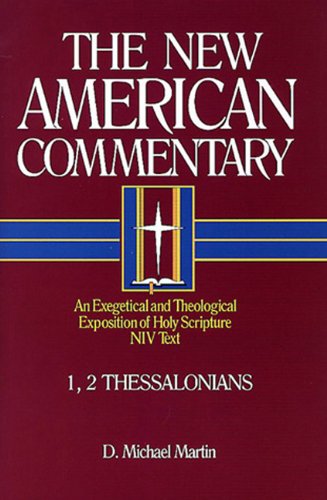
This commentary, by D. Michael Martin, an associate professor at Golden Gate Baptist Theological Seminary, is extremely well written and largely fulfils the intentions of the New American Commentary series for which it was written. The series is ‘designed primarily to enable pastors, teachers, and students to read the Bible with clarity and proclaim it with power’. The editors and the authors of the series ‘affirm the divine inspiration, inerrancy, complete truthfulness, and full authority of the Bible’, and this is clearly reflected in Martin’s commentary.
Apart from the usual front matter, the commentary consists of a 24-page introduction, followed by a 246-page exposition of 1 and 2 Thessalonians. The volume also contains a variety of useful indexes to assist the reader in accessing the commentary.
The commentary is based on the New International Version of the Bible, but Martin is not slavishly bound to the NIV and regularly prefers alternative translations. In line with the intention of the series this commentary does not break new ground, but it shows a generally adequate awareness of the recent research and scholarly debates on 1 and 2 Thessalonians and provides information for interested readers who may wish to pursue various matters further. Martin is particularly good about setting out in a clear and concise manner key areas of debate among scholars. When issues impinging on inspiration and inerrancy are involved, Martin comes down clearly in favour of traditional views: Paul wrote 2 Thessalonians; the book of Acts provides trustworthy historical information with which to supplement the information in 1 and 2 Thessalonians; 1 Thessalonians is a single, unified composition. But in areas where inspiration and inerrancy are not at issue Martin often takes a mediating position. For example, he accepts that the evidence is inadequate to establish with certainty the order in which the letters were written. His cultivated neutrality on some issues, such as the much debated problems associated with skeuos ktasthai in 1 Thessalonians 4:4, is, however, occasionally frustrating, and, as is the case with his exposition of 1 Thessalonians 4:4, may hinder the reader’s overall understanding of the passage.
One of the real strengths of Martin’s commentary is the way in which he tries to show the reader the conceptual and rhetorical connections that hold each letter together. His discussion of each thought unit is preceded by an introduction which situates the unit in the wider thought and rhetoric of the letter as well as illuminates various theological, rhetorical and epistolary features of the section to follow.
In keeping with one of the major goals of the New American Commentary Series, Martin attempts to provide the reader with practical contemporary exposition throughout his exegesis. This is no easy task, for at least two reasons. In the first place, 1 and 2 Thessalonians lack, with the exception of the theme of eschatology, any real discussion of many of the more important theological themes found in others of Paul’s letters (a point well illustrated by the fact that Martin finds only three theological themes in the two letters worth mentioning in the introductory section on the theology of the letters). Second, Martin’s use of the historical-critical method (the most widely used method in contemporary commentaries) has the unintended effect of largely limiting practical exposition to the moralizing and spiritualizing of Paul’s message, and on at least one occasion this leads him into a patronizing and offensive tone in his exposition (see p. 121). Expounding Paul’s message for contemporary Christians is profoundly important, but greater hermeneutical or interpretative sophistication is required than Martin demonstrates in this commentary.
In spite of the previous criticism, which applies to most commentators (myself included), Martin’s work provides a readable and informative historical-critical commentary written from an evangelical perspective. It can be recommended for pastors, Bible teachers and students who want a reliable, if not exhaustive, historical-critical commentary on 1 and 2 Thessalonians.