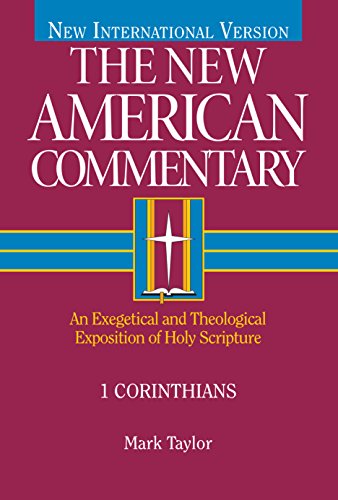
Mark Taylor, professor of New Testament at Southwestern Baptist Theological Seminary, enhances the abundance of literature available on 1 Corinthians with his recent expositional commentary. With this work Taylor intends a helpful resource for the church. He says, “I have written primarily for the church with the goal of producing a clear exposition of the text. I have not attempted to solve every exegetical problem, but I have tried to provide the reader with interpretive options and a lucid presentation of the argument and theological themes of the letter” (author’s preface). This review will explore whether he has accomplished his goal by revealing areas of strength and weakness in his commentary.
Taylor’s robust understanding of 1 Corinthians produces two significant contributions. First, I highly commend Taylor’s work as a guide for interpreting NT texts. His commentary demonstrates sound exegetical practices and offers insightful biblical-theological observations, culminating in a rich exposition of the text. For instance, when dealing with 1 Cor 1–3, Taylor demonstrates many parallels between chapters one and three which suggest that they should be included in the same unit. Taylor argues that Paul’s method is to make a propositional statement in chapter one and then invert it in chapter three. In 1:18–25 the cross is foolishness to the lost, but in chapter 3 the world’s wisdom is foolishness to God. In chapter one the way to become wise is to become a fool in the world and in 3:21 believers should disregard the wisdom of this age. In chapter 1 the Corinthians were claiming to belong to certain apostles, but in chapter 3 the apostles actually belong to the church. Taylor’s attention to this phenomenon in 1 Cor 1–3 greatly helps the reader keep Paul’s larger argument in view. Many other examples of sound exegesis and insightful biblical-theological observations appear throughout the book (e.g., see his discussion of love as Paul’s “crowning exhortation” in 1 Corinthians on p. 429).
Second, Taylor succinctly explains many difficult passages within 1 Corinthians. For example, after discussing three possible views of the phrase “It is good for a man not to have sexual relations with a woman” (7:1b), Taylor draws his reader’s attention to Paul’s main point in the passage: “Paul warns of ‘immoralities’ and emphasizes the obligations of spouses within marriage” (pp. 165–66). Later in 1 Cor 11 Taylor concisely describes what Paul means when he explains that a woman should cover her head because “woman is the glory of man” (11:8b). This reason for a head covering has perplexed commentators throughout the centuries, but Taylor helpfully summarizes, “The veiling of the woman has to do with the fact that she is man’s ‘glory.’ The purpose of the veil, then, is that people should not gaze on that which is man’s glory in worship since the focus is on God’s glory” (p. 262). In other words, first-century Christian women must wear head coverings so that they do not draw undue attention to themselves or mankind in general; instead, believers must glorify God in worship.
I now turn to two areas of weakness. First, sometimes (perhaps for the sake of brevity) the author fails to recognize or discuss possible views of controversial subjects. For instance, the perfect (τὸ τέλειον) is “undoubtedly” (p. 316) the final consummation of all things. Unfortunately, however, Taylor does not discuss other possible interpretations of the identity of the perfect including the completion of Scripture, the formation of the canon, or the maturity of the church. These other views, held by reputable scholars, are not even discussed in one footnote (in contrast, Rosner and Ciampa have one lengthy paragraph, Fee has three pages, and Garland has five pages). Instead, the author’s understanding is assumed to be the only one possible. In an earlier discussion about the meaning of not even eating with disciplined believers (5:11b), Taylor discusses whether the phrase means removal from the Lord’s Table or “exclusion from all private meals” (p. 141) without considering the alternative option of exclusion from eating with them in public/social gatherings (including at the Lord’s Table, the market place, and idol temples). Later, when discussing the “silence of women” in chapter 14, Taylor again fails to discuss at least one possible view. Some suggest that a woman’s silence refers to absolute silence in church gatherings (e.g. John Fish, “Women Speaking in the Church: the Relationship of 1 Corinthians 11:5 and 14:34–36,” Emmaus Journal 1 [1992]: 215–52), which might be the natural way a modern person would read this text. Other views are more likely in my opinion (and the overwhelming opinion of scholarship), but some mention of this view seems necessary.
Second, although normally lucid in his writing, Taylor occasionally fails to demonstrate his own views clearly on controversial subjects. For instance, his understanding of eternal security is unclear at times. When writing about those who “will not enter the kingdom” (6:9–11), Taylor exclaims, “Paul’s warning is not hypothetical but real. Those who persist in such behavior exclude themselves from the kingdom of God” (p. 149). Taylor does not clarify, however, what he means by “exclude themselves” or explain how the Corinthians might do so. The reader is left to speculate: the Corinthians might exclude themselves by disobedient behavior that results in either losing their salvation or revealing their false faith. Later, while commenting on the possibility that one might be ἀδόκιμος (“disqualified”) in 9:27, Taylor leaves the impression that many who initially profess Christ prove later that they were never true believers: “It is certainly the case that there are many in the church who profess faith in Christ but who do not possess genuine faith” (p. 224). In summary, examination of Taylor’s exegesis of 9:27 demonstrates his belief that some professing believers reveal through their actions that they are not genuine. His interpretation of 6:9–11 might be explained in the same way, but his comments on that passage allow for the possibility that believers lose their salvation by acting like unbelievers.
Other examples of a lack of clarity occur in his discussions about the mode of tongues speaking (i.e., foreign or angelic languages or unintelligible utterances, etc.) and about a man who commits immorality sinning against his own body. Taylor’s personal conclusions about these issues are either missing completely or intentionally obscure. To be fair, however, Taylor’s concise summaries of the multiplicity of views of controversial subjects in 1 Corinthians are normally well-done and offer much insight for the reader even if his own views are not always present.
Overall, Taylor accomplishes his goals of producing a clear exposition of 1 Corinthians and providing interpretive options for exegetical problems. The strengths of this commentary far outweigh its weaknesses, and any pastor or Bible teacher looking for a good midsized commentary will enjoy it immensely. Taylor has produced a helpful resource for the church, and I recommend this book to every person who desires a better grasp of the meaning and important themes of 1 Corinthians.