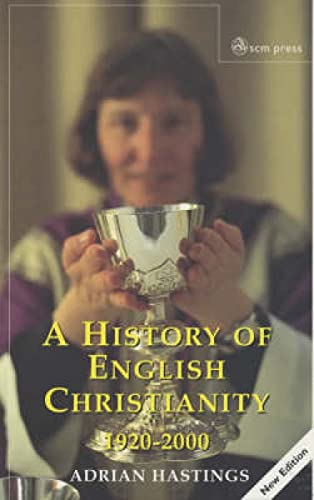
Fifteen years after it was first published, Adrian Hastings’ History of English Christianity remains the standard work in its field, unchallenged to any serious extent by other perspectives. His own Roman Catholic background is evident throughout, and he gives that church a more prominent role in English life than writers from other backgrounds would be inclined to do. At the same time, he underplays free church Protestantism, and in particular, he has little or nothing to say about the remarkable rise of ‘pentecostal’ or charismatic influences right across the board. Nevertheless, Professor Hastings is by no means uncritical of his own religious inheritance, and he does not hesitate to point out that the Roman Catholic Church has declined even more severely than the other major Christian denominations in the past forty years.
A second edition of the book, with only minor changes, appeared in 1987 and a third in 1991, which contained an additional chapter dealing with the 1980s. For the fourth edition, that chapter has been moved to the front of the book and supplemented by another section on the 1990s, which contains the bulk of new text.
Professor Hastings admits that it is impossible to prophesy what will happen next, and therefore extremely difficult to give a balanced assessment of the most recent period. For the major churches, it has undoubtedly been a time of considerable internal turmoil and continued decline in institutional terms, but there also significant signs of renewed life (like Alpha, for example) which Professor Hastings does not mention. He is quick to point out how English historians have revised the past to such an extent that the Protestant Reformation can no longer be taken as a given, but he fails to notice the equally strong revival of interest in the Protestant theology of the English Reformers, especially of Thomas Cranmer.
Nevertheless, it seems that Professor Hastings’ conclusions can be endorsed in at least two important areas. The first of these is Roman Catholicism, which he portrays as enjoying a new respectability and influence in establishment circles, largely thanks to the efforts of a few individuals like the late Cardinal Basil Hume, but which he also realises is in catastrophic decline at the grassroots level. He recognises that the most vibrant leadership among the young is almost all Protestant, and Evangelical Protestant at that, though he warns against making too much of this, since young Evangelicals have a way of going off the boil and becoming more liberal establishment figures as time goes on.
Evangelical Protestantism is the second area where it seems that Professor Hastings has hit the mark, and given his distance from, and general lack of sympathy towards that position, he must be congratulated for his perception. His words on this subject should be carefully pondered by every reader of Themelios, however uncongenial they may find them to be. A sample (xlv) will show just how painfully accurate he can be: ‘It seems characteristic of Evangelicalism both to appeal especially to youth and to make rather grand claims in regard to its advances … Many young Evangelicals fall away or merge sooner or later with the wider believing community, escaping the grip of its too often rather juvenile theology and spirituality … The consequence is that Evangelicalism looks like a tide always claimed to be just about to come in, yet never quite reaching the shore with the force proclaimed.’ Here is a judgement which Evangelicals need to take to heart if they ever expect to be more than a marginal influence on modern English church and society. Whether they are capable of doing so and rising to the challenge which Professor Hastings confronts them with, may well determine the shape of English Christianity in the century which is just now beginning.