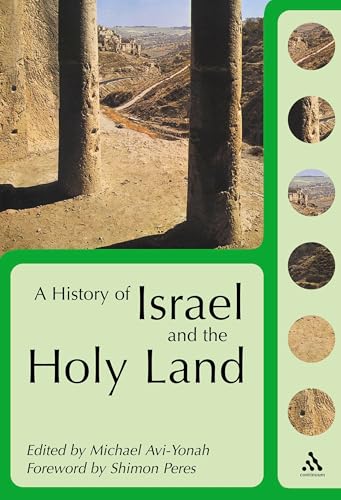
These two volumes from Continuum are presumably Intended for a general (perhaps older) readership, with a conventional feel, good quality paper and plenty of black-and-white illustrations. They are presented as revised editions of older works. However, the revisions are disappointing in several ways, and the resulting products are of limited scholarly use.
The History’s apparent editor Avi-Yonah died in the 1970s, yet no revision editor is named or explanation given, despite the last chapter relating events up to 2000. There are many photographs, but some look dated even for the 1970s. There are no scholarly references in the text, no footnotes, and no bibliography. Chapter 2 and half of chapter 3 cover the biblical period to 70 AD (sic), making about a third of the book. Early history largely follows the biblical text, though with the conquest occurring in waves. The rest gives a useful summary of post-biblical history of the land, with an inevitable if unobtrusive Jewish perspective. Helpful for a first read of ‘Holy Land’ history, but not a basis for academic study.
The Encyclopedia starts a little better, with a named revision editor, list of contributors, and many recent as well as older illustrations. However, all the articles are unsigned, so there is no way of checking who wrote what. And there are no bibliographies anywhere, so no means of following up information. The updating is often minimal, with only a summary list of recent excavation (in Megiddo) or excavators (in Jerusalem). Surprisingly for a Jewish publication, dates are still BC/AD. Often the information given is disappointingly brief (as for Qumran), and in many cases the reader is much better served by the Anchor Bible Dictionary. There is often an unquestioning acceptance of the biblical text (as for Massebah) in a way which ignores recent and heated archaeological debates. Some areas of current interest are unrepresented: there is no entry for Figurines, and I found nothing on the highland settlements. A possible first source for summary information, but any serious student will quickly need to complement it from elsewhere.