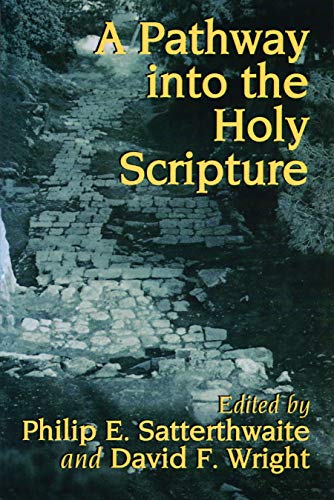
In 1994, the Tyndale Fellowship celebrated its 50th anniversary year by holding a jubilee conference at the Hayes Conference Centre in Swanwick, England. The published collection of the papers read and discussed on that occasion, A Pathway into the Holy Scripture, takes its title from a treatise by the organization’s namesake, William Tyndale (born 1494?). It reflects concern for the accessibility, interpretation and nature of the Christian Scriptures, preoccupations that exercised Tyndale during his life and which the Fellowship has since featured.
In line with this concern, the book offers essays by some of the Fellowship’s best-known members on these and related issues central to its mission. To quote the back cover, ‘this volume as a whole gives an up-to-date picture of evangelical scholarship across a wide range of theological disciplines’. Specifically, Pathwayincludes essays on the life and aims of William Tyndale, OT and NT studies, systematic and biblical theology, hermeneutics and the inspiration of Scripture, and the influence of the Bible on the church. Contributions include a Preface by David Wright and chapters by Carl R. Trueman, Carl E. Armerding, Craig L. Blomberg, Brian S. Rosner, Anthony C. Thiselton, Kevin Vanhoozer, A. Morgan Derham, H.G.M. Williamson, Howard Marshall, Gerald Bray, Nigel M. de S. Cameron, David F. Wright, Thomas A. Noble and Anthony N.S. Lane. Everyone who peruses this book will have some favourites among the essays, but this may be more a matter of what interests the reader than of the skill of the author. Or, to put the same thing another way, there is something here to attract all who pursue theology as a profession, whether one aspires to a study of Scripture, church history, systematics, or some other of the classic disciplines of Christian reflection.
That being so, one common complaint may be eliminated immediately. Often readers of a book of essays such as this are struck by the uneven quality of the contributions. Indeed, even in this volume there are undoubted differences of preoccupation and of the ability to communicate. Overall, however, the articles are characterized by their uninterrupted high quality, both individually and taken together. This is bound to make the purchase price of this volume attractive.
Does A Pathway into the Holy Scripture do what it set out to do? I think it does. William Tyndale would hardly recognize many of the terms in which the discussion is couched, which is inevitable given the changes that have occurred since he lived in even the matters under consideration, but he would welcome discussion of the issues; for many of them were current, and some were even first raised in his day. In that sense, he would probably not complain that the editors of this book have borrowed one of his titles. That very borrowing speaks of a commonality of concern with some issues vital in the life of the church and the life of the Christian. As for the level of the writing, while the essayists never speak down to the reader and could be read with profit by professional theologians, beginners in the study of theology will find much to instruct and guide in A Pathway into the Holy Scripture.