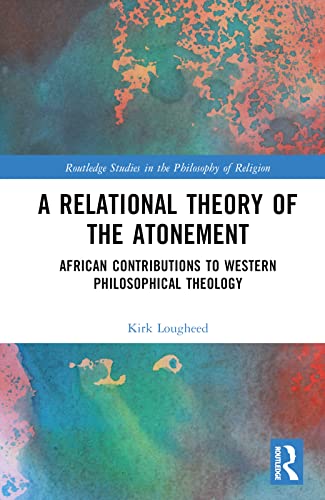
It has been said that analytic theologians are the magpies of the theological world. Rather than collect a variety of objects for nest construction, analytic theologians “collect” philosophical resources for theological construction. Analytic theology, simply put, is systematic theology that draws from analytic philosophical resources and is written in a style that conforms to typical analytic philosophy. While Kirk Lougheed’s monograph, A Relational Theory of the Atonement: African Contributions to Western Philosophical Theology, doesn’t purport to be “analytic theology,” some might be tempted to classify it as such. After all, it deals with an issue in systematic theology (i.e., atonement theories) and engages with analytic philosophy. One key difference, however, is that while analytic theology has tended to engage primarily with Anglo-American analytic philosophy, Lougheed’s work engages primarily with African analytic philosophy.
Lougheed presents a novel theory of atonement that draws specifically upon the work of African moral philosopher Thaddeus Metz. Lougheed’s aims are twofold. First, he hopes to make a case for the fruitfulness of engaging in African philosophy for addressing theological topics. He believes that African philosophy can help improve Western understandings of atonement. Second, Lougheed hopes to provide a novel account of atonement, one he dubs the “Relational Theory of Atonement.”
Lougheed’s proposal proceeds in several steps. First, he introduces Metz’s Relational Moral Theory. According to Metz, harmonious relationships are the highest good that ought to be pursued above all else. This assertion is in line with African moral intuitions. However, Metz refines this intuition by focusing on humanity’s capacity for such relationships. Metz’s use of the term friendliness, which includes identification and solidarity with others, is meant to capture this capacity for harmonious relationship (p. 20). Sin, on this framework, consists of unfriendliness. Unfriendliness impairs relationships with other humans and with God, thus reconciliation is necessary. With this framework in hand, he proceeds to address the issue of punishment. African intuitions, he writes, tend to reject punishment, especially the death penalty. Yet, it seems as though punishment, and a punishment of death, is necessary for salvation. Against these intuitions, Lougheed argues that African moral philosophy does not necessarily conflict with punishment and the death penalty. In fact, African communitarian ethics holds that “successful reconciliation consist in burdensome labor that is likely to foster moral reform on the part of wrongdoers and compensate their victims” (p. 33). Reconciliation involves burdensome punishment and disavowal of the wrongdoing. Punishment, he writes, should not be conceived as preventative or retributive. Punishment ought to be constructive. Having accepted the possibility of punishment, Lougheed turns to the African objection to the death penalty. The death penalty, it would seem, undercuts the constructive possibilities of punishment. However, under certain conditions the death penalty can meet its constructive ends.
Finally, Lougheed addresses the objection that God cannot punish Christ because it is unjust to punish an innocent person. He argues that such an objection is the result of “Western hyper-individualism” and that on “African communitarianism” a substitutionary death penalty begins to look more plausible (p. 67). He introduces the concept of relational shame, relational guilt, and relational punishment as concepts that undergird substitutionary penalty-taking. He dubs this logic Relational Rescue. Christ can undertake relational rescue because he meets the following conditions—where Christ is A and sinners are B:
- A is in a friendly relationship with B;
- A feels shame for B’s actions;
- A wishes to express solidarity with B’s victims;
- A disavows B’s wrongdoings;
- A freely undertakes punishment;
- the punishment A receives is constructive for B. (p. 72)
With these concepts in place—Relational Morality, a theory of punishment, and Relational Rescue—Lougheed has developed his novel theory of atonement. Simply put, the Relational Theory of Atonement is one where Christ restores friendliness with God by reconciling humanity to God through the substitutionary act of relational rescue.
At this point we might ask whether the author has met his goals. Did he provide an example of how fruitful African philosophy may be for work on atonement? Yes. Did he provide a novel account of atonement? Again, the answer is yes. In so far as he meets these goals, he deserves praise. However, there are some shortcomings in his proposal. First, he argues that it is “not an African-inspired version of penal substitution” (p. 81). Is he right? His model certainly includes penalty and substitution! He is only correct if retributive punishment, as opposed to other forms, is a necessary condition of penal substitutionary atonement. This claim, however, is debated in the literature. Additionally, readers might be concerned about his method. It would seem that Metz’s moral philosophy is what drives Lougheed’s model more than Scripture or Christian tradition. A properly theological account would begin with God’s revelation rather than a non-Christian philosophical system. This is where it would be helpful to remember what Lougheed is actually trying to do. Although analytic theologians will find his book helpful as a conversation partner—and they will notice many similarities in what he is doing with what they are doing—analytic theologians should be careful not to label this a work of analytic theology. It is more accurately labeled “philosophy of religion” or “philosophical theology.” One objection raised against analytic theology is that it is insufficiently theological and prioritizes philosophical concepts over theological convictions. This book could be evidence of that tendency. However, that is only if it is associated with analytic theology rather than philosophy of religion. If readers keep this distinction in mind, they will find Lougheed’s monograph to be a valuable conversation partner, otherwise they will find it lacking in theological, i.e., scriptural, depth.