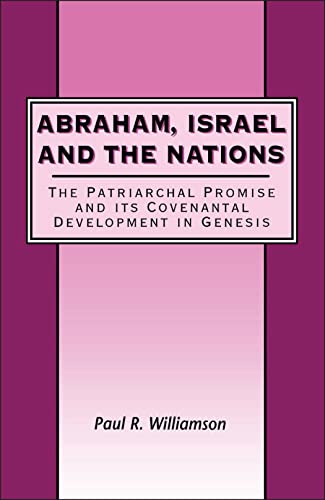
Contrary to many previous interpreters, Paul Williamson makes an excellent case for interpreting the two covenants of Genesis 15 and 17 as distinct yet related. In doing so he also demonstrates that a synchronic reading is not only legitimate, but also the best method for understanding both literary intricacies and editorial intention.
Williamson first identifies the problems: previous two-covenant explanations of Genesis 15 and 17 have been inadequate and confusing, while literary and theological connections between chapters 12, 15, 17 and 22 have been largely ignored. He then surveys previous interpretations of Genesis 15 and 17, in four interpretative categories: (1) a single covenant in two stages; (2) a covenant in chapter 15 reaffirmed in chapter 17; (3) the same covenant in different sources; (4) two distinct covenants. Christian and Jewish interpretations of all periods are surveyed thoroughly (if somewhat laboriously).
Williamson carefully analyses the third category of source-critical interpretations, and finds them unconvincing and inadequate. He then examines the fourth category, synchronic interpretation, and argues cogently that the two covenants are distinct yet related. Here he builds on the insights of his supervisor Desmond Alexander, and offers astute analysis of synchronic interpretations.
In chapters 4 and 5 Williamson offers a detailed analysis of the two covenant episodes, and demonstrates that the promises described in them are distinct: one focuses on the national blessing of descendants and land, the other on the international blessing of nations and kings; one would be fulfilled unconditionally, the other would require human activity. Thus the final editors intended that ‘each pericope … serve a specific function within the wider Abraham canvas’ (119). These two chapters are an excellent exercise in good exegesis.
Chapter 6 further explores the difference between the two covenants, notably the subtle differences in content, expression and emphasis and, most significantly, the time/literary gap between the ‘covenant between the pieces’ and the ‘covenant of circumcision’. While chapter 17 shares common promissory threads with chapter 15, it ‘transcends this guarantee of “seed” and “land” by both broadening and narrowing the promissory focus’ (212). For instance, ‘seed’ is both broadened to encompass a multitude of nations and narrowed to a particular line. ‘Thus the two covenants are not as unrelated as their respective promissory foci might initially suggest’ (212–13).
Finally, Williamson argues that the programmatic divine promise of 12:1–3 is expanded differently in chapter 15 (national blessing; cf. 12:1–2c), and chapter 17 (international blessing; cf. 12:2d–3). Thus two different covenants ratify two distinct promises. Further, the covenant of chapter 17 is actually ratified in chapter 22 through the sacrifice of the ram and the subsequent divine oath. Thus 12:1–3 and 19:16–18 form an inclusio binding the whole of the Abraham narrative by two major promissory themes: that Abraham is the physical father of a ‘great nation’ and the spiritual father of ‘all nations’.
Williamson has made a significant contribution, both to the legitimacy of synchronic reading and to the literary and theological interpretation of the covenant episodes of Genesis 15 and 17. He claims that this has ‘widespread ramifications’ for understanding subsequent divine-human covenants in Genesis-Kings. However one may ask whether the final editor(s) of Genesis 12 understood the royal ‘seed’ in whom the nations would be blessed as David or as a future Messiah. Is the latter a Christian reading which goes beyond their intentions? There are some huge hermeneutical issues here which go beyond a synchronic reading of Genesis, and these are not discussed. While it is true that, with every addition to the ‘canon’, previously recorded themes might acquire ‘surplus meaning’ unintended by authors or editors; but to assume that this is implied is to stretch synchronic reading beyond its limits. Otherwise, the merits of this book are too many for a teacher or student of theology to ignore.