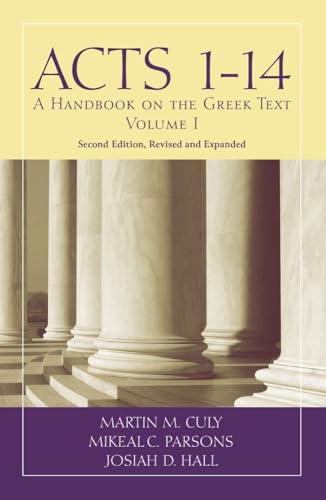
Anyone who has worked on the Greek text of Acts knows that the author often uses complicated grammatical constructions and word forms rarely found elsewhere in the New Testament. He especially like the pluperfect tense. Having a tool to help translation and analysis would be welcome. This two-volume work is such a tool. It is a revised and significantly expanded version of the first edition, which had 21 pages of front matter and 556 pages of analysis. This new version is almost twice that size. The series “offers an accessible and comprehensive, though not exhaustive, treatment of the Greek New Testament, with particular attention given to the grammar of the text” (p. ix). Beyond grammar, the series offers textual criticism, lexical semantics, discourse analysis, and more. Students and scholars alike should be aware, therefore, that Culy, Parsons, and Hall address topics such as these and assume readers understand the topic and the special vocabulary that is used. This is not a book for first-year Greek students. Users should be familiar with the contents of intermediate grammars, such as Daniel B. Wallace, Greek Grammar Beyond the Basics: An Exegetical Syntax of the New Testament (Grand Rapids: Zondervan, 1996), for maximum benefit. The revised and expanded edition cites others much more often and has longer discussions of many textual and grammatical issues.
The introduction discusses several topics. The text used in this revision is not NA28/UBS5, but the Editio Critica Maior (ECM). Eschewing traditional text-critical principles, the ECM, and therefore this handbook, use the Coherence-Based Genealogical Method (CBGM). Most of the ECM’s differences from NA28/UBS5 derive from this newer approach. The book also briefly discusses grammatical labels and phrase structure, discourse flow, and “More on the Functions of Participles.” Reading the introduction will be helpful for understanding terms and symbols in the book. Several times within the two volumes, reference is made to the view of a commentator or Greek grammarian, such as C. K. Barrett, A Critical and Exegetical Commentary on the Acts of the Apostles, 2 vols., ICC (Edinburgh: T&T Clark, 1994–1998). However, this is not a commentary; it focuses on grammar. Sometimes, there are descriptions that can be debated. For example, the handbook uses “attendant circumstance” for many participles. Culy (in private correspondence), stated that he disagrees with others over the traits necessary to identify a participle as attendant circumstance. That is something to be aware of as you read the analysis. It might not always match what you have been taught previously.
One of the benefits of this series is that there is a translation offered for every verse, divided into sections. The reviewer used a similar work in another series, but that series had no translation, which made it difficult to know how to apply the analysis. In the Baylor Handbook, for example, Acts 27:13–20 has a translation. After the translation, every word of every verse is analyzed for its identity and function. In Acts 27:13, we learn that Ὑποπνεύσαντος is an aorist active participle genitive singular and its function is temporal. Sometimes participles are labeled with functions such cause, manner, or purpose. This one is identified as part of a genitive absolute construction. Readers are directed to Acts 1:8 to learn about the genitive absolute. There are many references to other verses to learn more about what is being stated about a particular word. Often, there are several sentences for one word to talk about possible interpretations of the word grammatically. In Acts 27:13, the book disagrees with BDF over the use of κρατέω in τῆς προθέσεως κεκρατηκέναι. The authors describe κεκρατηκέναι as a present active infinitive in indirect discourse with verbs of cognition. Readers should not be put off by this. It is possible to benefit from the book without having all the background knowledge that is assumed. Not having learned CBGM or not owning the ECM should not prevent a potential reader for using this book. Much of the linguistic and text-critical discussion shows up only occasionally. Culy and Parson also wrote the Baylor Handbook of the Gospel of Luke, and at times the Acts handbook points back to the handbook on Luke. The book includes a bibliography, and author and grammar indexes.
This book is excellent and definitely worth having. It does exactly what it sets out to do. Acts, especially the last several chapters, can be very challenging. It has hundreds of rare words and numerous participle constructions. (Luke seems to have set out to show off how accomplished in Greek he was!) For anyone attempting to translate all or parts of Acts, this would definitely be a valuable tool on one’s desk.