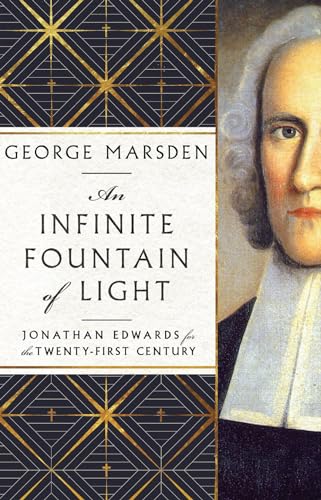
George Marsden’s thesis in An Infinite Fountain of Light is that eighteenth-century pastor Jonathan Edwards has something relevant to say to Christians today. Having written the award-winning biography of Edwards’s life, Marsden is well-qualified to illustrate such a thesis. The author understands himself as Edwards’s “translator,” presenting parts of the latter’s complex body of thought in contemporary language so that the pastor might speak today. Marsden’s intended audience is not the academy but the layperson. Therefore, the book is less a tightly refined argument and more an extended reflection on how Edwards’s view of the world clashes with and exposes contemporary Christian thought. Marsden succeeds in offering readers—through Edwards’s sermons, books, and letters—a different way of seeing things than perhaps they do now. He also provides a valuable example of retrieving the past for renewal today.
To drive the need for such a book, Marsden’s first two chapters present a brief biography of Edwards and articulate his relevance to our contemporary culture. Marsden comments on the present state of American culture—from which Christians are not exempt—with the help of Charles Taylor, David Brooks, and others, preparing readers to receive Edwards’s apt words. The eighteenth-century pastor’s personal struggle in his youth with assurance of faith, his eventual commitment to orthodox Christianity (expressed specifically in the Reformed-Puritan tradition), and his education in and engagement with a world captivated by reason, scientific discovery, and common-sense all place him at a crux of history, between the pre- and post-Enlightenment. Such characteristics, Marsden argues, make Edwards an appropriate commentator for post-Enlightenment readers.
Marsden’s third chapter cuts against the “immanent frame,” a concept borrowed from Charles Taylor. Edward’s grand understanding of God as the loving, acting, personal force behind all the universe was foundational to his thinking and prods Christians who tend to live as if God is distant from his creation and his people. Marsden reflects in chapter 4 on present-day Evangelicalism, characterized by Christian celebrities, individualism, and division. Yet, for all the problems one might see in Christian culture, Marsden holds Edwards up as one who was slow to discount the work of the Holy Spirit. Perhaps the author’s starkest application here is that Edwards’s example would commend one not to reject “the entire evangelical tradition just because it sometimes leads to false teachings and scandals” (p. 100). Marsden devotes his final chapter to Edward’s Religious Affections, a book whose purpose was to discern between genuine Christian faith, hypocrisy, and self-deceit. Hypocrisy and self-deceit are enemies of true faith, and both Edwards and Marsden want readers to have valid assurance and pursue the signs of true faith. Marsden’s conversational reflection in each chapter, engaging interlocutors from the past, such as George Whitefield and C. S. Lewis, is an able guide to reflection on the themes and real-world application of Edwards’s thought.
The book is valuable for a couple of reasons. First, Marsden translates Edwards clearly and conversationally for the non-expert. This book is for Christians—theologically and historically trained or not—to reflect on God, faith, and Christian living. Some readers may quarrel with Marsden’s inclusion of how God’s concern for the world relates to environmental care, or they might prefer him to have spent more time on Edwards’s understanding of the human will in salvation. However, Marsden’s guiding goal is not to be comprehensive but to make Edwards palatable and relevant to an audience who might not yet know him. By presenting Edwards’s key ideas and looking through that body of thought to make application to the Christian West as he sees it, Marsden retains a conversational and understandable tone.
Secondly, Marsden’s work has significant implications for Christian historians and theologians. While the book is aimed at a non-specialist audience, Marsden’s “translation” of Edwards for such readers is an example for the specialists. It is the tenured historian’s take on how specialists might retrieve our Christian heritage to renew today’s faith and practice. He avoids potential pitfalls of apologetic history that either co-opt the past uncritically or dismiss certain figures outright for their faults. One of the ways Marsden avoids such issues is by focusing on Edwards as a guide “who [has] proven reliable in many cultural settings” (p. 2). Marsden applies Edwards’s voice with attention to both the eighteenth-century context and our own. He clarifies where Edwards’s theology cuts against contemporary sensibilities, such as Taylor’s imminent frame, and also challenges perennial human struggles, such as pride, self-centeredness, and greed. He argues that we can learn from someone like Edwards despite his serious flaws and shows that, in fact, we should. To pretend otherwise would render every mortal incapable of offering others insight and wisdom.
The book is, in part, Marsden’s answer to the question: Is the past useful for us? If so, how? An Infinite Fountain of Light is a significant resource, written by a tenured historian, for those Christians considering the significance of the past. As such, it is worth a slow and reflective read both as an introduction to the life, thought, and relevance of Jonathan Edwards and as a model for theologians and historians seeking to use the past for their work today.