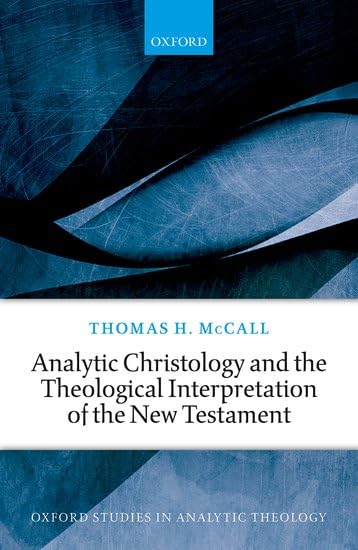
In this insightful and stimulating book, Thomas H. McCall, who holds the Tennent Chair of Theology at Asbury Theological Seminary, applies the methods of analytic theology to debates surrounding Christology and theological interpretation of Scripture. Although analytic theology has gained traction in theological circles, the exacting procedure entailed by analytic approaches has rarely been applied to exegesis and Biblical interpretation. While McCall admits he is neither a New Testament scholar nor an analytic philosopher, he fills this gap by demonstrating the exegetical and theological fruitfulness that the analytic method brings to complex matters of debate.
McCall offers this book as an example of “soft analytic theology,” rather than “hard analytic theology.” For the former, analytic tools and emphases, such as analytical logic, clarity of expression, and insistence on plain definitions, are used to illuminate and resolve issues. This is opposed to “hard analytic theology,” which freights in modern metaphysics and presuppositions that may tilt the conversation. One may wonder how easily these two approaches remain distinct, but McCall’s awareness of the concern and his attempts to objectivity are commendable. The book breaks down into six different chapters, all of which, to varying degrees, interact with points of debate within New Testament studies and Christology. Here are the issues he addresses—Christian identity and apocalyptic readings of Paul, the issue of πίστις Χριστοῦ, Bruce McCormack’s reading of Barth and his Christology, the submission of Christ in Hebrews, the theological exegesis of Karl Barth and Thomas Aquinas, Social Trinitarianism and the logic of Christ’s incarnation. Although McCall’s expertise is in systematic theology, he shows himself to be a competent analytical thinker and New Testament exegete. Some biblical scholars may dismiss McCall’s treatment of the text because he does not emphasize the historical cultural milieu, but such dismissal would be to the detriment of biblical exegesis and New Testament studies.
McCall’s book is a wonderful example of an interdisciplinary monograph that does not overstep the parameters of its study, nor does it over-promise and under-deliver. He has not set out to revolutionize either analytic theology or biblical exegesis. His goal, as I read it, is much more modest. At the end of the day, he is simply setting out a rigorous and eloquent example of hermeneutical chastity and precision. McCall demonstrates convincingly that analytic tools can aid various fields of investigation in their findings while providing points of rapprochement between disciplines that have remained at loggerheads. In a field such as New Testament studies, where the value of interpretations often seems to rest on their creativity and novelty, Analytic Christology is a help corrective.
Without detracting from the book as a whole, there are a few issues with the book worth mentioning. First, the book—at least in its digital version—contains an unfortunate number of typographical errors in the Greek and English. In general, circumflexes were excluded and other accents are often missing (ἡ πίστις τοῦ θεο, rather than τοῦ θεοῦ, p. 50). There are also some misspellings (εἰς τὸν διανεκές, rather than διηνεκές, p. 87). Although these are surface-level, I found them to be extremely distracting, especially given the quality of the book’s content.
The second critique concerns McCall’s use of New Testament scholarship. This is clearly observed in his chapter on the πίστις Χριστοῦ debates. After laying out the different options, he puts up Morna Hooker’s argument for a plenary understanding (that is, the reading that incorporates both subjective and objective aspects), but his discussion defending the plenary use is limited only to certain theological construal. He does not ask whether such a phrase makes sense grammatically. He also fails to interact with some of the more recent scholarship (for example Kevin Grasso’s recent article on πίστις Χριστοῦ [JSNT 43 (2020): 108–44], and the work by David Downs and Benjamine Lappenga [Faithfulness of the Risen Christ (Waco, TX: Baylor University Press, 2019)]). Although he makes some very helpful criticisms of the caricatures that the objective reading often faces, the way he uses the New Testament data and the discussion is not as up-to-date or as careful as it could have been.
Finally, although the Analytic Christology admirably blends analytic Christology and the interpretation of Scripture, the emphasis given to these subjects varies from one chapter to the next. The clearest example is found in the last chapter in which McCall interacts with the work of JC Beall, specifically with Beall’s claims in his The Contradictory Christ (Oxford: Oxford University Press, 2021). The chapter itself is well written and offers strong criticism against Beall’s arguments, but there is almost no attempt to synthesize analytic Christology with theological interpretation of Scripture. The last chapter felt a bit out of place with the rest of the book, which wedded together seamlessly Scripture and theology.
These criticisms are not meant to detract readers from the significance of this monograph. Despite some weak points, McCall has provided a model of interdisciplinary scholarship and Christian scholarship. Of the various books published on the theological interpretation of Scripture, McCall’s contribution to Analytic Christology is exemplary. While the book is geared more towards theology and analytic philosophy, New Testament—and even Old Testament—scholars will find it a stimulating read.