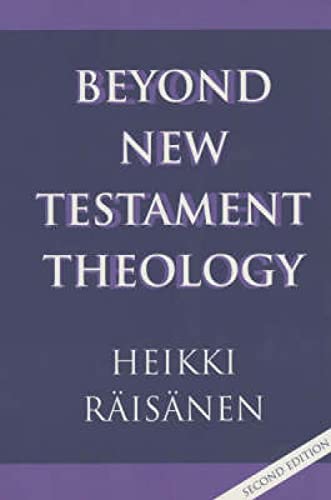
This is an updated version of Räisänen’s 1990 work of the same name. The structure is also the same, and the book consists of a history of research (the ‘story’) and a second part outlining some of the key points which the author feels should be taken into consideration in NT theology (the ‘programme’). The principal additions to the new edition consist of forty pages on works published in the 1990s, and major rewriting of parts of Räisänen’s ‘programme’ that he felt were misunderstood. He has the grace to admit that the misunderstanding of his discussion of ‘religious experience’ was partly his own fault. The new section on works from the 1990s, however, is the major new element, as Räisänen claims that the situation in scholarship has ‘dramatically changed’ since he wrote the first edition.
The ‘story’ is subdivided into three historical periods. The first runs from Gabler (end of the eighteenth century) to Wrede (beginning of the twentieth), and explains the course of the development of NT study among both liberals and radicals. The second period runs from the end of the First World War to the 1980s. Unfortunately for Räisänen, tragedy struck after the Great War when NT ideas were viewed as authoritative again! During this time, only a faithful few, according to Räisänen, kept alive the vision of Gabler to keep the exegetical and the theological tasks separate from one another. Krister Stendahl and Robert Morgan are given as two examples. The third part of the history-of-research describes ‘developments in the 1990s’. Only one scholar here, Gerd Theissen, receives really fulsome praise from Räisänen, while the biblical-theological approaches of Brevard Childs and Peter Stuhlmacher are particularly criticised, as are many others, for being too conservative. Räisänen is suspicious above all of those who attempt to harmonise the various elements of the NT. This will come as no surprise to those who know Räisänen’s work elsewhere. In his work on Paul, for example, Räisänen will often leap at the first sign of surface differences to conclude that Paul’s thought is riddled with contradictions, both on minor and major issues. There is little attempt here, in my judgement, to engage properly with those who offer a more optimistic picture of the coherence of the NT.
Räisänen’s account of the history is, in some ways, comprehensive. (The bibliography is a useful resource.) His linguistic skills mean he covers a wide geographical as well as chronological sweep. On the other hand, great conservative figures from the past, like Adolf Schlatter, are given short shrift, and a number of important schools of thought from earlier days, such as those who adopted a salvation-historical approach to NT theology, are given scarcely any attention. Räisänen’s historiography is a reminder of how much accounts of history are shaped by theological concerns, although Räisänen is at least open about some of those concerns (4). I found it intriguing that Räisänen sees NT theology as dominated by conservatism in its approach, while I find the exact opposite.
It is Räisänen’s ‘outline of a programme’ (the second part), however, that is most disturbing. Räisänen considers whether NT theology should address the church, or the wider world, and strongly criticises those who take the first approach. One could perhaps understand this criticism: biblical scholarship should, after all, function as proclamation to the world, and not merely be part of an in-house discussion. But Räisänen is even more strongly opposed to this idea of NT scholarship being proclamation (156). For Räisänen, ‘The truly appropriate horizon for biblical study (or any other discipline for that matter) is humankind as a whole …’ The future of humankind depends on the capacity of different nations—which to a considerable degree means different religions—to get on with one another’ (155). The primary goal, Räisänen tells us, is in fact ‘world peace’.
Needless to say, Räisänen’s goals here are shot through with ideological commitments which are his own choices, and Christian scholarship should feel under no obligation to fall into line with those personal choices. For true Christianity, unlike for Räisänen’s humanistic version, ‘the future of humankind’ depends not on everyone getting on with one another, but on the faithfulness of the God who has revealed himself definitively in Christ.
For the vast majority of readers, it would be far more useful to examine Peter Balla’s Challenges to New Testament Theology (Tübingen, 1997, and now available from Hendrickson). I would particularly recommend the writings of Adolf Schlatter as classic conservative accounts. Happily, these have just been translated into English and published by Baker, entitled The History of the Christ (vol. 1) and The Theology of the Apostles(vol. 2).