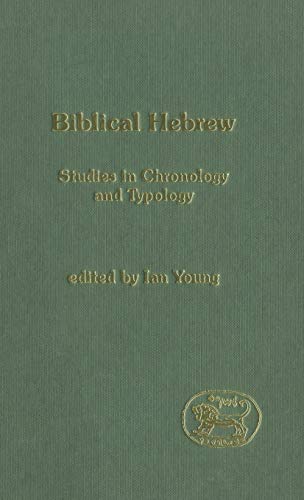
As OT scholars have debated the claims of ‘minimalists’, one area has often been held to contain the clearest refutation of datings of the whole OT to the Persian period or later—the presence within the OT of different forms of Hebrew, some of which are linguistically earlier and some of which are linguistically later. How could a community in a single time period produce texts that consistently display features from a period earlier than their own? This question forms an important backdrop for these essays, though not all of them address it directly. Young brings together some of those who have been working most prominently on the typology of Hebrew as well as the minimalist P. R. Davies and presents us with five essays that seek to explain differences between varieties of Hebrew from within the classic chronological framework and six essays that seek to challenge that framework. The volume is framed by Young’s ‘Introduction: The Origin of the Problem’ and ‘Concluding Reflections’.
Part I, Studies within the Chronological Framework: Pre-exilic Standard Biblical Hebrew and Postexilic Late Biblical Hebrew: Mats Eskhult, ‘The Importance of Loanwords for Dating Biblical Hebrew Texts’, argues that it is difficult to explain the non-occurrence of certain types of loanword in parts of the OT if it was all written in the Persian period; Avi Hurvitz, ‘Hebrew and Aramaic in the Biblical Period: The Problem of “Aramaisms” in Linguistic Research on the Hebrew Bible’, shows that there are many different types of ‘Aramaism’ with different chronological implications; Frank Polak, ‘Style is More than the Person: Sociolinguistics, Literary Culture, and the Distinction between Written and Oral Narrative’ (66 pages), investigates textual indicators that distinguish spoken and written language; Gary A. Rendsburg, ‘Hurvitz Redux: On the Continued Scholarly Inattention to a Simple Principle of Hebrew Philology’, shows how three scholars have assigned late dates to Psalm 116, 1 Kings 21 and Judges 5 using the false argument that late datings were necessitated by Aramaisms within the text; Richard M. Wright, ‘Further Evidence for North Israelite Contributions to Late Biblical Hebrew’, argues that six features identified as characteristic of Late Biblical Hebrew do occur sporadically in early texts and are in fact evidence of non-Judahite contributions to that form of Hebrew.
Part II, Challenges to the Chronological Model: Philip R. Davies, ‘Biblical Hebrew and the History of Ancient Judah: Typology, Chronology and Common Sense’, contents itself with (sometimes implausible) generalisations about the way languages display variation; Martin Ehrensvärd, ‘Linguistic Dating of Biblical Texts’, implausibly argues that what is normally identified as the earliest form of Hebrew comes from after the exile; Jacobus A. Naudé, ‘The Transitions of Biblical Hebrew in the Perspective of Language Change and Diffusion’, shows how language change is continuous and that no grammar is specially transitional; Robert Rezetko, ‘Dating Biblical Hebrew: Evidence from Samuel-Kings and Chronicles’, gives a first-rate survey of why the lateness of the language of Chronicles as opposed to Samuel-Kings needs reinvestigation on a thorough basis; David Talshir, ‘The Habitat and History of Hebrew during the Second Temple Period’, adduces literary and archaeological evidence for a hill-country—lowland language divide in post-exilic Judah; lan Young, ‘Late Biblical Hebrew and Hebrew Inscriptions’, argues that similarity between biblical language and pre-exilic inscriptions is not sufficient to guarantee a pre-exilic date for biblical books.
This volume reveals interesting developments in scholarship: the number of models now on offer to explain linguistic variation is greater than ever, and consequently some of the chronological anchors of standard scholarly datings of books are being loosened. Even a criterion like the presence or absence of Persian loan-words does not seem as clear-cut as before (284–85). In this volume the revolutionaries appear to have a strong hand, but this may be because, while the second half of the volume is generally polemic against the standard model, the essays in the first half are only ‘writing within’ that model rather than explicitly seeking to defend it.