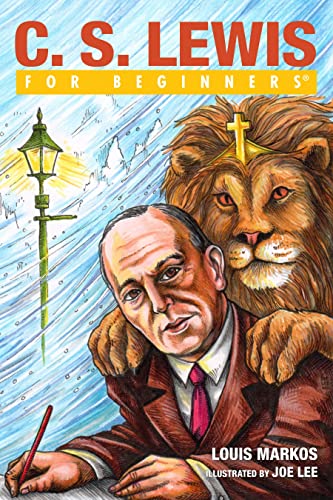
On Addison’s Walk beneath the trees, there strolled Lewis and Tolkien, and in a pub called the Eagle and Child, there conversed the Inklings. Those who know the tales may feel a certain Sehnsucht (C. S. Lewis’s favorite word for longing) to participate in a world of such reflection, friendship, and literary productivity. Like Sam and Frodo, there is a certain inseparability to the legacies of C. S. Lewis and J. R. R. Tolkien. It seems fitting, then, that they should receive their own documentary comic books in tandem.
Louis Markos is professor of English and the Robert H. Ray Chair in Humanities at Houston Christian University. He has previously written five other works on Lewis and Tolkien, and he demonstrates his fluency in the works of the most renowned Inklings in the latest volumes of the “For Beginners” catalog. Both of these books include biographical material, but they are primarily introductions to the works of these famed authors.
Markos introduces C. S. Lewis as “a profoundly human writer who spoke to people where they are” (p. 3). In his astute analysis of Lewis’s body of writings, Markos traces Lewis’s life as a respected scholar and a writer for the people. Markos introduces each of Lewis’s major works in chronological order. He summarizes plots, traces themes, and places each book within the larger body of Lewis’s thought. Through this chronological walking tour of Lewis’s works, the reader experiences the development of his thought and the maturation of his skill in expressing great truths in accessible fiction and penetrating prose. The chronological approach also supports Markos’s argument for a publication-order reading of The Chronicles of Narnia rather than the current standard of Narnian chronology (see p. 106). Markos approaches the Lewis corpus with such insight and passion that readers are bound to embark on fresh readings (or re-readings) of Lewis’s books.
Whereas C. S. Lewis placed his tales in Narnia, space, heaven, hell, and the English midlands, J. R. R. Tolkien’s literary world revolved around Middle Earth. Tolkien devoted so much energy into creating a realistic world that Markos reflects, “it seems to have a reality apart from its author. The engaged reader cannot help but feel that Tolkien is less a fantasy author than a scribe or chronicler of a history he has been allowed to glimpse” (p. 28). Many a lover of The Hobbit and The Lord of the Rings has found the complex history, language, and mythology of Middle Earth bewildering and stalled out in The Silmarillion or The Unfinished Tales. Markos provides in Tolkien for Beginners an experienced guide’s introduction to Tolkien and his literary world that will enable readers to navigate the oft-confusing cast of Valar, Maiar, Elves, Men, Hobbits, and Dwarves. Furthermore, Markos demonstrates the presence of Tolkien’s faith throughout his works in insightful ways.
Markos presents C. S. Lewis and J. R. R. Tolkien faithfully. They were mere men with imperfections. They shared a genuine friendship and great literary skill. Markos shows how their books flowed from their lives. Lewis and Tolkien were modern men who drank deeply of the Medieval world. Their works were full of enchantment in spite of the fearsome modernity of the world wars era. Lewis and Tolkien were well aware that there are monsters out there. Sometimes those monsters are people, and sometimes evil is as banal as choosing a lesser good (see Markos’s analysis of The Screwtape Letters pp. 61–68). Markos captures all of these aspects well in these introductory books.
These books are marketed as “documentary comic books” meant “for beginners.” Based on the cartoonish covers, one might expect these books to be geared toward tweens, but this is not the case. These books are written at an accessible level, but mid-to-late teens would be the youngest recommended audience. The illustrations for each of the books leave something to be desired, however. Some illustrations bear little to no resemblance to Lewis or Tolkien’s descriptions of characters, and others indulge in cheap visual humor that does not match the authorial tone. Overall, these documentary comic books are much more “book” than “comic.” Buyers who expect a comic book may be disappointed, but readers who expect an illustrated guidebook to the literary worlds of Lewis and Tolkien will be pleased.