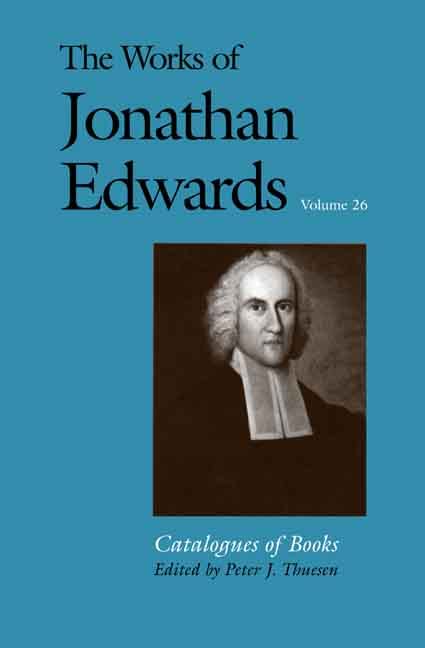
In the fall of 2008 the capstone was placed upon what is arguably one of the most significant publishing monuments of the twentieth and twenty-first centuries. After more than fifty years, the critical letterpress edition of The Works of Jonathan Edwards finally came to a conclusion with the release of volume twenty-six of this august set. Begun in 1957 with the herculean efforts of Harvard University American literature professor Perry Miller, the Yale edition of Edwards’ Works saw the general editorship pass from Miller to John Smith and finally to Harry S. Stout. And that is not all. With the arrival of the twenty-first century, the writings enter a new phase with the Jonathan Edwards Center website at Yale University: http://edwards.yale.edu. Even though this critical edition of Edwards’ Works would be considered mammoth by almost anyone’s assessment, the letterpress edition will not contain all of Edwards’ writings. However, over the next few years, that lacuna will be filled with all the great Northampton pastor-theologian’s work getting posted at the JEC website.
This final volume of the letterpress edition of Edwards’ Works is comprised of his reading catalogue and account-book entrees, which open for the reader a window into Edwards’ book-lending habits. Edwards scholars have previously been able to gain access to these documents by traveling to Yale’s Beineke Library. Now his reading habits can be analyzed in a convenient format ably assisted by the helpful editorial introduction of Peter J. Thuesen. Readers could be forgiven for thinking that this might be the least interesting of all the volumes in the Yale Works. However, that initially plausible reaction would be quite wrong. For years scholars have debated back and forth about Edwards’ intellectual influences. Was he a disciple of John Locke or was he more beholden to French Cartesian Nicolas Malebranche? Was his first love natural science, philosophy, or the Bible? These are the very kinds of questions that may find solutions in this volume.
Thuesen, echoing the ground-breaking work of Norman Fiering and other Edwards scholars, demonstrates that Edwards was not the lone intellectual prodigy living in a colonial wilderness that earlier generations of students of Edwards thought. Quite the contrary, Edwards was a member in good standing of what has been called the transatlantic republic of letters. While it is still quite true that Edwards was a brilliant thinker, he was no provincial. Despite the apparent geographical seclusion of the American colonies prior to the Revolutionary War, it is clear that Edwards kept his pulse on the intellectual currents of the mother country and indeed of much of Europe. Edwards was a bona fide citizen of the British Empire. Through regular and assiduous reading of newspapers, periodicals, other books, and correspondence with friends in the UK, Edwards was able to keep abreast of the latest intellectual trends of the day.
One thing is for certain. While Edwards read widely and truly was a renaissance man, it is clear that the center of his world was the Triune God of the Bible and his Word. It has been persuasively argued that Edwards was biblicistic and God-intoxicated. This volume is manifest evidence of that truth. This volume, along with some of its more recent companions in the Yale Works (the “Blank Bible” being one such example) clearly demonstrate that Edwards was a well-rounded reader, with interests in science, philosophy, geography, history, theology, biblical commentaries, languages, etiquette, and more. Thuesen ably assists us with navigating our way around the seemingly unintelligible lists. It is said that you can tell a lot about someone by looking over his or her library. This volume will enable the contemporary reader to do just that.
This volume is symbolic of an end of an era. For over fifty years Edwards scholars have waited (sometimes impatiently) for the next installment of the Yale Works. The wait is now over. But a new era of greater access to Edwards’ writings in this letterpress edition of his work and the JEC website has begun. One can hope that it will yield even greater understanding of the one who has been called America’s Augustine.