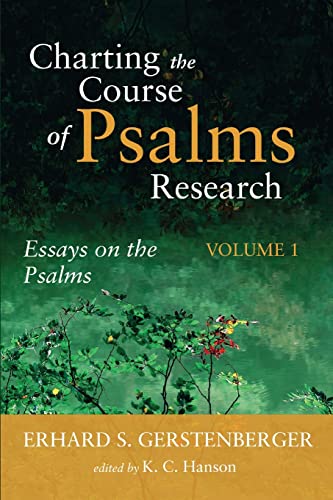

Research in the Psalms has a long and storied history, and Erhard Gerstenberger is an important scholar on the Psalms in the tradition of Gunkel and Mowinckel. In this collection, K. C. Hanson has brought together key essays and articles from the last fifty years to highlight Gerstenberger’s contributions and his focus on the Sitz im Leben from which the Psalms arose.
There are eight essays in this collection, ranging in date from 1974–2014, and still to come are two more volumes slated for release in this series over the next few years. One constant throughout this volume and evidently Gerstenberger’s most enduring contribution is his four-fold understanding of the sources behind the psalms, namely The Family, The Village or Town, The Monarchy, and The Post-Exilic Community (pp. 75–82). Naturally, such approaches rely on various levels of conjecture and speculation, as well as appropriating insights from the psalmody of the ancient Near East. His reliance on this is seen in his acceptance of Mowinckel’s festival model, which assigns 80 out of 150 psalms to such festivals held to be in analogue to other known festivals (p. 80).
He shows how this plays out, as psalms naturally flow out of their various spheres. For example, Psalm 92 is a psalm from a cult context (“For the Sabbath”) and Psalm 102 is a more personal or family psalm (“A prayer of the afflicted one”) (p. 129). He points also to the “marked religious speech in profane settings” such as the prayers offered from bed (Pss 6:7; 63:7), from the field (Ps 65:10–14) or in the military (e.g., Ps 68), all of which suggest a dynamic movement between the individual and official use of the psalms (pp. 132, 135).
These reflections are constructive approaches to the concept of Sitz im Leben, an often-difficult concept for the psalms because they are by their nature and use largely detached units with little traces of their origin(s). Perhaps then this is Gerstenberger’s greatest gift, in making this discipline more approachable to readers of the psalms.
Regardless of their origin, Gerstenberger wants readers to consider that the psalms can be fruitfully considered a form of communication expressing distance. Laments are necessary because the object of help is so far off, and is not nearby to help; praise on the other hand is understood as the response to a distant but generous king who is lauded for his gracious gifts (p. 120). This distance is even greater when it comes to wisdom or didactic psalms, where God is no longer interacted with directly, but instead through his inscripturated word. While not all would agree with this reading, and can think of counterexamples of psalms which express and give thanks for nearness, at the very least this is a reminder to consider what distance is being expressed in any given psalm, and perhaps whether this changes within a psalm and by what means.
There are some stimulating essays in this collection. His article from The Oxford Handbook of the Psalms (2014) is engrossing, his final essay against canonical readings is challenging, and his general ground-up theology is illuminating, even if not all readers will follow him all the way.
Nonetheless, there are issues with such a collection. The jumpy chronology is a little disorienting (the order is 1985, 1974, 2007, 2005, 2012, 2003, 2014, 1994), and some of the older essays stand at odds with some points in later ones, while the predictions of future directions in psalms research in the first essay have not all aged well. There is also a certain degree of repetition that a more judicious selection may have been able to eliminate.
Moreover, there were several areas in which I disagreed with Gerstenberger. Some are because of our difference in “school,” while others are more fundamental. In his third essay, he suggests that the psalms are not so much God’s word to us as our words to God (p. 86). I would hope that one would say both: the psalms are not only people speaking to God, but are also God’s gracious word to us, revealing himself, his character, and his purposes. However, in his fourth essay he clarifies his perspective by describing the book as “a treasury of early Jewish theologies,” which, rather than being instances of applying a pre-existing religious conviction (i.e., worship of YHWH) to circumstances, are instead examples of the “needs of congregations and their theological solutions” (p. 102). While I understand his push-back against a rigid biblical theology, I would suggest our biblical theology should be flexible enough to admit new information, to be shaped by what we learn of God in his self-revelatory word, rather than being rigid and blind to the nuances of the Scriptures. His stereotyping may thus be appropriate criticism against some roughshod approaches to Scripture, but as Christian listeners, we should all be willing to be challenged and have our understanding of God shaped by God’s word.
Another area which will no doubt provoke consternation from some readers is his rejection of canonical readings of the Psalter as a book. This approach has become mainstream since the work of Brevard Childs (“Reflections on the Modern Study of the Psalms,” in Magnalia Dei, the Mighty Acts of God: Essays on the Bible and Archaeology in Memory of G. Ernest Wright, ed. Frank Moore Cross et al. [Garden City, NY: Doubleday, 1976], 377–88) and Gerald Wilson (Gerald H. Wilson, The Editing of the Hebrew Psalter, SBLDS 76 [Chico, CA: Scholars Press, 1985]), and more recently in authors such as Nancy deClaissé-Walford (“The Canonical Approach to Scripture and The Editing of the Hebrew Psalter,” in The Shape and Shaping of the Book of Psalms: The Current State of Scholarship, ed. Nancy L. DeClaissé-Walford [Atlanta: SBL Press, 2014], 1–11). His final (but third oldest) essay unequivocally rebuts such approaches: “As nice as it sounds when a transparent ordering principle of the Psalter is presented, there is a great danger precisely in the theological uniformity it claims” (p. 164). As mentioned, his “school” is form criticism, which focuses on the importance of Sitz im Leben, and therefore his primary interest is the original forms which lie behind our text, and what is revealed about life and culture and tradition when the words in the Book of Psalms were first uttered. Although he admits to some shaping, he is adamant that “The Psalter is not a ‘book’ in our sense, certainly not a theological textbook with progressively unfolding statements about God; according to its nature it cannot be” (p. 162). This final essay challenges readers to (re)consider the validity of such approaches. This is not to say we must not read the psalms in this way; he even suggests we may, but we do so with a consciousness that we as readers bring this to the text and it may not flow out as axiomatically as we might have previously thought.
Overall, this collection of essays is certainly a wonderful primer to Gerstenberger’s work as a figurehead of form-criticism. It will be interesting to see what lies around the corner in the future volumes.
Douglas R. Fyfe
Carlingford, NSW, Australia
Early Christians had to develop and negotiate their (new) identity within a society, to which their beliefs and ethical convictions were largely alien. These beliefs were rooted in the Christ event, especially in the understanding of Jesus’s death on the cross as an event of…
Acts of the Apostles reports several uprisings and instances of mob violence that occur across Asia Minor, caused by or related to the evangelistic and missionary endeavors of Paul and his companions in the middle of the first century. While the historicity of the events…
As states continue to decriminalize marijuana and usage escalates in American culture, Christians must increasingly navigate their associations with the drug. The various implications of marijuana use are much discussed, but the true legal landscape is often misunderstood. Despite recent changes in individual state laws,…
This article seeks to retrieve from the past in order to gain perspective for the present. It begins by surveying the manuscripts of the MT Psalter, the LXX Psalter, and 11QPsa from the DSS, reporting on the unique aspects of the psalm superscriptions in each…
One of the most common critiques of Thomas Aquinas to be found in contemporary Protestant theology and apologetics is that Aquinas either outright denies the noetic effects of sin, or, at very least, minimizes the noetic effects of sin. Examples can be found in the…