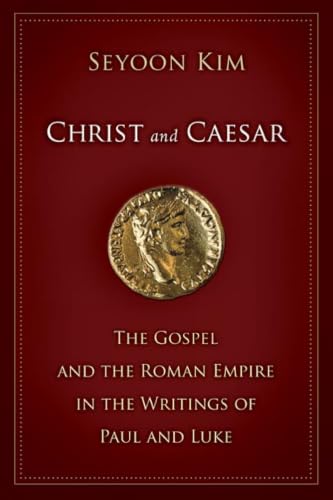
In this monograph, Seyoon Kim evaluates the thesis that the NT authors consciously (and polemically) criticized the public veneration of the Roman emperor. As the subtitle indicates, Kim focuses on the apostle Paul and on Luke-Acts. Kim’s book is thus divided into two parts, and his broad conclusion is that neither Paul nor Luke “formulate the gospel of the Kingdom of God and the Lord Jesus Christ in conscious antithesis to the imperial ideology of Rome” (p. xvi).
Part 1 (chs. 1–5) evaluates recent anti-imperial readings of Paul’s letters. Kim begins by evaluating the prominent counter-imperial interpretations of 1–2 Thessalonians from scholars such as E. A. Judge, K. Donfried, and J. R. Harrison (pp. 3–10). After eight pages, Kim rejects the view that Thessalonian correspondence contains counter imperial rhetoric. Chapter 2 (pp. 11–27) then widens the lens to summarize discussion of Philippians, Romans, and 1 Corinthians. Here Kim arrives at the same conclusion: “At most Paul points to the total inadequacy of the much-celebrated pax Romana (1 Thess 5:3) and of the Roman commonwealth and its sōtēria (Phil 3:20–21)” (p. 66).
His reasons for dismissing anti-imperial readings in Paul are set out systematically in the following two chapters: “The Problems of the Method” (pp. 28–33) and “Factors that Make an Anti-Imperial Interpretation Difficult” (pp. 34–64). Kim first highlights four methodological problems with anti-imperial readings of Paul, namely, that they suffer from (1) Sandmel’s “parallelomania” syndrome; (2) faulty assumptions about the “imperial cult” and Paul’s theology; (3) proof-texting certain Pauline terms such as gospel, Saviour, Son of God, and peace; and (4) a (self-contradictory) appeal to coding, i.e., why would Paul be simultaneously overt and covert in his critique of the Roman imperial order? Kim then provides a whole host of factors that in his view render an anti-imperial interpretation of Paul very unlikely. Indeed, in his “Summary and Conclusions” (pp. 65–71), Kim asserts that Paul “may well have judged that the Roman imperial system was, on the whole, more conducive than detrimental to his universal mission” (p. 70).
Part 2 (chs. 6–11) turns to Luke-Acts to evaluate whether these writings are deliberately counter-imperial. Here Kim largely agrees with scholars such as K. Rowe who posit that in Luke’s Gospel Jesus’ Messiahship is described in stark relief to Caesar’s lordship (pp. 77–93). Chapter 8 (“Jesus’ Redemption: It is Not a Deliverance from the Roman Empire,” pp. 94–113), to be sure, does not therefore conclude that Luke’s Gospel was written to announce any impending imperial overthrow. Instead, chapter 9 (pp. 114–50) argues that Luke aims to present Jesus’ deliverance from the dominion of Satan and to point forward to the imminent consummation of God’s Kingdom. Kim then argues in his subsequent chapter (pp. 151–60) that these twin themes are developed further in the book of Acts: “the exalted Lord empowers and directs his apostolic church through the Holy Spirit to carry on this saving work” (p. 151). In his final chapter of Part 2, Kim provides various reasons he believes Luke-Acts was not written to critique the imperial order. Indeed, “Luke seems to evaluate the Roman imperial order or pax Romana as relatively superior to other states, as it provides an environment in which Christian mission can progress” (p. 178). Following his conclusions (pp. 191–99), Kim theologically reflects in a brief epilogue (pp. 200–203).
Kim’s monograph, of course, responds to a flurry of “anti-imperial” energy among a wide range of NT scholars (e.g., R. Horsley, J. R. Harrison, R. Jewett, N. T. Wright, B. W. Winter, and even the present reviewer!). Although many of Kim’s individual arguments cannot be assessed within the limited confines of this review, it may be helpful at least to highlight two of the more significant shortcomings in this work.
First and perhaps most importantly, it remains unclear how precisely Kim defines the term “anti-imperial.” Several times in his discussion, I got the impression that he was defining this term in a very literal sense, i.e., the church is being encouraged to overthrow the emperor then and there. After admitting, for example, that in Philippians Paul clearly exhorts the church to live as an “alternative society” as citizens of another Kingdom, Kim then states, “However nowhere in his epistles does Paul suggest that doing the duties of the citizens (πολιτεύεσθε) of God’s Kingdom involves fighting a human kingdom” (p. 51). Now if “anti-imperial” means “pick up a sword,” then Kim is certainly correct, but I am unaware of any NT scholar who is defining anti-imperial in this way. Indeed, the present reviewer would tentatively define anti-imperial as “providing an alternative (Davidic) King and Kingdom to the Roman emperor and empire and thus encouraging the church to live as a community in society according to the reality of God’s Kingdom as they eagerly await the return of the true King.” Of course, a robust eschatology—Jesus’ victory over all powers and his imminent return to redeem his people and to restore creation—is all part of this message, and so surely the NT authors need not “consider the church eventually replacing the Roman Empire in this world” (p. 66) for them to be anti-imperial.
Secondly, I am not convinced that Kim needs to discuss Paul and Luke-Acts together (see his rationale for this on pp. xiv–xvi). Given the swirl of debate around both Paul’s letters and Luke-Acts, the book would have been much tighter had he focused his attention upon one of these writings. Indeed, Kim even admits that attempting to cover such a wide-ranging discussion results in a “deficiency in thoroughness” (p. xi) and that “a deeper and wider reflection would have made the book more complete” (p. xii). His discussion would be particularly stronger, for example, if he interacted with scholars such as P. Oakes on 1 Thessalonians or R. Jewett on Romans 13. It would also be helpful to assess Paul’s letter to the Galatians, which interpreters (including the present reviewer) have placed in a Roman imperial context. Despite these deficiencies, Kim offers his initial installment in what will undoubtedly remain a very important debate among NT scholars.