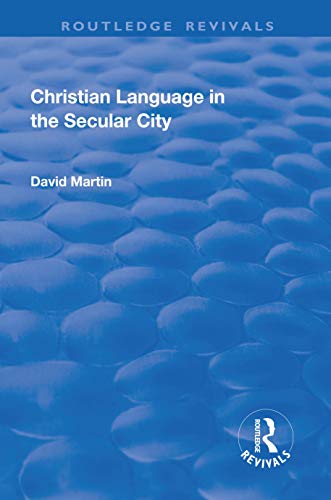
David Martin is a Christian sociologist and lay theologian (though he is now an ordained Anglican priest) who has spent most of his life studying patterns of worship in many different Christian communities, both in Britain and in Latin America. He has a vast knowledge of people and places, and a deep sensitivity to human nature, both in its good and in its bad aspects. All this is put to good use in this remarkable collection of sermons, which he has delivered over a number of years, but which he has now edited and published in a single, and surprisingly short, volume.
Most of the sermons probably took no more than ten minutes to deliver, and so they can be read fairly quickly, but don’t let this mislead the reader. Short they may be, but ‘simple’ they are not! Indeed, if they were delivered as written, most of the congregations who heard them must have gone away somewhat bemused, since they would have had a great deal more to think about than they probably bargained for. This is the beauty of having the sermons in written form, since they can be pondered and meditated upon in the way they deserve, and not simply forgotten as we move on to the ‘peace’ or some other more exciting part of the worship service.
The book is divided into three parts, of roughly equal length and importance. The first is a cycle of sermons dedicated to the main highlights of the Christian year. In effect, they cover the life, death and resurrection of Jesus. The second part groups together a series of sermons on different themes of the Christian life, some of them doctrinal, others more social or liturgical in outlook. Finally, the third section is a series of commemorative addresses, given over a fifteen-year period and reflecting the wide range of the author’s interests and competence.
The sermons are rooted in the Authorised Version of the Bible, and in the Book of common prayer, with occasional forays into both classical and contemporary literature. At every point, David Martin seeks to understand and explain the Christian revelation to a generation which he knows is sceptical (at least superficially), but which he also knows is in as much need as anyone ever was of the challenging and healing words of Christ’s Gospel. His vision is thoroughly orthodox without being in any way conventional, and that is the particular charm of this book. We live in a world which does not want to talk about sin, so Professor Martin spares us nothing in his determination to unveil the mystery of evil in modern life. He brings home in an entirely fresh way the absolute necessity of grace, and the centrality of justification by faith in the shed blood of Christ. He is aware that these images are off-putting to many people today, and so he argues that that is precisely why they need to be recovered, so that the truths which they proclaim may be heard again in our time.
David Martin is not an evangelical, but rather a board church Anglican in the old-fashioned liberal sense—rather like C.S. Lewis. His is a ‘mere’ or generic Christianity, applicable to all traditions and types, and in that respect is quintessentially Anglican. However, although his range is broad, the wonderful sermon on William Tyndale shows where his heart is. As he puts it (169), in Tyndale:
we hear the high trumpet tunes of reformed Christianity according to which repentance of the heart takes precedence over the priestly sacraments of penance. There is a world-shaking revolution here implied in the shift from a sacrament of penance to the inward circumcision of the heart. The individual standing before God and before his Word without intermediary took responsibility for his eternal salvation, through grace and through faith in the blood of Christ. Sola fide, sola gratia sola scriptura.
That is the note that Professor Martin sounds above all else, from beginning to end.
That is a book to challenge both theological students and preachers to think again about what they believe and why, and to put those beliefs in language which is truly on the cutting-edge of contemporary life. It will challenge every serious reader, and in places it may even shock us, but it will never leave us indifferent, nor will we be the same when we finally put the book down, It is a rare accomplishment for a book of sermons to achieve this, and no higher compliment can be paid either to it or to its author.