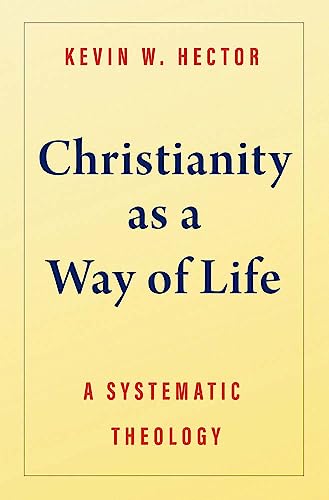
Kevin Hector’s Christianity as a Way of Life: A Systematic Theology is a fine addition to contemporary works on Christian theology. Hector is the Naomi Shenstone Donnelley Professor of Theology and of the Philosophy of Religions at the University of Chicago Divinity School. Combining the expertise of a theologian and a philosopher, Hector captures the contents of this monograph in a simple yet loaded title. Christianity, Way, and Life, all call for deep and sustained engagements and deliberations—and hence an exercise in Systematic Theology. Hector’s objective is crystal clear: to present a “clear, understandable interpretation of Christianity” and to highlight the wisdom Christianity offers to conduct one’s life well in this real world with real challenges amid real relationships (p. ix). Beyond the verbal and the propositional, Hector argues that Christianity as a way of life conveys this wisdom practically, more specifically, through spiritual practices (p. x). With the modest aim of proposing a form of systematic theology that engages “a set of practices designed to transform one’s way of perceiving and being in the world” (p. 2), the book renders itself suitable for lay people and scholars alike, who are interested in discussions on theology and wisdom irrespective of one’s socio-cultural and geographical location or gender identity.
A categorical thread which runs through all seven chapters of the book is that of “orientation.” By a way of life, Hector means “a constellation of practices designed to orient a person’s life toward that which is taken to be ultimate” (p. 10). The seven chapters revolve around the good of theology, the way of the world, deliverance from sin, reorientation towards God, spiritual practices of transformation while being in the world and while in relationship with others, and eternal fulfillment as the ultimate purpose of the way of life.
Beyond the stereotypical approach to themes of systematic theology, Hector demonstrates much creativity and relatability in engaging with them vis-à-vis our contemporary context. An example of this is how he discusses the potential of Christianity as a way of life to produce and contribute “epistemic goods” to the world of academic knowledge, irrespective of its religious affiliation. Hector insightfully discusses two epistemic goods, viz., “Understanding” (pp. 16–25) and “Wisdom” (pp. 25–27).
Orientation to the way of the world discusses the Christian view of sin. Engaging the theology of sin in the thoughts of Augustine (sin as disordered love), Luther (sin as misplaced trust), and contextual theology (sin as the absolutization of worldly standards), Hector observes that the common denominator to all three approaches is that sinfulness is orientation to the world, intrinsic to which is the aspect of bondage to sin. The realistic way Hector addresses this truth renders it relatable and non-offensive, considering that in today’s world, this is one reality humanity finds hard to reckon with.
Given the undeniable reality of sin, Hector moves to the discussion of orientation towards Jesus as the one who inaugurates a new way of being in the world, and as the one who breaks “the power of Sin and Death” (p. 67). Hector argues that Jesus’s orientation “wholly by and to God” (p. 82) is the way to be free from our bondage to sin. The whole discussion is reminiscent of Schleiermacher’s idea of God consciousness, which is understandable considering that Hector is a critical admirer of Schleiermacher (see especially Kevin W. Hector, The Theological Project of Modernism: Faith and the Conditions of Mineness [Oxford: Oxford University Press, 2015]). The fascinating side of the discussion, though, is his portrayal of the human ability to have this orientation to God.” In an interesting, unconventional, and deeply engaging manner, Hector creatively discusses sacramentology in Christianity as a way of life by highlighting the practices of baptism, confession and forgiveness, and friendship and self-narration. The point here is that in and through these practices, a person who orients herself afresh to God hears and is assured of God’s affirmation (see pp. 117–18).
The thread of orientation leads its way into being reoriented via homemaking practices, practices of imitation, and practices of becoming one. The themes of community worship, eucharistic communion, Christian fellowship, emulation and mimicry, and church unity and fellowship are the core focus of this chapter. Orientation, in relation to “Being in the World,” discusses our relationship to the world around us. The focus is “Being” through the practices of prayer and wonder, vocation, and laughter and lament. A highlight in Hector’s book is his discussion of orientation in relation to “Being with Others.” The attention is given to practices of interpersonal relationships, which are especially understood as “Christian love,” at the core of which is the aspect of justice. An aspect of the book that deserves special attention is the in-depth exploration of “Love and Justice” (pp. 225–41). The discussion of the “image of God” (pp. 211–15) calls for special attention, considering that we are living in an age where there is much division in the name of creed, color, and gender. Hector references and critically engages with diverse contextual theologians, including James Cone, Kazoh Kitamori, C. S. Song, and some feminist theologians. His daring claim that Jesus’s “suffering is itself an act of devotion” (p. 74) evokes the theology of Sadhu Sundar Singh, who was captivated by the “Lord of the Cross” (see A. J. Appasamy, ed., The Cross is Heaven: The Life and Writings of Sadhu Sundar Singh [London: Lutterworth, 1956]).
Hector’s work is influenced by a wide variety of thinkers and perspectives, and it does not align with any single ideological stance. He concludes by noting that, from beginning to end, the telos of Christian orientation is God and God alone, that is, “communion with God” (p. 243). Hector has done the global community of faith a great service in keeping alive the promise of thinking through the faith systematically by engaging it with day-to-day practical issues. If anyone shares this concern, this is a book one must read.